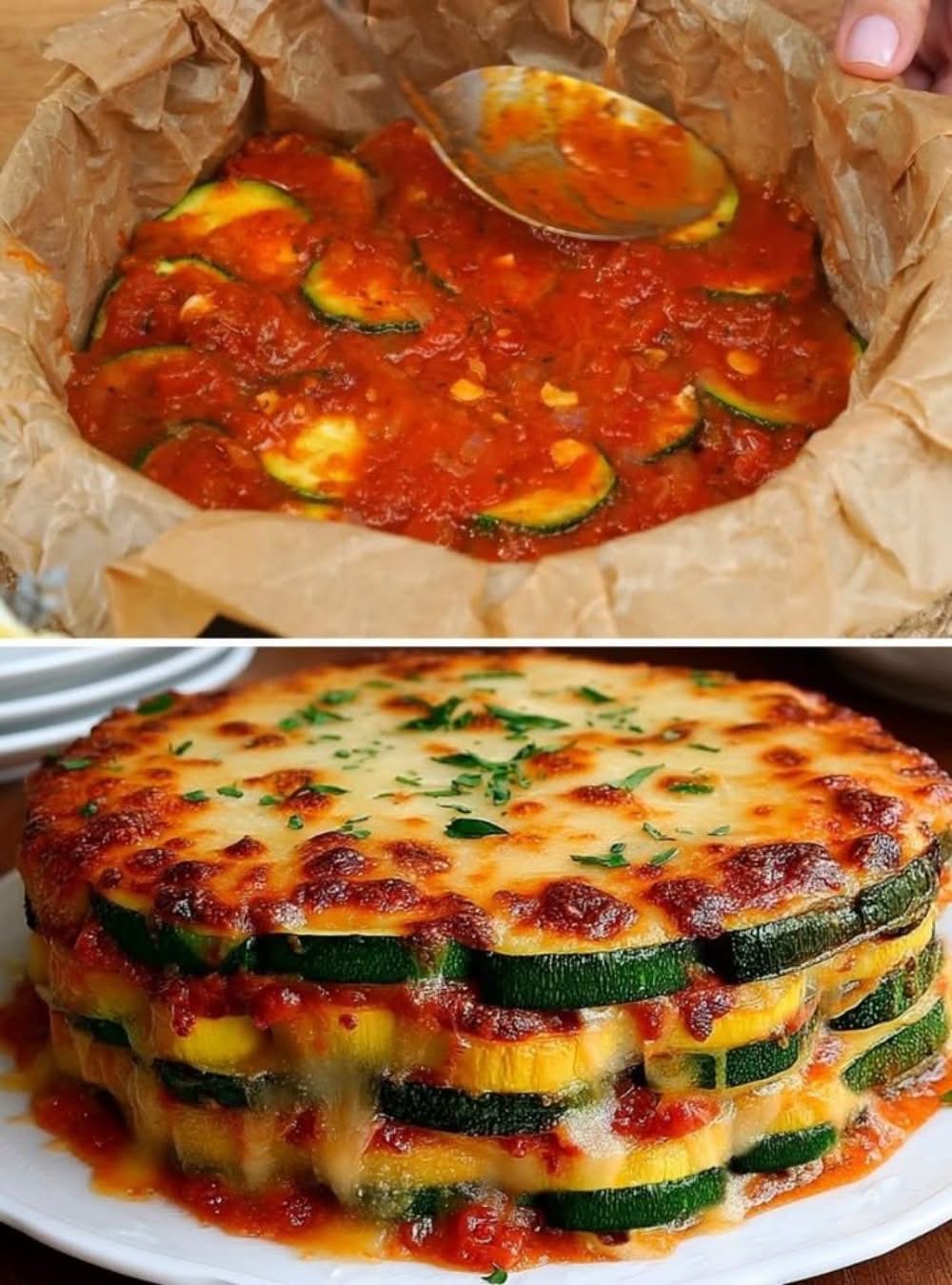
Welcome to the ultimate culinary guide for preparing zucchini in a way that completely transforms its texture and flavor profile. If you have never tried zucchini prepared as Crispy Golden Garlic-Parmesan Zucchini Gratin and Stuffed Boats, you are in for an incredible experience.
This dish completely redefines what this versatile squash can achieve. By combining strategic salting techniques, structural roasting, and a savory, cheese-heavy crust, this recipe eliminates the common complaint of soggy squash. It delivers a deeply satisfying, texturally contrasting meal that works beautifully as a standalone dinner or a show-stopping side dish.
Culinary Visual Inspirations
📘 Section 1: Detailed Ingredients Profile
Achieving the perfect balance of a crispy exterior and a tender, flavor-infused interior requires specific ingredients chosen for their structural properties and chemical interactions.
Below is the complete, high-volume ingredient blueprint for a large family-style feast serving 6 to 8 adults.
The Squash Base
- 6 large, firm fresh green zucchinis (approx. 2.5 kg or 5.5 lbs total weight). Select straight, dense, heavy-for-their-size squash with taut skin. Avoid overly large, fibrous marrow-like squashes, as they contain excessive water and large, woody seeds.
- 4 medium yellow summer squashes (approx. 1.2 kg or 2.6 lbs total weight). These introduce a beautiful color contrast and a slightly sweeter, nuttier flavor profile to the final gratin layers.
The Savory Aromatic Filling & Binder
- 500g (1.1 lbs) premium lean ground beef (90% lean, 10% fat) or high-quality Italian fennel sausage removed from its casings.
- 1 large sweet Vidalia or yellow onion, finely minced (approx. 200g).
- 8 cloves fresh garlic, peeled and microplaned or minced to a fine paste.
- 1 bunch fresh flat-leaf Italian parsley, finely chopped (leaves and tender stems).
- 1 bunch fresh sweet basil leaves, torn or chiffonaded just before assembling.
- 2 tablespoons fresh thyme leaves, stripped from the woody stems.
- 3 large farm-fresh eggs, room temperature, lightly beaten to emulsify and bind the protein matrix.
The Golden Cheese & Breadcrumb Crust
- 200g (2 cups) authentic Parmigiano-Reggiano or Pecorino Romano cheese, freshly grated from the block. Do not use pre-shredded varieties, as anti-caking agents prevent clean melting.
- 300g (3 cups) low-moisture, whole-milk mozzarella cheese, shredded coarse.
- 150g (1.5 cups) flaky Japanese Panko breadcrumbs. Panko provides a light, airy crunch that resists absorbing moisture from the squash far better than standard fine breadcrumbs.
- 50g (0.5 cup) traditional golden breadcrumbs, seasoned with Italian herbs for full coverage.
Oils, Fats, and Liquids
- 120ml (0.5 cup) premium extra virgin olive oil (EVOO), cold-pressed, split for sautéing and drizzling.
- 60g (4 tablespoons) unsalted organic butter, melted, to moisten the panko crust matrix.
- 400g (1 can) crushed San Marzano tomatoes or a thick, high-quality marinara reduction sauce.
Seasonings and Spices
- 3 tablespoons coarse kosher salt (primarily for the osmotic sweating process).
- 1 tablespoon fine sea salt, adjusted across the filling and sauce.
- 1.5 teaspoons freshly cracked black peppercorns.
- 1 teaspoon dried red pepper flakes (optional, for a subtle background warmth).
- 0.5 teaspoon freshly grated whole nutmeg (the secret weapon to elevate dairy and squash flavors).
🍳 Section 2: Step-by-Step Cooking Instructions
Follow these exact steps to ensure a flawless texture and concentrated flavor.
[Harvest & Selection] ➔ [Osmotic Sweeping / Salting] ➔ [Aromatic Sautéing]
                                                               ⬇
[Golden Broiling] 🔀 [Oven Baking (375°F / 190°C)] 🔀 [Assembly & Layering]
Step 1: Pre-Treatment and Osmotic Salting (The Secret Step)
- Wash the squashes thoroughly under cold running water to remove residual grit. Trim away the woody stem ends, but leave the bottom base intact on the pieces meant for boats to retain their structure.
- For the Boats: Take 4 of the large zucchinis and slice them perfectly in half lengthwise. Using a melon baller or a sturdy metal teaspoon, gently scrape out the watery seed-bearing core. Leave a structural wall exactly 1/4-inch thick on all sides. Do not discard the scooped flesh; chop it finely and reserve it for the filling mixture.
- For the Gratin Layers: Slice the remaining 2 zucchinis and 4 yellow squashes into uniform coins exactly 1/8-inch thick. A mandoline slicer is highly recommended to guarantee even cooking.
- Line two large wire cooling racks set inside rimmed baking sheets with triple-layered paper towels. Arrange the zucchini boats cut-side down, and spread the squash coins across the towels in a single layer.
- Dust all exposed surfaces evenly with the 3 tablespoons of coarse kosher salt. Let the squash sit undisturbed at room temperature for 45 minutes. This osmotic action pulls out excess moisture, concentrating flavors and preventing sogginess in the oven.
- After 45 minutes, rinse the squash pieces briefly under a gentle stream of cold water to remove surface salt. Pat them completely dry with clean kitchen towels. Press firmly on the coins to express any remaining water pockets.
Step 2: Preparing the Savory Aromatic Filling
- Heat 2 tablespoons of extra virgin olive oil in a heavy-bottomed 12-inch cast-iron skillet over medium-high heat.
- Add the minced sweet onion and a pinch of fine sea salt. Sauté for 5 to 6 minutes, stirring frequently, until the onions turn translucent and develop soft, golden edges.
- Stir in the minced garlic and the dried red pepper flakes. Cook for exactly 90 seconds until the aroma fills the kitchen. Avoid letting the garlic brown, as burnt garlic turns bitter.
- Add the ground beef or Italian sausage to the skillet. Use a flat wooden spoon to break the meat apart into tiny crumbles. Sauté for 7 to 8 minutes until completely browned and no pink remains.
- Stir in the reserved, finely chopped zucchini flesh that you scooped out from the boats. Cook for an additional 5 minutes to evaporate the moisture released by the chopped squash.
- Remove the skillet from the heat source. Stir in the crushed San Marzano tomatoes, fresh thyme, half of the fresh parsley, and the freshly grated nutmeg. Allow the filling mixture to cool for 10 minutes until it is warm but no longer steaming.
- Once cooled slightly, fold in the 3 beaten eggs and 50 grams (0.5 cup) of the grated Parmigiano-Reggiano cheese. Mix thoroughly until a cohesive filling forms.
Step 3: Engineering the Crispy Topping Matrix
- In a medium mixing bowl, combine the 150 grams of flaky Panko breadcrumbs with the 50 grams of traditional seasoned breadcrumbs.
- Add the remaining 150 grams of grated Parmigiano-Reggiano cheese and the remaining fresh parsley to the crumbs. Toss to combine.
- Pour the 60 grams of melted unsalted butter and 2 tablespoons of extra virgin olive oil evenly over the crumb mixture.
- Work the mixture with your fingertips until every crumb is lightly coated in fat. The texture should resemble damp sand. This step ensures that the breadcrumbs fry to a beautiful golden brown in the oven instead of drying out.
Step 4: Assembly and Structural Layering
- Preheat your oven to 375°F (190°C) with a rack positioned in the exact upper-middle slot.
- Lightly grease a large 10×15-inch ceramic baking dish or glass lasagna pan with a tablespoon of olive oil.
- Assemble the Boats: Arrange the hollowed, dried zucchini boats skin-side down in the center of the baking dish. Spoon generous amounts of the meat and aromatic filling into each boat, packing it down gently and mounding it slightly over the top.
- Assemble the Surrounding Gratin: In the remaining spaces around the boats, shingle the salted zucchini and yellow squash coins in an alternating, overlapping pattern. Tuck any remaining filling between the layers of squash coins to maximize flavor integration.
- Spoon any remaining tomato juices over the shingled coins. Top the entire dish evenly with the 300 grams of shredded low-moisture mozzarella cheese, ensuring full coverage across both the boats and the coins.
- Scatter the damp garlic-parmesan breadcrumb matrix in a thick, uniform layer over the cheese.
Step 5: Thermal Baking and Broiling Profile
- Place the uncovered baking dish into the preheated oven. Bake at 375°F (190°C) for 35 to 40 minutes. You will see the tomato juices bubbling actively along the sides of the pan, and the squash will soften into an incredibly tender consistency.
- Switch the oven function to Broil (High setting) for the final 2 to 3 minutes. Watch the dish closely during this time. The breadcrumbs will quickly puff up and transform into a deeply crisp, mahogany-golden crust.
- Remove the pan from the oven. Scatter the freshly torn sweet basil leaves across the top of the bubbling crust.
- Crucial Rest Period: Let the dish rest undisturbed on the counter for 12 to 15 minutes before slicing or serving. This allows the structural proteins and cheeses to firm up, making cleanly portioned servings easy to lift.
📐 Section 3: Cooking Methods Analysis
Understanding the specific culinary dynamics at play helps explain why this unique approach yields such superior results compared to traditional methods.
| Cooking Phase | Primary Kinetic Mechanism | Temperature Profile | Functional Structural Goal |
|---|---|---|---|
| Osmotic Sweating | Hypertonic extraction of cellular moisture via sodium chloride crystals. | 68°F – 72°F (20°C – 22°C) Room Temp | Eliminates the standard “spongy” water release during baking, concentrating flavor compounds. |
| Aromatic Sautéing | Maillard reaction breakdown of sugars and amino acids in meat and alliums. | 325°F – 350°F (163°C – 177°C) Medium-High | Develops complex savory basenotes (umami) that balance out the sweetness of the summer squashes. |
| Thermal Convection Baking | Gelatinization of starches and denaturation of egg/meat binders. | 375°F (190°C) Steady Hot | Softens cell walls of squash into a tender texture while setting the internal filling into a sliceable matrix. |
| Direct Radiant Broiling | Rapid caramelization of cheese fats and fast dehydration of surface breadcrumbs. | 500°F (260°C) Direct Overhead Heat | Creates a protective, intensely crispy, texturally satisfying top barrier that seals in internal moisture. |
📜 Section 4: History and Evolution of Cultivated Zucchini
To fully appreciate this ingredient, it helps to understand its fascinating botanical journey across continents.
[Mesoamerica: Ancient Squash Domestication] ➔ [The Columbian Exchange to Europe]
                                                    ⬇
[Late 20th Century Global Superfood Adoption] ➔ [19th Century Italian Varietal Selection]
The zucchini we enjoy today is the result of thousands of years of agricultural selection. Its lineage traces back directly to Mesoamerica, where ancient agrarian societies cultivated wild Cucurbita pepo ancestors over 7,000 years ago. These early varieties were prized primarily for their robust, protein-dense seeds rather than their bitter flesh.
Following the global trade shifts of the Columbian Exchange, these early squashes traveled across the Atlantic to Europe. Mediterranean farmers quickly recognized their potential, adapting them to local soils. The modern zucchini (zucchino, meaning “little pumpkin” in Italian) was systematically refined in late 19th-century northern Italy. Exceptional cultivars like the Zucca Santa and regional variants near Milan were bred for tender skins, minimal seed cavities, and mild, sweet flesh when harvested immature.
Italian immigrants brought these refined varieties back to the Americas in the early 20th century, particularly to California and the East Coast. Initially embraced within immigrant communities, zucchini soon captured the attention of the broader public. Its rapid growth cycles and culinary adaptability earned it a permanent home in home gardens and kitchens worldwide, paving the way for the inventive, modern preparations we enjoy today.
🥦 Section 5: Comprehensive Nutritional Analysis
Zucchini is an exceptional choice for nutrient-dense, calorie-conscious cooking. It is naturally packed with essential vitamins and dietary fiber while remaining incredibly low in carbohydrates.
$$100\text{g Raw Zucchini} \approx 17\text{ Calories} \ \vert \ 3.1\text{g Carbs} \ \vert \ 1.2\text{g Protein} \ \vert \ 1.0\text{g Fiber}$$
Nutritional Distribution per Family Serving:
[████████████████████] Protein: 32g
[██████████████████████████] Healthy Fats: 28g
[██████████] Net Carbohydrates: 14g
[████] Dietary Fiber: 4g
Below is a detailed breakdown of the nutritional metrics calculated per single serving of this finished dish (assuming 8 equal servings):
- Total Energy Content: 436 Kilocalories
- Protein Content: 32.5 Grams (derived from lean beef, cheese blends, and pasture eggs)
- Total Lipids (Fats): 28.4 Grams
- Saturated Lipids: 11.2 Grams
- Monounsaturated Lipids: 13.5 Grams
- Total Carbohydrates: 18.2 Grams
- Dietary Soluble Fiber: 4.1 Grams
- Net Active Carbohydrates: 14.1 Grams
- Micro-Nutrient Breakdown:
- Vitamin C: 45% of Recommended Daily Intake (RDI)
- Vitamin A: 35% of RDI (primarily beta-carotene from the green skins)
- Calcium: 40% of RDI (driven by the Parmigiano-Reggiano and whole-milk mozzarella)
- Potassium: 680 Milligrams (vital for maintaining healthy cellular fluid balances)
- Iron: 18% of RDI
🌟 Section 6: Wellness Benefits
Incorporating this recipe into your regular meal rotation provides several notable wellness benefits:
- Cellular Hydration and Electrolyte Support: Raw zucchini is composed of roughly 94% water. Even after the osmotic sweating process, it retains structural water integrated with key electrolytes like potassium and magnesium. This combination supports efficient cellular hydration and muscle function.
- Potent Antioxidant Protection: The dark green skin of zucchini is loaded with lutein, zeaxanthin, and beta-carotene. These powerful carotenoid antioxidants accumulate over time to support long-term eye health and protect cells against environmental oxidative stress.
- Optimized Glycemic Control: By swapping out carb-heavy pasta layers for nutrient-dense zucchini slices and boat hulls, this dish significantly reduces glycemic load. The dietary fiber content slows glucose absorption, preventing energy crashes and supporting steady metabolic health.
- Enhanced Digestive Health: The combination of soluble and insoluble fibers in summer squash provides excellent fuel for beneficial gut bacteria. This supports a healthy microbiome and comfortable digestion.
🔬 Section 7: Culinary Formation Dynamics
The secret to this recipe’s success lies in basic kitchen chemistry:
Water Retaining Pores ➔ [Applied Coarse Sodium Crystals] ➔ Osmotic Outflow ➔ Concentrated Squash Structure
- Osmotic Dehydration Mechanics: Zucchini cell walls enclose a high volume of water. When you apply salt crystals to the raw surface, you create a highly concentrated external environment. To balance this out, water flows out through the semi-permeable cell walls via osmosis. This partial collapse of the cellular spaces ensures the squash bakes to a velvety, tender texture rather than turning into a watery soup.
- The Science of a Crispy Crust: Combining airy Panko breadcrumbs with melted fats coats each piece of starch individually. When exposed to the high heat of the oven and broiler, these fats fry the surface of the breadcrumbs instantly. This barrier traps rising steam beneath a perfectly crisp, savory shell.
💖 Section 8: Why Squash Lovers and Skeptics Alike Adore This Dish
This recipe has a unique ability to bridge the gap between dedicated squash enthusiasts and those who typically avoid it.
- For Devoted Squash Enthusiasts: This method celebrates the inherent qualities of summer squash rather than masking them. The concentrated sugars in the roasted flesh pair beautifully with the rich alliums and bright tomatoes. It offers a fresh, elevated showcase for a favorite summer harvest.
- For the Former Skeptics: Most people who dislike zucchini are put off by memories of mushy, unseasoned slices. This approach changes the game entirely. The osmotic step yields a firm, satisfying texture, while the savory meat filling and crispy, cheese-laden crust transform it into a truly comforting meal. It completely redefines what zucchini can be.
🏁 Conclusion
This Crispy Golden Garlic-Parmesan Zucchini Gratin and Stuffed Boats recipe proves that simple ingredients can deliver spectacular results when prepared with the right techniques. By using osmotic sweating to manage moisture and combining contrasting textures, you can transform everyday zucchini into an extraordinary family feast. It is straightforward, reliable, and bound to become a new favorite in your kitchen.
If you are eager to explore more creative ways to enjoy your summer harvest, let me know!
- Show me a low-carb, keto-compliant variant of this exact dish
- Give me a 100% plant-based, vegan version with equivalent protein
- Provide a fast, 15-minute air-fryer version for quick weeknight dinners