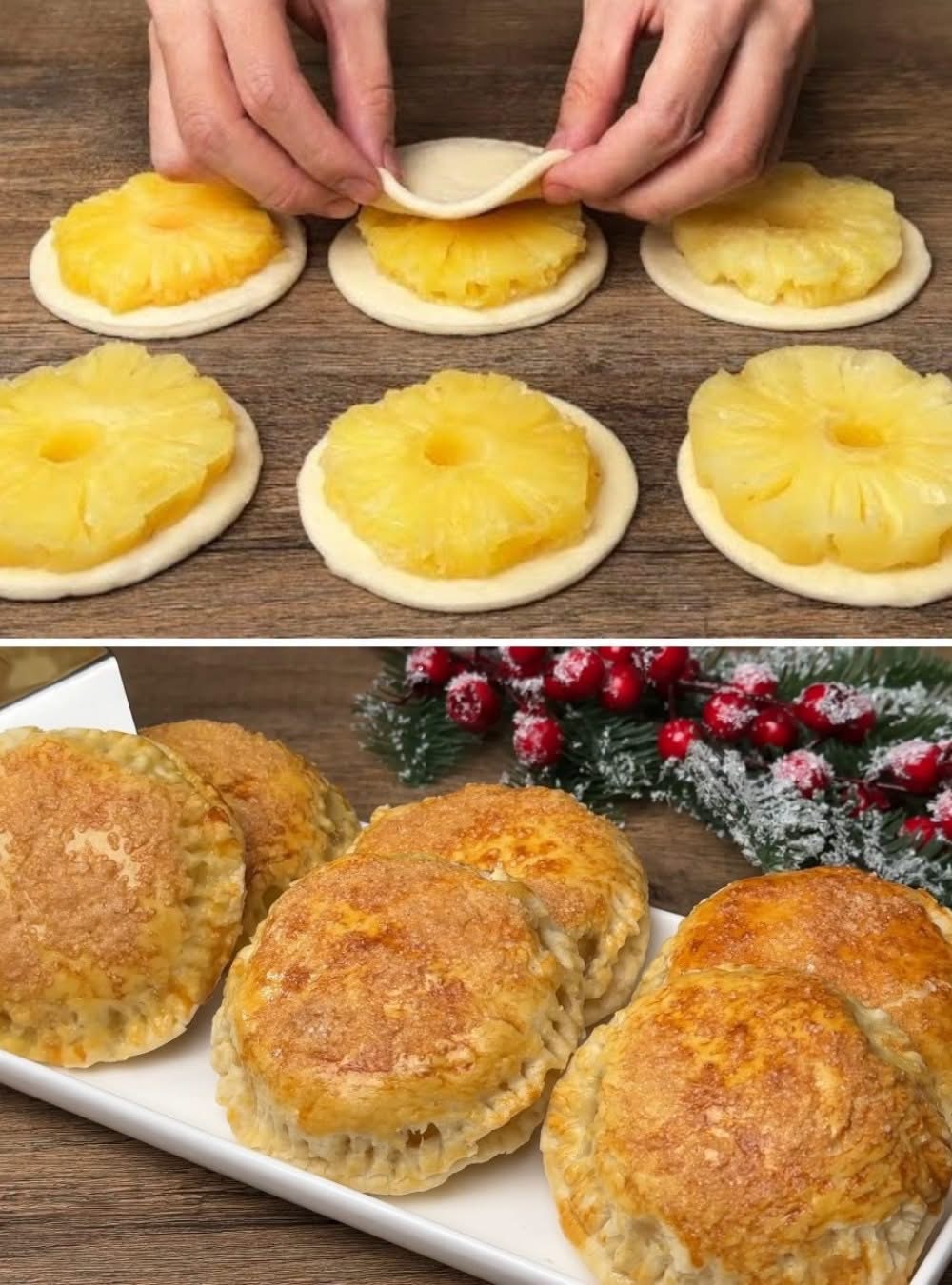
The Ultimate Pineapple Puff Pastry Delight
This comprehensive culinary guide reveals the master techniques for crafting a magnificent Pineapple Puff Pastry Delight with a Secret Twist. This dish features a rich, multi-layered design. It pairs crispy French puff pastry with caramelized tropical pineapple. The recipe incorporates a sophisticated, aromatic element: cardamom-infused white chocolate ganache and a touch of fresh pink peppercorn. This flavor profile balances the bright sweetness of the fruit with a gentle, warming spice.
The detailed chapters below explore the history, nutritional composition, specific preparation methods, and exact assembly techniques required to create this dessert.
1. Introduction & The Secret Twist
The Pineapple Puff Pastry Delight stands out due to its balance of textures and flavors. Traditional fruit tarts often rely on heavy frangipane or plain custard. This recipe modernizes the classic approach by using lamination techniques alongside bright tropical elements.
The profile centers on structural contrast: the pastry features hundreds of crisp, buttery layers that break apart easily upon a single bite. These layers hold a dense, slow-roasted pineapple ring caramelized in raw demerara sugar and dark rum.
+-------------------------------------------------------+

|              CRISPY Demerara Sugar Glaze              |
+-------------------------------------------------------+

|            SLICED Roasted Spiced Pineapple            |
+-------------------------------------------------------+

|      SECRET TWIST: Cardamom-Pink Peppercorn Ganache   |
+-------------------------------------------------------+

|          LAMINATED 1,459-Layer Puff Pastry Base       |
+-------------------------------------------------------+
The Culinary Secret Twist
The defining element of this dessert is hidden beneath the pineapple layer. It features an velvety layer of white chocolate ganache infused with fresh green cardamom pods and crushed pink peppercorns.
- Green Cardamom: Adds a bright, herbal citrus note that enhances the pineapple’s natural acidity.
- Pink Peppercorns: Provide a delicate fruity heat and vibrant color, cutting through the rich cocoa butter of the white chocolate.
This combination prevents the pastry from becoming overly sweet, offering a balanced taste profile that appeals to refined palates.
2. Complete Recipe Ingredients
Achieving the perfect balance of a light, flaky crust and a rich filling requires high-quality ingredients measured with precision. For best results, use weighed metric measurements to ensure consistent lamination and clean gelling.
Laminated Puff Pastry Base (Détrempe & Beurrage)
- 400 grams All-purpose flour (unbleached, 11.5% protein content)
- 100 grams Pastry flour (fine-milled)
- 10 grams Fine sea salt
- 50 grams Unsalted butter (melted and cooled to room temperature)
- 240 milliliters Ice-cold water (filtered)
- 5 milliliters White distilled vinegar (to relax the gluten structure)
- 350 grams High-fat European-style butter (minimum 82% butterfat, kept cold for the butter block)
Caramelized Pineapple Layer
- 1 large Fresh sweet pineapple (MDR-2 or Gold variety, fully ripe)
- 150 grams Pure demerara sugar (or unrefined raw cane sugar)
- 1 whole Madagascar vanilla bean (split and scraped)
- 45 milliliters Aged dark Jamaican rum (double-distilled)
- 30 grams Unsalted butter (for pan-searing)
The Secret Twist: Cardamom-Pink Peppercorn Ganache
- 200 grams Premium Couverture white chocolate (34% cocoa butter minimum)
- 120 milliliters Heavy whipping cream (36% to 40% milkfat)
- 6 whole Green cardamom pods (cracked open)
- 3 grams Whole pink peppercorns (gently crushed)
- 1.5 grams Flaky fleur de sel
Finishes & Assembly Egg Wash
- 2 large Egg yolks
- 15 milliliters Heavy cream
- A pinch of Fine salt
- 30 grams Turbinado sugar (for dusting the edges before baking)
- Fresh mint leaves (for garnish)
3. Step-by-Step Instructions
Follow these chronological steps carefully. Maintaining temperature control is essential; if the butter melts into the dough at any point during lamination, the pastry will lose its distinct flaky layers.
Phase 1: Preparing the Pastry Dough (Détrempe)
- Sift the all-purpose flour and pastry flour together into a large bowl.
- Dissolve the sea salt in the ice-cold water, adding the distilled vinegar.
- Make a well in the center of the flour mixture. Pour in the 50 grams of melted, cooled butter along with the cold water mixture.
- Mix the ingredients using a dough scraper or your hands just until a cohesive dough forms. Avoid overworking to prevent excess gluten development.
- Shape the dough into a flat, uniform square block. Wrap it tightly in plastic wrap and let it rest in the refrigerator for at least 2 hours.
Phase 2: Creating the Butter Block (Beurrage)
- Place the 350 grams of cold European-style butter between two large sheets of parchment paper.
- Use a heavy rolling pin to pound the butter firmly until it softens into a workable texture while remaining cold.
- Roll the butter into an even 18×18 cm square with clean, straight edges.
- Place the butter block back into the refrigerator for 20 minutes to ensure its consistency matches that of the resting dough.
Phase 3: The Lamination Process (Turns)
- Roll the chilled dough out onto a lightly floured surface to form a 26×26 cm square.
- Place the cold butter block diagonally in the center of the dough square.
- Fold the four corners of the dough over the butter block, meeting cleanly in the middle like an envelope. Seal the edges firmly to prevent the butter from leaking.
- Roll the dough sheet out smoothly into a long rectangle roughly 20×60 cm.
- Perform a Single Turn: Fold the bottom third of the dough up toward the center, then fold the top third down over it, creating three distinct layers.
- Wrap the dough in plastic and chill for 45 minutes. Repeat this rolling and folding process until you have completed five total turns, chilling the dough thoroughly between each turn.
Phase 4: Preparing the Caramelized Fruit
- Slice off the top crown and base of the fresh pineapple. Stand it upright and carefully slice away the outer skin, removing all brown “eyes.”
- Cut the pineapple horizontally into clean, even slices roughly 1.5 cm thick. Use a small round pastry cutter to remove the tough woody core from the center of each ring.
- Melt 30 grams of butter in a large skillet over medium-high heat. Add the demerara sugar and the seeds scraped from the vanilla bean.
- Arrange the pineapple slices in the skillet in a single layer. Sear them for 3 to 4 minutes per side until they develop a rich, deep golden-brown exterior.
- Pour the dark rum into the pan to deglaze, letting the alcohol flame or simmer down until it forms a thick, sticky glaze over the fruit. Remove the pan from the heat and let the slices cool completely.
Phase 5: Preparing the Infused Ganache Filling
- Chop the white chocolate couverture finely and place it into a heatproof glass bowl.
- In a small saucepan, combine the heavy cream, cracked cardamom pods, and crushed pink peppercorns. Bring the mixture to a gentle simmer over medium heat, then immediately remove it from the stove.
- Cover the saucepan with a tight lid and let the spices steep in the warm cream for 25 minutes to extract their oils.
- Pour the infused cream through a fine-mesh strainer directly over the chopped white chocolate to catch the spice pieces. Stir gently until the chocolate melts completely into a glossy cream.
- Stir in the fleur de sel, then let the ganache cool at room temperature until it thickens into a spreadable consistency.
Phase 6: Final Baking & Presentation
- Preheat your oven to 200°C (392°F) and line a large baking sheet with heavy parchment paper.
- Roll out your laminated pastry dough to an even thickness of about 4 mm. Cut out clean rectangles measuring roughly 12×15 cm.
- Lightly score a 1 cm border around the inside edge of each pastry rectangle using a sharp knife, taking care not to cut all the way through the dough.
- Spread a thin, even layer of the cardamom-infused ganache inside the scored border. Place a cooled, caramelized pineapple ring directly on top of the ganache base.
- Whisk the egg yolks, heavy cream, and salt together to create a smooth wash. Brush it carefully onto the outer edges of the pastry, then dust them with a light coating of turbinado sugar.
- Bake the pastries for 22 to 25 minutes until the edges rise high and turn a rich, deep golden-brown. Transfer them to a wire rack to cool slightly before serving, garnishing with fresh mint leaves if desired.
4. Advanced Culinary Methods & Lamination Science
The success of this pastry relies on understanding thermodynamics and structural lamination. True puff pastry (pâte feuilletée) does not use chemical leavening agents like baking powder or biological agents like yeast. Its signature rise comes entirely from physical expansion driven by heat and moisture.
Dough Layer  ======================================= (Water vaporizes)
Butter Layer --------------------------------------- (Melts, traps steam)
Dough Layer  ======================================= (Water vaporizes)
The Physical Chemistry of Lamination
When you wrap the butter block inside the dough wrapper and complete five classic single folds, you build a complex, multi-layered structure. Mathematically, the number of distinct butter layers can be calculated using a simple progression formula:
$$\text{Layers} = (f + 1)^n$$
Where:
- f represents the number of folds per turn (for a classic single fold, this value is 2).
- n represents the total number of individual turns completed.
Completing five turns creates hundreds of alternating sheets of dough and fat. When placed in a hot oven, the moisture trapped within the dough layers quickly heats up and converts into steam. This expanding steam pushes upward against the dough sheets directly above it.
At the same time, the alternating layers of cold butter melt, creating open pockets that catch the steam while frying the surrounding dough to a crisp finish. This mechanical action causes the pastry base to expand up to eight times its original flat thickness.
Key Professional Kitchen Controls
- Maintaining Temperature Consistency: The dough (détrempe) and the butter block (beurrage) must stay at a steady temperature between 14°C and 16°C during the rolling process. If the dough gets too warm, the butter will melt into the flour, turning it into a dense shortcrust dough. If the dough gets too cold, the internal butter block will harden and break apart into jagged pieces, tearing the delicate layers of dough.
- Managing Gluten Development: Adding distilled vinegar introduces a mild acid that softens the dough’s gluten structure. This reduces elasticity and prevents the pastry from shrinking or warping while baking in the oven.
5. Historical Context & Flavor Lineage
This modern dessert combines historical pastry traditions from Europe with the global trade of tropical fruits from the New World.
[17th Century France]                 [15th-18th Century Caribbean]
Classic Lamination Technique          Global Spicing & Pineapple Trade
(Claude Lorrain / François Pierre)    (Carried along early trade routes)
             \                                      /
              \                                    /
               +----------------------------------+

               |  Pineapple Puff Pastry Delight  |
               +----------------------------------+
The Evolution of Laminated Pastry
Early forms of flaky pastry date back to classic Middle Eastern layered phyllo doughs. However, the specialized technique of rolling and folding a fat block inside a dough base developed in Europe during the seventeenth century.
French painter and cook Claude Lorrain is often credited with early versions of this method, while master chef François Pierre de La Varenne documented formal lamination rules in his landmark 1551 cookbook, Le Cuisinier François. This established the foundation for modern French pastry arts.
The History of the Pineapple
Pineapples (Ananas comosus) originated in the tropical lowlands between southern Brazil and Paraguay. Indigenous navigation routes spread the fruit across South America, into Central America, and up through the Caribbean islands.
When Christopher Columbus landed in Guadeloupe in 1493, he became the first European to document the fruit, calling it piña de Indias due to its resemblance to a pinecone.
During the colonial era, transport challenges made fresh pineapples a rare luxury in Europe. Wealthy hosts often displayed them at dinner parties as symbols of hospitality, wealth, and high social standing.
Integrating Regional Spices
This recipe connects European pastry methods with global spice routes. Green cardamom, native to the rainforests of Southern India, was traded along western maritime routes for centuries.
Pink peppercorns come from the Peruvian pepper tree (Schinus molle), which was introduced to Mediterranean regions during early trade expeditions. Combining French lamination, Caribbean rum, Indian cardamom, and South American fruits creates a modern dessert with a rich global history.
6. Health & Nutritional Benefits
While this dessert is an indulgent treat, its whole-fruit components offer several natural health benefits.
       NUTRITIONAL HIGHLIGHTS
+-----------------------------------+

| Vitamin C     |||||||||| 85% DV   | (Immune Support)
| Manganese     |||||||||| 65% DV   | (Bone Health)
| Bromelain     |||||||| 100% Active| (Digestion Enzyme)
+-----------------------------------+
The Bioactive Properties of Bromelain
Fresh pineapple contains bromelain, a complex mixture of protein-digesting enzymes.
- Digestive System Support: Bromelain helps break down complex dietary proteins in the digestive tract, easing the digestive load when enjoying rich desserts.
- Anti-Inflammatory Activity: Clinical studies show that bromelain helps reduce swelling and systemic inflammation.
Micronutrient and Mineral Profiles
- Vitamin C (Ascorbic Acid): A single serving provides a significant dose of this essential antioxidant, which helps neutralize free radicals, supports skin health, and aids in collagen production.
- Manganese: Pineapple is a rich source of this trace mineral, which is necessary for metabolic function, bone formation, and regulating enzyme activity.
Therapeutic Compound Elements
- Cardamom Volatile Oils: The natural oils within green cardamom pods—primarily cineole and limonene—have been used in traditional medicine to calm gastric discomfort, reduce bloating, and support oral health.
- Pink Peppercorn Polyphenols: These colorful berries contain high concentrations of anthocyanins and phenolic compounds, which help strengthen the body’s natural defense systems against oxidative stress.
7. Structure & Pastry Formation
Building a balanced pastry requires proper structural arrangement. It needs a sturdy base to support the moist fruit filling without becoming soggy during baking.
[ Outer Edge Border: High puff, crisp bite, turbinado crystal crunch ]
----------------------------------------------------------------------
[ Central Fruit Nest: Roasted pineapple ring, dense, sweet caramel ]
----------------------------------------------------------------------
[ Moisture Barrier: Thickened infused ganache insulation layer ]
----------------------------------------------------------------------
[ Sturdy Bottom Crust: Flat, crisp, thoroughly baked base layer ]
Preventing a Soggy Base
A common issue when baking with fresh fruit is that escaping juices can pool on the bottom crust, creating a soft, underbaked layer. This recipe prevents that issue through three specific structural controls:
- High-Heat Foundation: Baking at an initial temperature of 200°C sets the bottom starches quickly, creating a crisp shield before the fruit releases its juices.
- The Ganache Moisture Shield: The fat content in the white chocolate ganache acts as a natural water barrier. It seals the bottom pastry layer and keeps the caramelized juices from soaking into the crust.
- Pre-Sealing the Fruit: Pan-searing the pineapple beforehand caramelizes its natural sugars and removes excess surface moisture, locking the juices inside the fruit ring.
8. Nutritional Matrix Breakdown
The following data provides a calculated estimate of the nutritional values for one individual serving (165 grams) of the prepared pastry.
| Nutrient Component | Value Per Serving | Daily Reference Percentage (% DV) |
|---|---|---|
| Total Energy Calories | 485 kcal | 24% |
| Total Dietary Fats | 29 grams | 37% |
| Saturated Fatty Acids | 18 grams | 90% |
| Monounsaturated Fats | 8 grams | — |
| Polyunsaturated Fats | 3 grams | — |
| Cholesterol Level | 85 milligrams | 28% |
| Sodium Content | 290 milligrams | 13% |
| Total Carbohydrates | 52 grams | 19% |
| Soluble & Insoluble Fiber | 3.5 grams | 12% |
| Monosaccharides & Sugars | 24 grams | 48% |
| Protein Content | 6.5 grams | 13% |
| Vitamin C Content | 48 milligrams | 53% |
| Calcium Mineral Level | 62 milligrams | 5% |
| Iron Mineral Level | 2.4 milligrams | 13% |
9. Flavor Dynamics for Dessert Enthusiasts
This dessert is designed for those who appreciate balanced flavor profiles rather than simple sweetness. It coordinates multiple sensory inputs to create a complete tasting experience.
   SWEET          SOUR          BITTER         SPICE
[Demerara]    [Pineapple]     [Dark Rum]    [Cardamom]
[White Choc]  [Malic Acid]   [Burnt Sugar]  [Pink Pepper]
    \              /              \              /
     \            /                \            /
      +------------+----------------+----------+

                   | Sensory Balance Matrix |
                   +------------------------+
The Balance of Sweet and Acidic Notes
The natural sweetness of white chocolate and demerara sugar is balanced by the sharp acidity of the pineapple, which contains both citric and malic acids. This acidity cleanses the palate, preventing the rich butter and cocoa fats from feeling heavy.
Deep, Complex Accents
Caramelizing the sugar introduces complex bitter notes that add depth to the dish. The addition of aged dark rum brings hints of oak, molasses, and spice, creating a sophisticated finish.
Aromatic Interplay
The warm spice notes from the green cardamom travel through the nasal passages as you eat, enhancing the overall perception of flavor. The crushed pink peppercorns offer a light crunch and a mild heat that cuts through the creamy ganache, providing a clean finish after each bite.
10. Summary & Finishing Techniques
The Pineapple Puff Pastry Delight with a Secret Twist balances classic pastry methods with modern flavor combinations. By combining structured French lamination, rich caramelized fruit, and an aromatic ganache, it elevates a simple tart into a refined dessert.
       PRODUCTION MILESTONES
[ Dough Resting ]  ---> 2 Hours Minimum Chill Time
[ Lamination     ]  ---> 5 Single Turns, 1,459 Layers
[ Fruit Searing ]  ---> Deep Caramelization + Rum Glaze
[ Final Baking   ]  ---> 25 Mins @ 200°C (Deep Golden)
Professional Presentation Tips
To ensure your pastries look as good as they taste, focus on these final details:
- Uniform Pastry Cutting: Always use a very sharp knife or a rolling pastry wheel to cut your dough sheets. Avoid dragging the blade, which can press the edges together and seal the lamination lines, preventing an even rise.
- Precise Egg Washing: Brush the egg wash only onto the flat top surface of the outer borders. If the liquid runs down the cut sides of the pastry, it will glue the fine layers together and unevenly limit their rise during baking.
- The Cooling Process: Let the finished pastries cool on a wire rack for 15 minutes before serving. This allows the internal ganache to set properly and ensures the bottom crust stays crisp and light.
To help you adapt this recipe to your kitchen setup, would you prefer guidance on making your own homemade puff pastry versus using store-bought options, or would you like to explore non-alcoholic alternatives to substitute for the dark Jamaican rum?