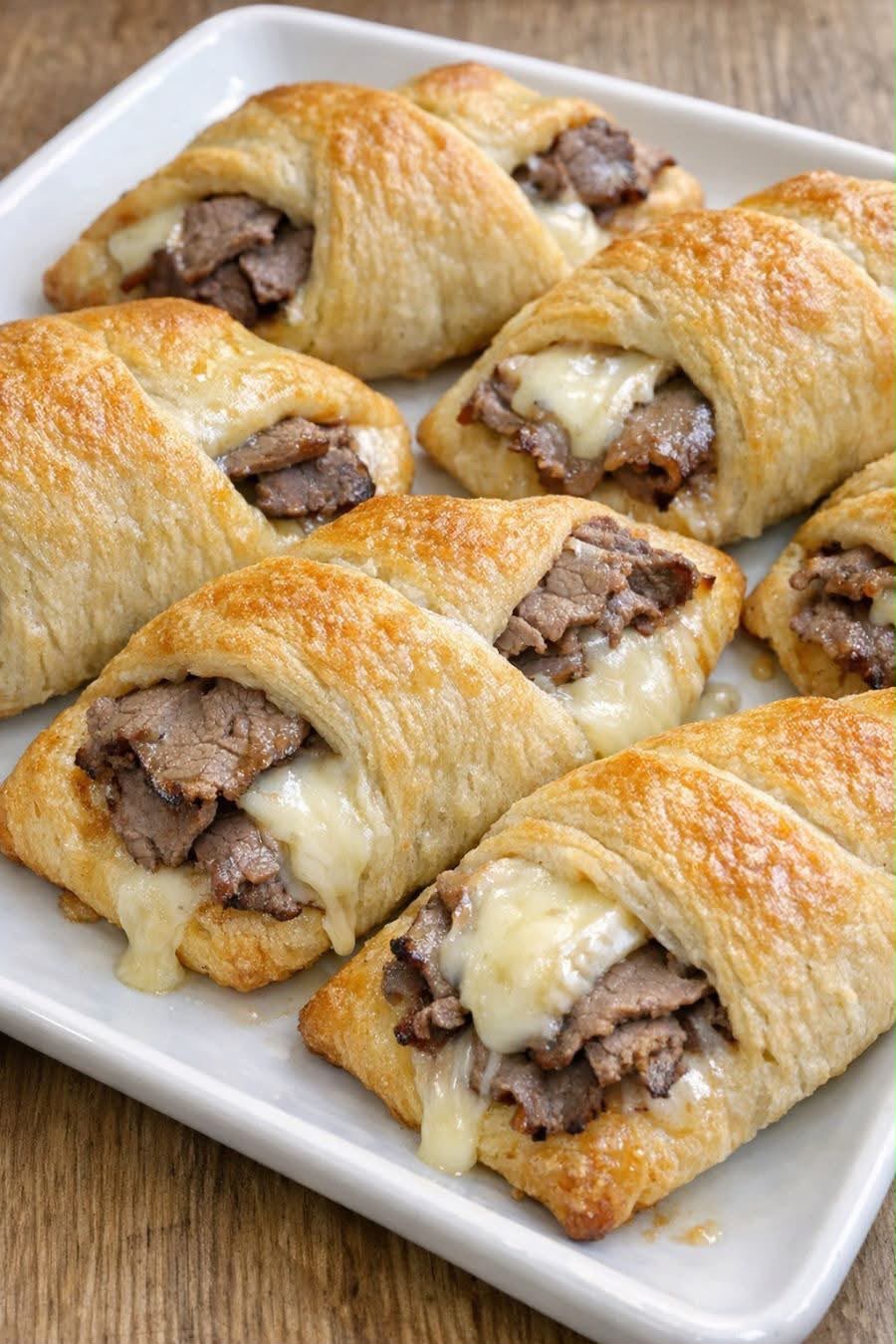
Thin-sliced roast beef and provolone folded into crescent dough and baked until the pastry puffs golden and the cheese runs out at the edges. Five minutes of assembly, twenty in the oven, and eight of them off one tray.
The technique that decides whether these come out flaky or soggy is blotting the beef. Deli roast beef sits in its own moisture in the packet, and that liquid turns to steam inside the pastry, softening the layers from within before they have a chance to set. Thirty seconds with a paper towel is the whole fix.
Ten minutes of prep, twenty in the oven, and they are best eaten hot.
Why You Will Love This Recipe
They take one packet of dough. A tube of crescent rolls, deli beef, and sliced cheese. Nothing needs measuring.
The pastry stays flaky. Blotting the beef and keeping the filling away from the edges are what preserve the layers.
They work for any meal. Lunch, a quick dinner, or cut in half as party food.
Children eat them without argument. Mild, handheld, and familiar.
They reheat properly. Ten minutes in a hot oven brings the crisp back, which is rare for anything wrapped in pastry.
Recipe Overview
Prep time: 10 minutes
Cook time: 20 minutes
Total time: 30 minutes
Yield: 8 rolls, serving 4
Difficulty: Easy
Best for: Weeknight dinners, lunchboxes, party food, using up deli meat
Ingredients
For the rolls
• 1 tube refrigerated crescent roll dough, 8 count
• 8 ounces thin-sliced deli roast beef
• 8 slices provolone cheese
• 2 tablespoons butter, melted
• 1 teaspoon garlic powder
• ½ teaspoon onion powder
• ¼ teaspoon black pepper
For the egg wash
• 1 egg
• 1 tablespoon water
Optional additions
• 2 tablespoons horseradish sauce or Dijon mustard
• ½ small onion, thinly sliced and sautéed
• Sesame seeds, for the tops
Choosing the Right Roast Beef
The beef is most of the flavour here, so it is worth a moment at the counter.
Deli-sliced rare roast beef. The best choice. Sliced thin at the counter, still pink in the middle, and far more tender than pre-packaged.
Deli-sliced well-done roast beef. Perfectly usable and a little firmer. Slightly drier, so do not over-blot it.
Leftover home-roasted beef. Excellent if you slice it genuinely thin. Thick slices make the roll bulky and hard to seal.
Pre-packaged sandwich slices. They work, though they carry more moisture and more salt. Blot them thoroughly and skip any added salt.
Shaved steak. A different dish entirely, since it needs cooking first, but very good if you want something closer to a cheesesteak.
Ask for it sliced as thin as the machine will manage. Thin slices fold and layer; thick ones sit in a lump and split the dough.
Why Blotting the Beef and Sealing the Edges Both Matter
Crescent dough is a laminated pastry, which means thin sheets of dough separated by layers of fat. In the oven that fat melts and the water in the dough turns to steam, and the steam pushes the sheets apart. That is what creates the flaky layers, and it depends entirely on the dough being able to dry and set as it rises.
Deli roast beef holds a great deal of moisture, both its own and the brine it is packed in. Wrapped inside pastry, that liquid boils off as steam with nowhere to escape, and it soaks into the underside of the dough exactly while the layers are trying to separate. The result is a roll that looks golden on top and is pale and doughy underneath. Blotting the slices between paper towels removes most of it in half a minute.
The edges matter for the same reason from the other direction. Filling pushed right to the perimeter stops the dough from bonding to itself, so the seam opens in the oven and the cheese escapes onto the tray. Leaving a clear half-inch border and pressing the seam firmly keeps everything inside, and it is the difference between eight tidy rolls and a tray of melted cheese with pastry floating in it.
How to Make Roast Beef and Provolone Crescent Rolls
Step 1: Heat the oven
Preheat to 375°F and line a baking sheet with parchment.
Parchment matters here. Any cheese that does escape welds itself to a bare tray.
Step 2: Blot the roast beef
Lay the slices between paper towels and press firmly for about thirty seconds.
This is the step that keeps the pastry flaky. Do not skip it.
Step 3: Mix the seasoned butter
Stir the garlic powder, onion powder, and pepper into the melted butter.
Step 4: Separate the dough
Unroll the crescent dough and separate it into 8 triangles along the perforations. Work quickly while it is cold.
Warm dough stretches and tears. If it softens, put it back in the fridge for five minutes.
Step 5: Layer the filling
Place a slice of provolone on the wide end of each triangle, then a folded slice of roast beef on top, keeping everything half an inch clear of the edges.
Fold the beef rather than laying it flat. A folded slice sits compact instead of hanging over the sides.
Step 6: Add horseradish or mustard if using
Spread a thin layer over the beef before rolling.
Step 7: Roll and seal
Roll each triangle up from the wide end toward the point, then press the tip and the side seams down firmly.
Press properly. An unsealed seam opens in the first five minutes of baking.
Step 8: Egg wash and season
Beat the egg with the water and brush over the tops, then drizzle with the seasoned butter and add sesame seeds if using.
The egg wash gives the deep golden colour, and the butter carries the seasoning. Both, not one or the other.
Step 9: Bake and rest
Bake for 18 to 20 minutes, until deeply golden. Rest 5 minutes before serving.
The cheese is molten straight from the oven and the pastry firms as it cools slightly.
Tips for the Best Crescent Rolls
Keep the dough cold. Take it from the fridge only when you are ready to fill, and work fast.
Do not overfill. One slice of cheese and one of beef per triangle. More filling means an open seam and a doughy centre.
Space them well. Two inches between rolls on the tray. Crowded rolls steam each other and stay pale on the sides.
Use the egg wash generously. Cover the whole surface, including the sides, or you get patchy colour.
Serve them hot. These are at their best in the first fifteen minutes off the tray.
Easy Variations
• Swap the provolone for Swiss, havarti, or pepper jack
• Add sautéed onions and peppers for something closer to a steak sandwich
• Use turkey and cheddar for a lighter version
• Add a thin layer of cream cheese under the beef for extra richness
• Sprinkle everything bagel seasoning over the egg wash
• Serve with au jus for dipping, made from beef broth simmered with a splash of Worcestershire
What to Serve With It
A simple green salad with a sharp vinaigrette balances the richness of the pastry and cheese. Potato chips or a handful of fries turn it into a proper lunch.
For dipping, horseradish cream, au jus, or a garlic aioli all work. As party food, cut each roll in half and set them out with two or three dips.
Make-Ahead and Storage
Make ahead. Assemble up to 4 hours in advance and keep covered in the fridge unbaked. Egg wash just before baking and add 3 minutes.
Fridge. Store baked rolls in an airtight container for up to 3 days.
Freezer. Freeze assembled unbaked rolls on a tray, then bag them for up to 2 months. Bake from frozen at 375°F for 25 to 28 minutes.
Reheating. A 350°F oven for 8 to 10 minutes, or an air fryer at 350°F for 4 minutes. The microwave makes the pastry limp.
Frequently Asked Questions
Can I use puff pastry instead?
Yes. Cut it into rectangles, fill, and fold over, and bake at 400°F for about 20 minutes.
Why did my rolls open in the oven?
Either the filling reached the edges or the seams were not pressed firmly. Leave a half-inch border and press hard.
Can I use a different cheese?
Any good melting cheese works. Provolone is traditional with roast beef, but Swiss and havarti are both excellent.
Do I have to use the egg wash?
Not strictly, but without it the tops bake pale rather than golden. Melted butter alone gives colour but less shine.
Can I make these in an air fryer?
Yes. Cook at 330°F for 10 to 12 minutes, in a single layer with space between them.
Why is the bottom of my rolls doughy?
The beef was not blotted, or the oven was too cool. Blot thoroughly and bake at a full 375°F.
Nutrition Information
• Calories: 245 per roll
• Protein: 14g
• Fat: 15g
• Carbohydrates: 13g
• Fiber: 0g
• Sodium: 690mg
Nutrition is estimated and will vary with portion size and brands used.
Final Thoughts
Two rules make these work. Blot the roast beef before it touches the dough, and keep the filling half an inch clear of the edges. The first protects the flaky layers and the second keeps the cheese where it belongs.