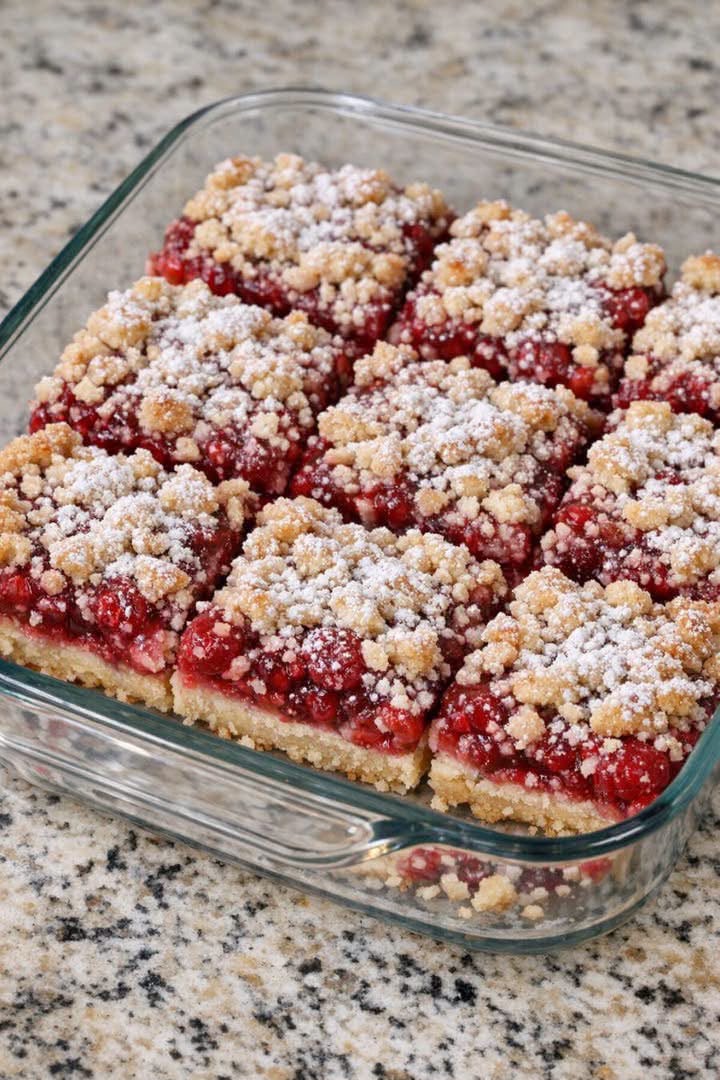
A buttery shortbread base, a thick layer of raspberries, and a crumble topping made from the same dough as the base. One bowl, one dough, and three distinct layers out of a single 8×8 pan.
The technique worth knowing here is the cornstarch in the fruit. Raspberries release a great deal of liquid as they bake, and without a thickener that liquid soaks straight down into the shortbread and turns the base to paste. A tablespoon of cornstarch holds the juice as a set filling instead.
Twenty minutes of prep, fifty in the oven, and the cooling time is not negotiable.
Why You Will Love This Recipe
The dough does double duty. You make one batch, press two thirds into the pan, and crumble the rest over the top. There is no second mixture to prepare.
No mixer required. The butter is cut in with your fingertips or a fork, which takes about four minutes.
It works with frozen berries. Straight from the freezer, no thawing, which means you can make it in any month of the year.
It slices cleanly. The shortbread base holds its shape, so you get squares with sharp edges rather than a spooned dessert.
It travels well. Sturdy enough for a lunchbox, a picnic, or a bake sale table.
Recipe Overview
Prep time: 20 minutes
Cook time: 50 minutes
Cooling time: 3 hours
Total time: 4 hours 10 minutes
Yield: 9 to 16 bars
Difficulty: Easy
Best for: Bake sales, picnics, afternoon coffee, making a day ahead
Ingredients
For the dough and crumble
• 2 cups all-purpose flour
• ⅔ cup granulated sugar
• ¼ teaspoon salt
• ½ teaspoon baking powder
• 1 cup cold unsalted butter, cubed
• 1 large egg
• 1 teaspoon vanilla extract
For the raspberry filling
• 3 cups raspberries, fresh or frozen
• ⅓ cup granulated sugar
• 1 tablespoon cornstarch
• 1 tablespoon lemon juice
• ½ teaspoon lemon zest
To finish
• 2 tablespoons powdered sugar, for dusting
Choosing the Right Raspberries
The fruit you use changes both the flavour and how much liquid you are managing.
Fresh summer raspberries. The best flavour, and worth using when they are in season and reasonably priced. They break down slightly and hold their shape at the edges.
Frozen whole raspberries. Excellent here, and often better than out-of-season fresh. Use them frozen and do not thaw, which keeps them intact through mixing.
Fresh out-of-season raspberries. Usually expensive and watery. Frozen is the better choice in winter.
Mixed berries. Raspberries with blackberries or blueberries work well. Keep raspberries as at least half the total, since they provide the tartness.
Raspberry jam. A shortcut some recipes use, but it produces a flatter, one-note filling and a much sweeter bar. Whole fruit is worth the small extra effort.
Avoid raspberries that look darkened or feel soft in the punnet, and check the bottom of the container for staining, which indicates crushed fruit underneath.
Why the Cornstarch and the Cooling Time Matter
Raspberries are roughly 85% water, and nearly all of it comes out in a hot oven. Without a thickener that water has nowhere to go but down into the shortbread, and the base you spent time pressing into the pan turns soft and grey underneath.
Cornstarch works by gelatinising as the fruit juice heats, thickening it into a filling that stays where you put it. One tablespoon per three cups of berries is the right ratio here. Tossing it with the sugar before it meets the fruit keeps it from forming lumps.
The cooling time works on the same principle from the other direction. That thickened filling is still liquid at oven temperature and only sets as it cools. Cut into these bars warm and the filling runs, no matter how much cornstarch went in.
Three hours at room temperature is the minimum. An hour in the fridge afterwards makes the cuts even cleaner, and the flavour is better on day two than on day one.
How to Make Raspberry Crumble Bars
Step 1: Prepare the pan
Line an 8×8 baking pan with parchment, leaving an overhang on two sides. Preheat the oven to 375°F.
The overhang is how you lift the whole slab out later. Cutting in the pan gives you ragged edges.
Step 2: Mix the dry ingredients
Whisk the flour, sugar, salt, and baking powder together in a large bowl.
Step 3: Cut in the cold butter
Add the cubed butter and work it in with your fingertips or a pastry cutter until the mixture looks like coarse crumbs with some pea-sized pieces remaining.
Keep the butter cold. Those visible pieces are what make the topping crumbly rather than uniform.
Step 4: Add the egg and vanilla
Beat the egg with the vanilla, pour it over the mixture, and stir with a fork until it comes together into a shaggy, clumpy dough. It should hold when squeezed but still look loose.
Step 5: Press the base
Set aside a generous third of the dough for the topping. Press the rest firmly and evenly into the lined pan, pushing it right into the corners.
Use the flat bottom of a glass to compact it. A well-pressed base is what holds the bar together when you pick it up.
Step 6: Par-bake the base
Bake for 15 minutes, until the surface looks dry and the edges are just beginning to colour.
This is the step that keeps the base crisp under wet fruit. Skipping it is the most common cause of a soggy bottom.
Step 7: Prepare the filling
While the base bakes, toss the sugar and cornstarch together in a bowl, then add the raspberries, lemon juice, and zest. Fold gently until the fruit is coated.
Mix the cornstarch with the sugar first. Adding it directly to wet fruit leaves white lumps.
Step 8: Assemble
Spread the raspberry mixture evenly over the hot par-baked base, then scatter the reserved dough over the top in irregular clumps.
Leave gaps. The fruit showing through is what gives these bars their look, and full coverage traps steam.
Step 9: Bake and cool completely
Return to the oven for 35 to 40 minutes, until the crumble is golden and the filling bubbles visibly at the edges.
Cool in the pan for at least 3 hours before lifting out and cutting. Dust with powdered sugar just before serving.
Tips for the Best Raspberry Crumble Bars
Keep the butter cold throughout. If the kitchen is warm and the dough softens while you work, chill it for ten minutes before pressing.
Do not overwork the dough. Stop mixing the moment it holds together. Overworked shortbread bakes up tough instead of short and tender.
Press the base hard. Loosely pressed dough crumbles apart when you cut the bars.
Dust the sugar at the last minute. Powdered sugar dissolves into moisture within an hour or two, so dust after cutting and shortly before serving.
Wipe the knife between cuts. A clean blade gives clean edges. Warm it under hot water and dry it for the sharpest slices.
Easy Variations
• Add ½ teaspoon of cinnamon to the crumble topping for a warmer, autumnal version
• Fold ½ cup of sliced almonds into the reserved topping dough for crunch
• Use half raspberries and half rhubarb, cut small, for a sharper filling
• Swap the vanilla for almond extract, which pairs particularly well with raspberry
• Add 2 tablespoons of rolled oats to the topping for a more rustic crumble
• Drizzle with a simple glaze of powdered sugar and lemon juice instead of dusting
What to Serve With It
These are excellent on their own with coffee or tea, which is how most people eat them. Warmed slightly and topped with a scoop of vanilla ice cream, they become a proper dessert.
A spoonful of lightly whipped cream or crème fraîche alongside cuts the sweetness. For a dinner party, serve them cut small with an espresso.
Make-Ahead and Storage
Make ahead. The dough can be made a day in advance and refrigerated. Let it sit at room temperature for 15 minutes before pressing.
Room temperature. Store in an airtight container for up to 3 days. The crumble softens slightly but the flavour deepens.
Fridge. Up to 5 days in a sealed container. Bring to room temperature before serving, since cold dulls the fruit.
Freezer. Freeze cut bars, well wrapped, for up to 3 months. Thaw at room temperature for a couple of hours and dust with fresh powdered sugar.
Frequently Asked Questions
Can I use frozen raspberries without thawing?
Yes, and it is the better approach. Toss them frozen with the sugar and cornstarch and add 5 minutes to the bake time.
Why is my filling runny?
Either the bars were cut before cooling completely, or the cornstarch was short. Three hours at room temperature is the minimum.
Can I double this in a 9×13 pan?
Yes. Double everything, par-bake for 18 minutes, and bake the assembled bars for 45 to 50 minutes.
Can I use salted butter?
Yes, and simply omit the added salt.
Why did my base go soggy?
Almost always because the par-bake in step 6 was skipped or cut short. Fifteen minutes is what seals the surface.
Can I make these gluten free?
A cup-for-cup gluten free flour blend works well in this recipe, since shortbread does not rely on gluten development.
Nutrition Information
• Calories: 285 per bar, based on 12 bars
• Protein: 3g
• Fat: 16g
• Carbohydrates: 34g
• Fiber: 2g
• Sugar: 18g
Nutrition is estimated and will vary with portion size and brands used.
Final Thoughts