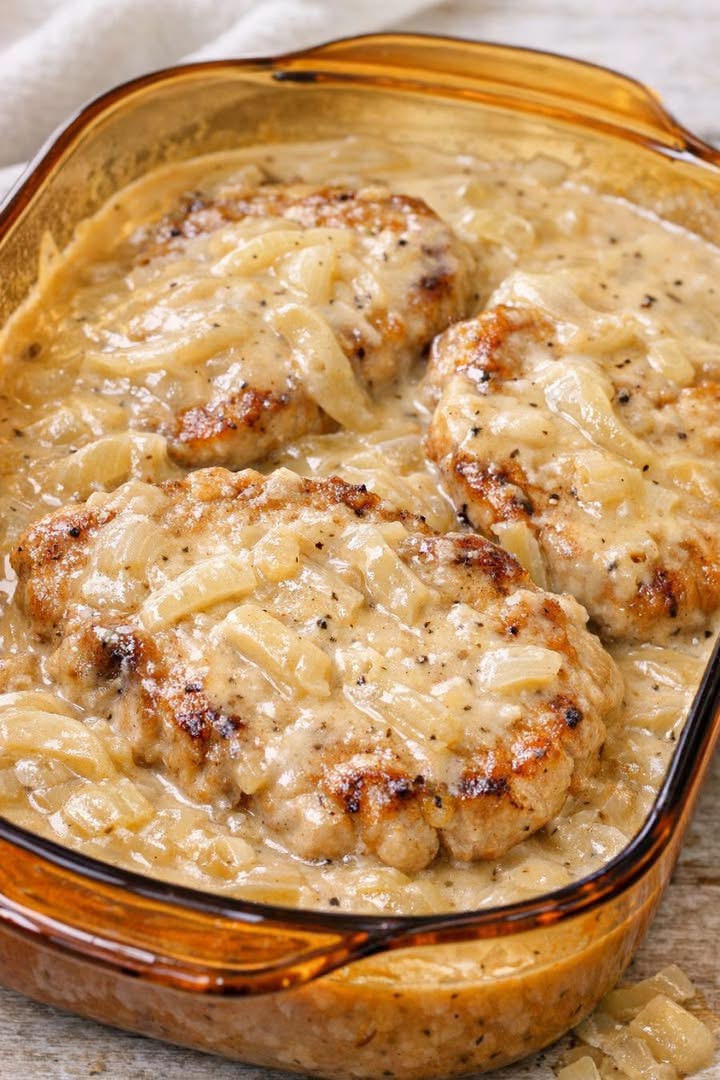
Thick-cut pork chops seared until golden, then buried in a creamy onion gravy and baked until they pull apart under a fork. This is the version that fixes the usual problem with pork chops, which is that they come out dry and tight.
The technique that matters here is the flour dredge. It does two jobs at once: it gives the chops their golden crust in the skillet, and the flour left behind in the pan becomes the thickener for the gravy. You never open a packet of anything.
Fifteen minutes of prep, fifty in the oven, and one dish on the table in just over an hour.
Why You Will Love This Recipe
The chops stay tender. Baking them submerged in gravy means they cook in moisture rather than dry heat, so they never seize up the way pan-only chops do.
The gravy makes itself. The flour from the dredge and the browned bits from the skillet do all the work. No packet gravy and no separate roux.
It is one skillet and one dish. Sear, build the gravy in the same pan, pour it over, and bake.
It reheats better than most meat dishes. The gravy protects the chops in the fridge, so day-two portions are as good as the first.
It costs very little. Pork chops, two onions, and pantry staples feed four people generously.
Recipe Overview
Prep time: 15 minutes
Cook time: 50 minutes
Total time: 1 hour 5 minutes
Yield: 4 servings
Difficulty: Easy
Best for: Weeknight dinners, Sunday supper, cooking ahead
Ingredients
For the pork chops
• 4 bone-in pork chops, 1 to 1¼ inches thick
• ½ cup all-purpose flour
• 1½ teaspoons salt
• 1 teaspoon black pepper
• 1 teaspoon garlic powder
• ½ teaspoon paprika
• 2 tablespoons vegetable oil
• 2 tablespoons butter
For the onion gravy
• 2 large yellow onions, thinly sliced
• 3 cloves garlic, minced
• 2 tablespoons butter
• 2 tablespoons of the seasoned flour, reserved
• 2 cups chicken broth
• ½ cup heavy cream
• 1 teaspoon Worcestershire sauce
• 1 teaspoon fresh thyme leaves, or ½ teaspoon dried
• Salt and pepper to taste
Choosing the Right Pork Chops
The cut you buy determines almost everything about how this dish turns out.
Bone-in rib chops, 1 to 1¼ inches. The best choice. The bone insulates the meat and slows the cooking, and the fat cap along the edge melts into the gravy. This is what to ask for at the counter.
Bone-in loin chops. The T-bone-looking cut with tenderloin on one side. Excellent flavour, though the tenderloin side cooks faster than the loin side.
Boneless loin chops, thick-cut. Perfectly workable if they are at least an inch thick. Reduce the bake by about ten minutes and check earlier.
Thin chops, under ¾ inch. These are not suited to this method. They finish long before the gravy has developed, and no amount of liquid saves them. Save them for a quick pan sear.
Shoulder or blade chops. Fattier and more marbled, and genuinely delicious here, but they need closer to an hour and fifteen minutes to become tender.
Look for chops with visible marbling through the meat and a firm white fat cap rather than a yellowed one.
Why Thick Chops and a Flour Dredge Change Everything
Pork loin is lean. Once its internal temperature climbs past about 145°F, the muscle fibres contract and squeeze out moisture, and there is no fat marbled through the meat to compensate. That is the entire reason most pork chops disappoint.
A thick chop buys you time. The exterior can brown properly while the centre is still well below that threshold, and the mass of the chop means it heats slowly and evenly in the oven. A thin chop gives you no margin at all.
The flour dredge then solves the second half of the problem. Flour on the surface browns fast and dry, which is what produces the golden crust in ninety seconds a side. Because the crust forms quickly, you can pull the chops long before they have cooked through and let the oven finish them gently under gravy.
And the flour that stays behind in the skillet, toasted in butter and fat, is a ready-made roux. Whisk broth into it and it thickens on its own. This is why the recipe needs no cornstarch slurry and no packaged mix.
How to Make Smothered Pork Chops
Step 1: Bring the chops to room temperature
Take them out of the fridge 20 to 30 minutes before cooking and pat them completely dry with paper towels.
Dry surfaces brown. A wet chop steams in the pan and stays pale.
Step 2: Mix the seasoned flour
Combine the flour, salt, pepper, garlic powder, and paprika in a shallow dish. Set aside 2 tablespoons of the mixture for the gravy before you dredge anything.
Step 3: Dredge the chops
Press each chop into the flour on both sides and along the edges, then shake off the excess. You want a thin even coating, not a thick jacket.
Step 4: Sear until golden
Heat the oil and butter in a large skillet over medium-high heat until the butter foams. Sear the chops 2 to 3 minutes per side, until deeply golden.
They will not be cooked through, and they should not be. Transfer them to a 9×13 baking dish.
Step 5: Soften the onions
Lower the heat to medium and add 2 tablespoons of butter to the same skillet. Add the sliced onions with a pinch of salt and cook 8 to 10 minutes, stirring occasionally, until soft and lightly golden.
Do not rush this. Raw-tasting onions stay raw-tasting in the oven.
Step 6: Add the garlic and reserved flour
Stir in the minced garlic and cook 30 seconds, then sprinkle over the 2 tablespoons of reserved seasoned flour. Stir constantly for a full minute so the flour toasts rather than tasting raw.
Step 7: Build the gravy
Pour in the chicken broth a little at a time, whisking after each addition and scraping the browned bits off the bottom of the pan. Add the Worcestershire sauce and thyme, and simmer 3 to 4 minutes until it thickens slightly.
Stir in the heavy cream and taste for salt and pepper.
Step 8: Pour and bake
Pour the gravy over the chops in the baking dish, making sure the onions are distributed across the top. The gravy should come about halfway up the sides of the chops.
Cover tightly with foil and bake at 350°F for 35 minutes.
Step 9: Uncover and finish
Remove the foil and bake another 10 to 15 minutes, until the gravy has thickened and the tops of the chops are burnished.
An instant-read thermometer in the thickest part should show 145°F. Rest 5 minutes before serving.
Tips for the Best Smothered Pork Chops
Slice the onions evenly. Uniform thickness means they soften at the same rate and none of them stay crunchy.
Do not crowd the skillet. Sear in two batches if you need to. Chops packed together steam instead of browning, and you lose the crust and the fond.
Use a thermometer. Pork is safe and still juicy at 145°F. Cooking to the old 160°F guideline is what dried out a generation of pork chops.
Make the gravy slightly thinner than you want it. The chops release juices as they bake, and the uncovered final stage tightens it further.
Let them rest. Five minutes off the heat lets the juices redistribute through the meat instead of running out onto the plate.
Easy Variations
• Add 8 ounces of sliced mushrooms with the onions for a deeper, earthier gravy
• Swap half the broth for dry white wine and reduce it before adding the rest
• Stir in 2 tablespoons of Dijon mustard with the cream for a sharper finish
• Use smoked paprika in the dredge for a subtle barbecue note
• Add a bay leaf and a sprig of rosemary to the gravy before baking, and remove before serving
• Finish with ½ cup grated Gruyère over the top during the last 10 minutes uncovered
What to Serve With It
Mashed potatoes are the natural partner, since the whole point of a gravy this good is having something to spoon it over. Buttered egg noodles or plain white rice work equally well.
For a vegetable, green beans, roasted carrots, or a simple side salad with a sharp vinaigrette cut through the richness. Crusty bread for the last of the gravy is not optional in most households.
Make-Ahead and Storage
Make ahead. Sear the chops and make the gravy up to a day in advance. Keep them separate in the fridge, then assemble and bake when you need them, adding 5 minutes to the covered time.
Fridge. Store in an airtight container for up to 4 days. The chops absorb the gravy overnight and improve.
Freezer. Freeze cooked chops in their gravy for up to 3 months. Cream-based gravies can separate slightly on thawing but come back together with a whisk when reheated.
Reheating. Cover and warm in a 325°F oven for 20 minutes, or gently in a covered skillet on the stove with a splash of broth. Avoid the microwave on high, which toughens pork quickly.
Frequently Asked Questions
Can I use boneless chops?
Yes, provided they are at least an inch thick. Start checking the temperature about 10 minutes earlier.
Why is my gravy thin?
Either the flour was not toasted long enough in step 6, or the broth went in too quickly. Simmer it uncovered for a few extra minutes at the end and it will tighten.
Can I skip the cream?
You can. The gravy will be lighter and more like a classic brown onion gravy. Add an extra tablespoon of butter at the end for body.
Do I have to sear the chops first?
Yes. Without the sear there is no crust, no browned fond in the pan, and the gravy loses most of its depth.
What if my chops come out tough?
They were almost certainly overcooked. Pull them at 145°F, and if you are using shoulder chops, they need longer covered time rather than higher heat.
Can I make this in a slow cooker?
Sear the chops and build the gravy on the stove first, then cook on low for 4 to 5 hours. Add the cream in the final 20 minutes.
Nutrition Information
• Calories: 520 per serving
• Protein: 42g
• Fat: 32g
• Carbohydrates: 14g
• Fiber: 1g
• Sodium: 890mg
Nutrition is estimated and will vary with the exact cut, portion size, and brands used.
Final Thoughts