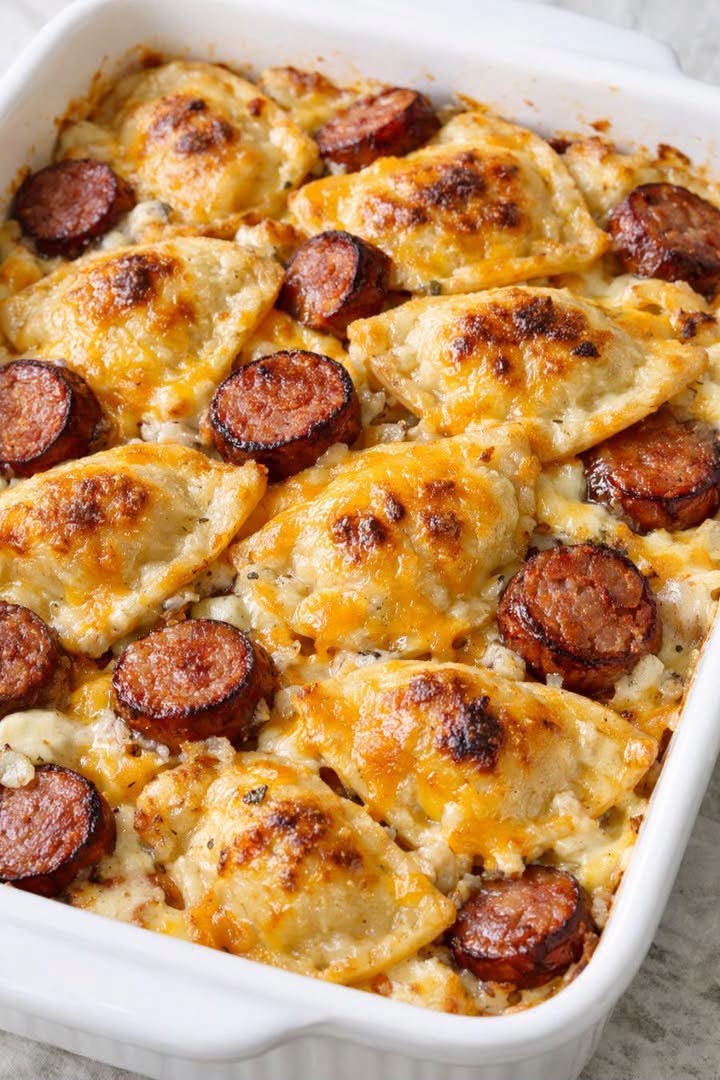
There is a whole category of dinner that exists because someone stared into a freezer at 6 p.m. and made a decision. This casserole is the best possible outcome of that moment: a bag of frozen pierogi, a ring of smoked kielbasa, and enough cheese to fuse the two into something that comes out of the oven bubbling and browned at the edges.
The pierogi soften into pillowy pockets of potato under a blanket of melted cheddar and mozzarella, while the kielbasa slices, seared first in a hot skillet, keep their smoky bite and caramelized edges. Between them sits a creamy, garlicky sauce that seeps into everything.
It takes about fifteen minutes of actual work. There is no dough to make, no filling to shape, and no technique to master — which is precisely why it has become a standard in so many kitchens across the Midwest and Northeast.
Table of Contents
• Why You Will Love This Recipe
• Recipe Overview
• Ingredients You Will Need
• Why Searing the Kielbasa First Matters
• Choosing Pierogi and Cheese That Bake Well
• How to Make Cheesy Pierogi and Kielbasa Casserole
• Tips for the Best Results
• Variations
• What to Serve With It
• Make-Ahead and Storage
• Frequently Asked Questions
• Nutrition Information
• Final Thoughts
[AD SLOT 1]
Why You Will Love This Recipe
It comes together from four core ingredients. Frozen pierogi, kielbasa, cream, and cheese carry the entire dish, and everything else is seasoning you already own.
No boiling or thawing required. The pierogi go into the dish frozen and cook through in the sauce, which saves a pot and a step.
It feeds people generously and cheaply. A single 9×13 pan stretches to eight servings for the cost of a fairly modest grocery run.
The leftovers are excellent. Unlike many cheesy bakes, this one holds together and reheats without turning oily or grainy.
Recipe Overview
Course: Main Dish
Cuisine: Polish-American
Prep Time: 15 minutes
Cook Time: 40 minutes
Total Time: 55 minutes
Servings: 6 to 8
Difficulty: Easy
Method: Baked
Equipment: Large skillet, 9×13 baking dish, mixing bowl
Ingredients You Will Need
For the base
• 2 packages (16 oz each) frozen potato and cheese pierogi
• 14 oz smoked kielbasa, sliced into ½-inch rounds
• 1 tablespoon olive oil
• 1 small yellow onion, finely diced
For the sauce
• 3 tablespoons butter
• 3 cloves garlic, minced
• 1 cup heavy cream
• ½ cup sour cream
• ½ cup chicken broth
• 1 teaspoon Dijon mustard
• 1 teaspoon dried parsley
• ½ teaspoon smoked paprika
• ½ teaspoon black pepper
• ¼ teaspoon salt
For the topping
• 1½ cups shredded sharp cheddar
• 1½ cups shredded low-moisture mozzarella
• 2 tablespoons chopped fresh parsley, for finishing
The Dijon is doing more than it appears to. A single teaspoon cuts through the cream and cheese and keeps the whole dish from tasting flat and heavy by the third bite.
Sour cream is not optional either. It brings the gentle tang that traditionally gets spooned over pierogi at the table, built directly into the sauce instead.
[AD SLOT 2]
Why Searing the Kielbasa First Matters
Kielbasa is already fully cooked when you buy it, so it is tempting to slice it and drop it straight into the dish. That works, but it produces sausage that is warm and soft rather than sausage with any character.
Searing the rounds in a hot skillet for a few minutes per side browns the sugars and proteins on the cut surfaces, creating the dark caramelized rims you see on top of a good casserole. That browning contributes a depth of flavor the oven alone cannot generate through a layer of cream and cheese.
The rendered fat left in the skillet is the second reason. Cooking the onion and garlic in it pulls all that smoky flavor into the sauce base rather than leaving it behind in the pan.
There is a textural argument too. Seared slices hold their shape through forty minutes of baking, while unseared ones tend to go limp and lose their edges entirely.
Choosing Pierogi and Cheese That Bake Well
Frozen pierogi are the right choice here, and the standard potato and cheese variety is the most reliable. Refrigerated fresh pierogi are thinner and can go mushy over a long bake, while frozen ones hold their structure.
Do not boil them first. Cooking them from frozen in the sauce lets them absorb liquid and flavor, and pre-boiled pierogi arrive at the oven already saturated with plain water.
For cheese, shred your own from a block whenever possible. Bagged shredded cheese carries a starch coating that resists melting and can leave a slightly grainy film across the top.
Sharp cheddar supplies flavor and the orange color visible in the browned patches, while mozzarella supplies stretch and coverage. Using only cheddar gives you taste without pull; using only mozzarella gives you pull without much taste.
[AD SLOT 3]
How to Make Cheesy Pierogi and Kielbasa Casserole
1. Heat the oven and grease the dish
Preheat the oven to 375°F (190°C) and butter a 9×13 baking dish. Greasing the sides properly matters, since cheese that runs down the edges will weld itself to bare ceramic.
2. Sear the kielbasa
Heat the olive oil in a large skillet over medium-high heat and add the kielbasa rounds in a single layer. Cook for 2 to 3 minutes per side until deeply browned, then transfer to a plate.
Work in two batches if the pan looks crowded. Crowded sausage steams instead of searing and you lose the browning entirely.
3. Build the sauce base
Lower the heat to medium and add the butter to the same skillet along with the diced onion. Cook for 4 to 5 minutes until softened, then add the garlic and cook for 1 minute more.
Scrape the browned bits off the bottom of the pan as the onion releases moisture. That fond is concentrated kielbasa flavor and belongs in the sauce.
4. Finish the sauce
Pour in the chicken broth and heavy cream, then whisk in the sour cream, Dijon, parsley, smoked paprika, salt, and pepper. Simmer gently for 3 to 4 minutes until slightly thickened.
Keep the heat moderate. Sour cream can split if it boils hard, so a lazy bubble is all you want.
5. Assemble the casserole
Arrange the frozen pierogi in the baking dish in a single overlapping layer. Tuck the seared kielbasa rounds between and around them, then pour the sauce evenly over the top.
Overlapping slightly is fine and looks better than a rigid grid. Just make sure the sauce reaches every corner of the dish.
6. Bake covered
Cover tightly with foil and bake for 25 minutes. The foil traps steam, which is what cooks the frozen pierogi through without drying their edges into leather.
7. Add cheese and finish uncovered
Remove the foil, scatter both cheeses evenly across the surface, and return the dish to the oven for 12 to 15 minutes. Bake until the cheese is fully melted with golden brown patches across the top.
If you want more color, broil for 1 to 2 minutes at the end. Stay at the oven door, because the gap between golden and burnt at that stage is roughly ninety seconds.
8. Rest and serve
Let the casserole sit for 5 minutes before serving, then scatter fresh parsley over the top. Resting lets the sauce thicken enough to cling rather than running across the plate.
[AD SLOT 4]
Tips for the Best Results
Use the same skillet for everything. Every step builds on the flavor left by the previous one, and washing the pan mid-recipe throws that away.
Keep the pierogi frozen until the moment they go in the dish. Partially thawed pierogi release water and dilute the sauce.
Taste the sauce before pouring it. Kielbasa brands vary widely in saltiness, so adjust seasoning at that stage rather than after baking.
Cover the dish tightly for the first bake. A loose foil seal lets steam escape and leaves you with underdone pierogi in the center.
Let it rest even when it smells finished. Cutting into it immediately gives you a soupy first serving.
Variations
With vegetables: Stir in 2 cups of chopped broccoli florets or a handful of spinach before adding the sauce.
Loaded baked potato style: Top with crumbled bacon and sliced green onions after baking, and serve with extra sour cream.
Spicy: Use andouille sausage instead of kielbasa and add ½ teaspoon cayenne to the sauce.
Sauerkraut version: Layer 1 cup of drained sauerkraut under the pierogi for a sharper, more traditionally Polish result.
Lighter: Replace the heavy cream with whole milk and reduce the cheese to 2 cups total. It will be looser but still satisfying.
[AD SLOT 5]
What to Serve With It
This dish is heavy, so the ideal partner is something sharp and cold. A cucumber salad dressed with vinegar and dill is the classic pairing and cuts the richness immediately.
Steamed green beans, roasted brussels sprouts, or a plain butter lettuce salad with a lemon vinaigrette all work well. Pickled red onions or cornichons on the side are a small addition that does a lot.
Skip the bread. Between the pierogi and the cream sauce, there is already more than enough starch on the plate.
Make-Ahead and Storage
Make ahead: Assemble the casserole through step 5, cover, and refrigerate for up to 24 hours. Add 10 minutes to the covered baking time.
Refrigerator: Store covered for up to 4 days.
Freezer: Freeze the fully assembled unbaked casserole for up to 2 months. Bake from frozen, covered, for 50 minutes before adding cheese.
Reheating: Cover with foil and warm at 350°F for 15 to 20 minutes. Individual portions reheat well in the microwave at 70 percent power.
Frequently Asked Questions
Do I need to thaw or boil the pierogi first?
No. They cook through during the covered portion of the bake, and pre-cooking them leads to a mushy texture.
Can I use a different sausage?
Yes. Andouille, smoked turkey sausage, or Italian sausage all work, though each changes the flavor direction noticeably.
Why did my sauce look curdled?
The sour cream was likely heated too aggressively. Keep the simmer gentle and add it off direct high heat.
Can I make this in a slow cooker?
It works but you lose the browned cheese top. Cook on low for 3 hours, then transfer to a dish and broil briefly.
Can I halve the recipe?
Yes. Use an 8×8 dish and reduce the covered bake to 20 minutes.
[AD SLOT 6]
Nutrition Information
Per serving (based on 8 servings):
• Calories: 610
• Protein: 24 g
• Carbohydrates: 42 g
• Fat: 39 g
• Saturated Fat: 20 g
• Fiber: 2 g
• Sodium: 1,180 mg
These numbers are estimates and will shift depending on the brands of pierogi and sausage you choose.
Final Thoughts