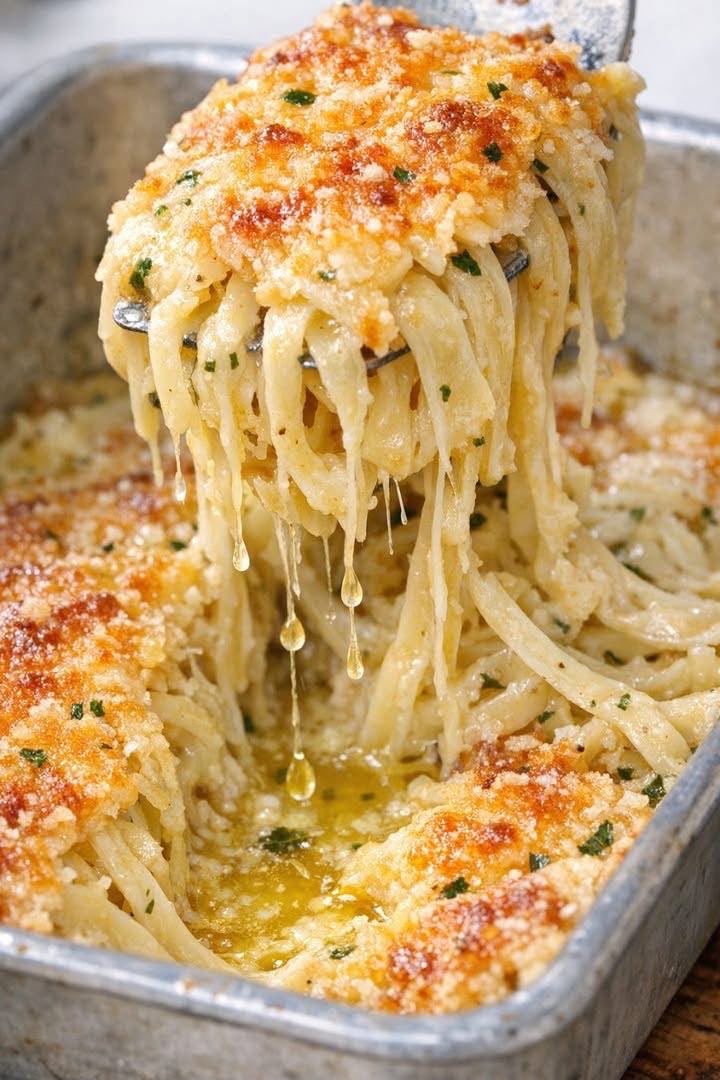
Some dishes earn their place at the table by being complicated. This one earns it by being the opposite: spaghetti, butter, garlic, and a serious amount of Parmesan, baked until the top turns into a golden crust you have to break through with the edge of a spoon.
What makes it work is the contrast. Underneath that crisp, craggy top layer, the pasta stays soft and slippery, coated in garlic butter that pools slightly at the bottom of the dish and clings to every strand you lift out.
It is the kind of recipe that started as a way to use leftover spaghetti and became a thing people actually request. No sauce to simmer, no meat to brown, nothing to chop beyond a few cloves of garlic and a handful of parsley. One pan goes in the oven and comes out looking like it took far more effort than it did.
Table of Contents
• Why You Will Love This Recipe
• Recipe Overview
• Ingredients You Will Need
• Why This Bakes Into a Crust Instead of Drying Out
• Choosing the Right Cheese and Pasta
• How to Make Baked Garlic Butter Parmesan Spaghetti
• Tips for the Best Results
• Variations
• What to Serve With It
• Make-Ahead and Storage
• Frequently Asked Questions
• Nutrition Information
• Final Thoughts
[AD SLOT 1]
Why You Will Love This Recipe
It uses ingredients you almost certainly already have. Dried pasta, butter, garlic, Parmesan, and a little cream or milk — this is a pantry dinner dressed up as an occasion.
The texture does all the work. A crisp browned top over soft buttery noodles gives you two completely different mouthfeels in the same bite, which is why it feels far richer than the ingredient list suggests.
It reheats better than most pasta. The crust re-crisps in the oven, so leftovers are genuinely good rather than merely edible.
It scales up easily for a crowd. Double it into a 9×13 dish and it feeds a table without any extra technique.
Recipe Overview
Course: Main Dish, Side Dish
Cuisine: Italian-American
Prep Time: 15 minutes
Cook Time: 30 minutes
Total Time: 45 minutes
Servings: 6
Difficulty: Easy
Method: Baked
Equipment: Large pot, 8×8 or 9×9 baking dish, skillet, box grater
Ingredients You Will Need
For the pasta
• 1 pound spaghetti
• 1 tablespoon kosher salt, for the pasta water
• 1 cup reserved pasta cooking water
For the garlic butter
• 10 tablespoons unsalted butter
• 8 cloves garlic, finely minced
• ½ teaspoon black pepper
• ¼ teaspoon red pepper flakes (optional)
• 3 tablespoons fresh parsley, finely chopped
For the cheese mixture
• 2 cups finely grated Parmesan cheese, divided
• 1 cup shredded low-moisture mozzarella
• ½ cup heavy cream or whole milk
• 2 large eggs
• ½ teaspoon salt
For the topping
• ½ cup grated Parmesan
• ⅓ cup panko breadcrumbs
• 2 tablespoons melted butter
• 1 tablespoon chopped parsley, for finishing
The eggs are the quiet workhorse here. They set gently as the dish bakes and bind the strands together just enough that a spoonful lifts out in one piece instead of collapsing into loose noodles.
Reserve the pasta water before you drain — it is starchy, salty, and the thing that turns melted butter and cheese into an actual sauce rather than a greasy slick.
[AD SLOT 2]
Why This Bakes Into a Crust Instead of Drying Out
The top of a baked pasta dish and the middle experience two completely different environments. The surface sits in dry radiant heat and browns, while everything underneath is effectively steaming in the moisture trapped by the pasta itself.
That is exactly what you want, and it is why the cream-and-egg mixture matters. It keeps the interior humid enough that the noodles stay tender for the full thirty minutes while the exposed Parmesan on top dehydrates and browns.
Parmesan browns particularly well because it is low in moisture and high in protein and fat. As it heats, those proteins undergo Maillard browning and then set into a brittle sheet — the same reason a Parmesan crisp holds its shape.
Adding panko to the topping gives that sheet something to grip. Cheese alone can go leathery, but cheese plus breadcrumbs bakes into an uneven, porous crust with real crunch.
Choosing the Right Cheese and Pasta
Grate your own Parmesan. Pre-grated cheese is dusted with cellulose to stop it clumping, and that coating prevents it from melting smoothly into the butter or browning properly on top.
Use low-moisture mozzarella rather than fresh. Fresh mozzarella releases water as it bakes and will leave your dish soupy instead of rich.
For the pasta, cook it two minutes short of the package time. It will continue softening in the oven, and pasta cooked fully before baking turns mushy by the time the crust is golden.
Spaghetti is traditional here, but linguine, bucatini, or angel hair all work. Long strands are the point — they tangle and hold the butter in a way short shapes do not.
[AD SLOT 3]
How to Make Baked Garlic Butter Parmesan Spaghetti
1. Heat the oven and prepare the dish
Preheat the oven to 400°F (200°C). Butter an 8×8 or 9×9 baking dish generously, including the sides.
A metal pan browns the edges more aggressively than glass or ceramic. If you want those crisp corner pieces, metal is the better choice.
2. Cook the pasta
Bring a large pot of well-salted water to a boil and cook the spaghetti until just short of al dente. Scoop out 1 cup of the cooking water before draining.
Do not rinse the pasta. The starch clinging to the surface is what helps the butter and cheese emulsify into a coating.
3. Make the garlic butter
Melt the butter in a skillet over medium-low heat, add the minced garlic, and cook for 2 to 3 minutes until fragrant but not colored. Stir in the black pepper, red pepper flakes, and parsley, then remove from the heat.
Browning the garlic is the one real mistake available in this recipe. Once it turns dark it goes bitter, and that bitterness carries through the whole dish.
4. Whisk the cheese mixture
In a bowl, whisk the eggs with the cream and salt until smooth. Stir in 1½ cups of the Parmesan and all of the mozzarella.
Let the garlic butter cool for a minute before combining, then temper by whisking a few spoonfuls of the warm butter into the egg mixture before adding the rest. This keeps the eggs from scrambling.
5. Combine everything
Add the drained pasta to a large bowl, pour over the garlic butter and cheese mixture, and toss with tongs until every strand is coated. Add reserved pasta water a few tablespoons at a time until the mixture looks glossy and loose rather than stiff.
It should look slightly wetter than you think it needs to be. The pasta absorbs liquid in the oven, and a mixture that looks perfect in the bowl will bake up dry.
6. Assemble and top
Transfer the pasta to the prepared dish and spread it into an even layer without packing it down tightly. Combine the remaining ½ cup Parmesan with the panko and melted butter, then scatter it evenly over the surface.
7. Bake until golden
Bake for 25 to 30 minutes, until the top is deep golden brown and the edges are bubbling. If the crust needs more color, run it under the broiler for 1 to 2 minutes, watching constantly.
8. Rest before serving
Let the dish sit for 5 to 8 minutes before cutting into it. The egg-set interior firms up as it cools slightly, which is what lets you lift out clean portions.
[AD SLOT 4]
Tips for the Best Results
Undercook the pasta more than feels comfortable. Two full minutes short of package instructions is correct, not cautious.
Grate the Parmesan finely rather than shredding it. Fine grating melts into the butter evenly instead of leaving stringy pockets.
Salt the pasta water properly. It is the only chance to season the noodles themselves, and unseasoned pasta under a rich topping tastes hollow.
Temper the eggs before mixing. Pouring hot butter straight into raw eggs gives you sweet scrambled bits distributed through your dinner.
Do not press the pasta flat in the dish. A loose, slightly mounded surface catches more heat and produces a much better crust than a compacted layer.
Variations
Cacio e pepe style: Swap half the Parmesan for Pecorino Romano and double the black pepper.
With chicken: Fold in 2 cups of shredded rotisserie chicken before baking for a more substantial main.
Bacon and leek: Cook 6 slices of chopped bacon, sauté a sliced leek in the fat, and stir both into the pasta.
Lemon and herb: Add the zest of one lemon and a tablespoon of chopped thyme to the garlic butter for a brighter version.
Spicy: Increase the red pepper flakes to a full teaspoon and add a spoonful of calabrian chili paste to the butter.
[AD SLOT 5]
What to Serve With It
This is rich, so lean toward acid and greenery alongside it. A simple arugula salad with lemon and olive oil cuts through the butter better than anything else on the table.
Roasted broccoli or blistered green beans work well and can share the oven at the same temperature. Garlic bread is technically redundant but nobody has ever complained.
As a side dish, it pairs naturally with roast chicken, meatballs, or grilled Italian sausage. Serve smaller portions in that case — it is filling on its own.
Make-Ahead and Storage
Make ahead: Assemble the full dish, cover, and refrigerate for up to 24 hours. Add the topping just before baking and allow an extra 8 to 10 minutes in the oven.
Refrigerator: Store covered for up to 4 days.
Freezer: Freeze the assembled unbaked dish for up to 2 months. Thaw overnight in the fridge before baking.
Reheating: Cover with foil and warm at 350°F for 15 to 20 minutes, removing the foil for the last 5 minutes to re-crisp the top. A splash of milk before reheating restores moisture.
Frequently Asked Questions
Can I make this without eggs?
Yes, though the result will be looser and won’t hold its shape when served. Increase the cream to ¾ cup to compensate.
Can I use leftover cooked spaghetti?
Absolutely, and it is arguably the best use for it. Toss the cold pasta with a splash of hot water to loosen it before mixing.
Why is my dish greasy?
Usually the butter separated because there was not enough starchy pasta water to emulsify it. Add more reserved water and toss vigorously.
Can I use a different cheese?
Gruyère, fontina, or provolone all melt well. Keep at least half the total cheese as Parmesan for the crust.
Does it work in an air fryer?
Small portions do. Use a 6-inch pan at 350°F for 15 minutes.
[AD SLOT 6]
Nutrition Information
Per serving (based on 6 servings):
• Calories: 640
• Protein: 25 g
• Carbohydrates: 59 g
• Fat: 34 g
• Saturated Fat: 20 g
• Fiber: 3 g
• Sodium: 810 mg