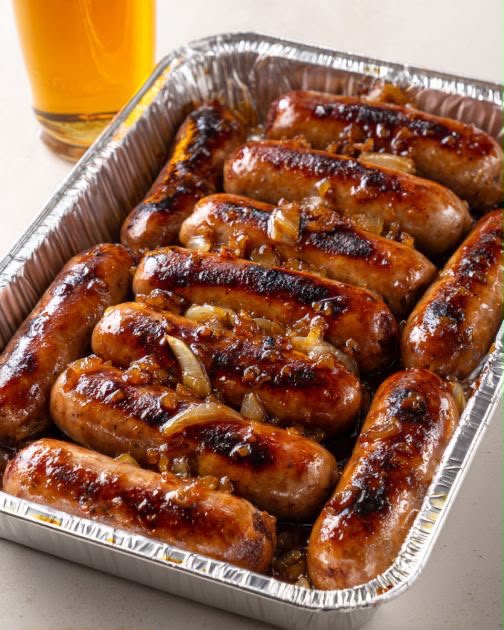
Beer brats done properly are grilled first and simmered second, and getting that order right is the whole recipe. Grilling gives the casings their char and snap, and the beer-and-onion bath afterward keeps them hot, juicy, and endlessly servable.
This is how it is done at tailgates across Wisconsin, in a disposable foil pan set on the cool side of the grill. Brats can sit in that pan for an hour without drying out, which is exactly what you want when people are eating in waves.
Boil them first, the way many recipes suggest, and you wash flavour into the pot and end up with pale, split casings. Grill first and the brats keep everything.
Why You Will Love This Recipe
The hot tub method solves timing. Brats hold in the beer bath for up to an hour without overcooking, so you are not cooking to order for a crowd.
Charred outside, juicy inside. Direct heat for colour, gentle simmer for moisture. You get both instead of choosing.
The onions become the topping. They cook down in beer and bratwurst fat while everything else happens, and go straight onto the buns.
One disposable pan. Set it on the grill, serve out of it, throw it away.
It scales endlessly. Two packages or six, the method is identical.
Recipe Overview
Prep time: 10 minutes Grill time: 12 to 15 minutes Simmer time: 20 minutes minimum, up to 1 hour Total time: About 45 minutes Yield: 10 brats Difficulty: Easy Best for: Tailgating, game day, cookouts, backyard parties, Fourth of July
Ingredients
10 fresh uncooked bratwurst
2 large yellow onions, sliced into half moons
4 tablespoons unsalted butter
24 ounces (2 bottles) beer, lager or pilsner
1 teaspoon coarsely ground black pepper
1/2 teaspoon caraway seeds, optional
10 brat buns or hoagie rolls
For Serving
Stone-ground or spicy brown mustard Sauerkraut Sliced pickles Sport peppers
Choosing the Right Beer
A German-style lager or pilsner is the traditional and the safest choice. Clean, malty, and mild enough to season the brats without dominating them.
Wisconsin-style American lagers work exactly as intended. This is the beer the dish was built around, and there is no reason to spend more.
Amber ales and Oktoberfest beers add pleasant malty depth if you want a slightly richer bath.
Avoid IPAs and heavily hopped beers. Hop bitterness concentrates as the liquid reduces and turns genuinely unpleasant. This is the one beer choice that can ruin the dish.
Avoid stouts and porters unless you want a very dark, roasted flavour and a murky-looking pan.
Non-alcoholic beer works well, since the flavour compounds are still there. Chicken broth with a tablespoon of cider vinegar is a reasonable substitute if you would rather skip beer entirely.
Why You Grill First, Not Last
The order is the single most argued-about detail in beer brats, and the answer is clear once you understand what each step does.
Grilling first sets the casing. Direct heat browns and tightens the natural casing, creating the snap that defines a good bratwurst. That reaction cannot happen in liquid.
Simmering first waterlogs the casing. A brat that has sat in liquid before grilling has a soft, saturated skin that tends to split when it meets high heat, releasing fat and juice.
Simmering second is a holding step. Once the brats are cooked and coloured, the beer bath keeps them at serving temperature, infuses them slowly, and prevents them drying out.
The flavour direction also matters. Grilled fat and browned bits drip into the beer, so the bath gets richer over time and those onions end up tasting of bratwurst.
How to Make Wisconsin Beer Brats
Step 1: Set up the grill for two zones
Light one side of the grill to medium-high and leave the other side off or on low. You need direct heat for the brats and a cool zone for the pan.
On a charcoal grill, bank the coals to one side.
Step 2: Start the onions
Put the butter, sliced onions, black pepper, and caraway seeds if using into a disposable foil pan. Set it over the direct heat for about 8 minutes, stirring occasionally, until the onions soften and take on some colour.
Step 3: Add the beer
Pour in the beer, then move the pan to the cool side of the grill. Let it come to a bare simmer while you grill the brats.
The liquid should just cover the base of the pan. If it looks shallow with your pan size, add more beer.
Step 4: Grill the brats
Place the brats over direct heat and grill for 12 to 15 minutes, turning every 3 to 4 minutes, until they are browned on all sides.
Do not pierce the casings. Every hole releases fat and juice into the fire and dries out the brat.
Keep the heat at medium-high, not high. Fresh bratwurst has a high fat content, and flare-ups will blacken the casings before the inside is done.
Step 5: Check the temperature
Bratwurst is fully cooked at an internal temperature of 160°F. Check the thickest one with an instant-read thermometer.
Step 6: Move them into the bath
Transfer the grilled brats into the pan of beer and onions, turning them once to coat.
Step 7: Hold and serve
Keep the pan on the cool side of the grill at a gentle simmer, never a boil. The brats will hold happily for 20 minutes to an hour, getting better as the liquid reduces.
If the beer reduces too far, add a splash more. If you want the onions jammier, move the pan closer to the heat for the last 10 minutes.
Step 8: Build the buns
Serve each brat in a bun with a generous spoonful of the beer onions, mustard, and whatever else is on the table.
Tips for the Best Beer Brats
Buy fresh, uncooked bratwurst. Pre-cooked brats will not benefit from this method and can turn mealy in the bath. Look for them in the refrigerated case, not the hot dog section.
Never boil the beer. A hard boil toughens the casings and drives off the beer flavour. You want the barest simmer.
Use a sturdy foil pan or a cast iron skillet. Thin foil pans buckle when full and hot, which is how people spill a pan of beer onto their coals.
Toast the buns cut-side down for 30 seconds over the direct heat. It takes almost no time and stops the bun going soggy.
Do not pierce, cut, or roll the brats aggressively. Casings are the container holding all the juice.
Easy Variations
Stovetop version. Brown the brats in a skillet over medium-high heat, then simmer in the beer and onions in the same pan for 20 minutes.
Oven version. Broil the brats on a sheet pan for 10 to 12 minutes, turning once, then transfer to a baking dish with the beer and onions and hold at 300°F.
Spicy. Add sliced jalapeños and a teaspoon of red pepper flakes to the onions.
Sweet and tangy. Add 2 tablespoons of brown sugar and 1 tablespoon of cider vinegar to the beer bath.
Sheboygan style. Serve on a hard roll with butter, mustard, onions, and pickles, and skip the sauerkraut.
With sauerkraut in the pan. Add 2 cups of drained sauerkraut to the beer bath in the last 15 minutes.
What to Serve With Them
German potato salad is the traditional partner, served warm with bacon and vinegar rather than mayonnaise.
Beer cheese soup, soft pretzels with mustard, and coleslaw round out a Wisconsin-themed spread.
For a cookout, grilled corn, baked beans, chips, and a cold cucumber salad all work.
Leftover brats slice well into scrambled eggs, pasta, or a skillet with peppers and potatoes.
Make-Ahead and Storage
Make-ahead: Slice the onions a day ahead. You can also grill the brats a few hours in advance, refrigerate them, and reheat in the beer bath before serving.
Refrigerator: Store brats in their beer and onions in an airtight container for up to 4 days. Keeping them in the liquid is what stops them drying out.
Freezer: Freeze cooked brats with some of the liquid for up to 3 months.
To reheat: Simmer gently in the beer and onions until heated through, or warm covered at 325°F for 15 minutes. Avoid the microwave, which makes the casings rubbery.
Frequently Asked Questions
Should I boil brats before grilling? No. Grill first, then hold in the simmering beer. Boiling first leaches flavour and softens the casing so it splits on the grill.
Can I make these without a grill? Yes. Brown them in a heavy skillet over medium-high heat, then simmer in beer and onions in the same pan.
What beer is best? A lager or pilsner. Avoid IPAs, since hop bitterness intensifies as the liquid reduces.
How long can brats sit in the beer bath? Up to about an hour at a bare simmer. Past that the casings begin to soften noticeably.
Do I have to use beer? No. Chicken broth with a splash of cider vinegar, or non-alcoholic beer, both work well.
Can I do this in a slow cooker? Yes, and it is a good option for a party. Grill the brats, then hold them in the beer and onions on low for up to 4 hours.
Why did my brats split? Heat too high, or the casings were pierced or pre-boiled. Medium-high heat and unpunctured casings prevent it.
Nutrition Information
Approximate values per brat with bun and onions, based on 10 servings:
Calories: 460 Total fat: 29 g Saturated fat: 11 g Carbohydrates: 28 g Protein: 18 g Sodium: 980 mg
Nutrition is estimated and will vary with brands and portion sizes.
Final Thoughts
Wisconsin beer brats are less a recipe than a sequence: char first, simmer second, and let the onions cook down in the fat and beer while you deal with everything else at the party.
Get the order right and the brats hold for an hour without suffering. That, more than any ingredient, is why this method has lasted.