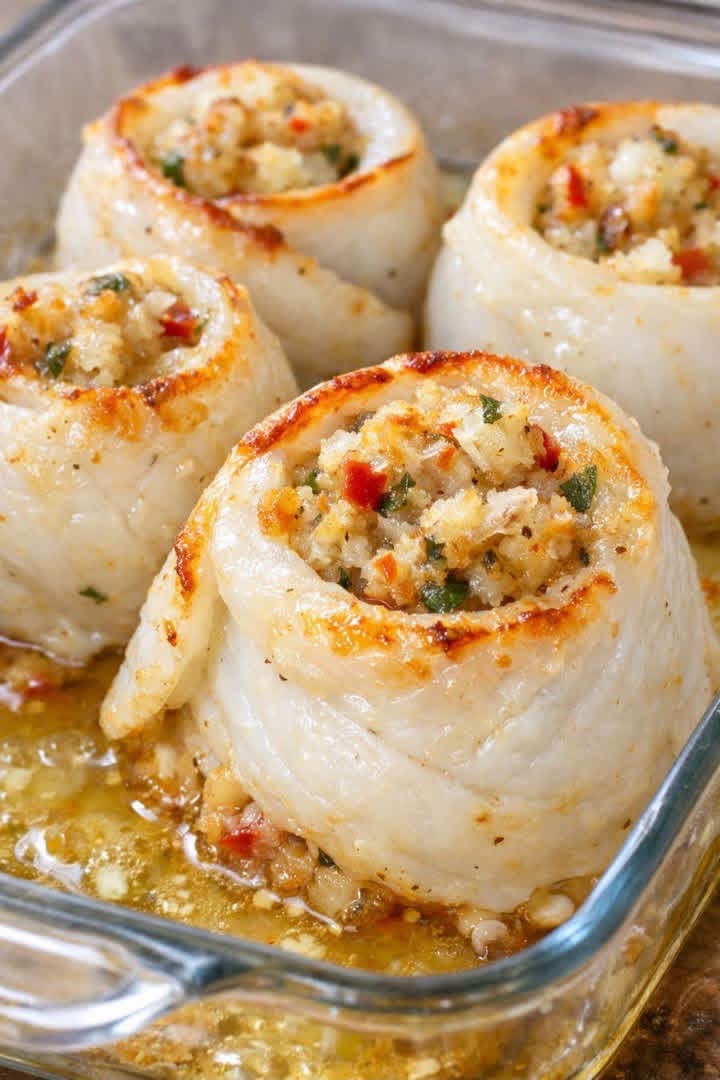
Thin white fish fillets rolled around a crab and panko stuffing, stood upright in a dish, and baked in garlic butter until the tops turn golden. They look like something plated in a restaurant and take about twenty minutes to put together.
Standing the rolls upright rather than laying them flat is what produces the shape in the photo. The exposed stuffing browns while the fish stays pale and moist around it, and the butter pools underneath and bastes the base.
Flounder and sole are the right fish because they are thin enough to roll without cracking. Anything thicker fights you.
Why You Will Love This Recipe
It looks far harder than it is. Spread, roll, stand up, bake. There is no technique here beyond rolling.
Twenty minutes of hands-on work. Most of the time is the fish sitting in the oven.
The stuffing does the heavy lifting. Crab, Old Bay, and lemon give the mild fish everything it lacks on its own.
Naturally low-carb apart from the panko. Swap in crushed pork rinds or almond flour and it fits a low-carb menu.
It scales cleanly for a dinner party. Assemble in the morning, refrigerate, and bake when guests arrive.
Recipe Overview
Prep time: 20 minutes Bake time: 22 to 25 minutes Total time: About 45 minutes Yield: 6 rolls, 6 servings Difficulty: Easy to moderate Best for: Dinner parties, holidays, date night, elegant weeknight meals
Ingredients
For the Fish
• 6 flounder or sole fillets, about 5 ounces (140 g) each • 1/2 teaspoon kosher salt • 1/4 teaspoon white or black pepper
For the Crab Stuffing
• 8 ounces (225 g) lump crab meat, drained and picked over
• 3/4 cup (45 g) panko breadcrumbs
• 1/4 cup (55 g) mayonnaise
• 1 large egg yolk
• 2 tablespoons finely diced red bell pepper
• 2 tablespoons chopped fresh parsley
• 2 cloves garlic, minced
• 1 teaspoon Old Bay seasoning
• 1 teaspoon Dijon mustard
• 1 tablespoon fresh lemon juice
• 1/4 teaspoon black pepper
For the Garlic Butter
• 6 tablespoons unsalted butter, melted
• 4 cloves garlic, finely minced
• 2 tablespoons fresh lemon juice
• 1/2 teaspoon sweet paprika
• 1 tablespoon chopped fresh parsley
• 1/4 teaspoon kosher salt
For Serving
• Lemon wedges
• Extra chopped parsley
Choosing the Right Fish
Flounder is the standard choice. The fillets are thin, wide, and flexible, which is exactly what rolling requires.
Sole works identically and is often easier to find. Dover sole, lemon sole, and grey sole all behave the same way in this recipe.
Tilapia is the budget option. It is slightly thicker and firmer, so roll it a little more gently and expect a marginally denser result.
Plaice and petrale sole both roll beautifully if you can get them.
Avoid cod, halibut, and salmon. They are too thick to roll without splitting and will need cutting or butterflying first, which defeats the purpose.
Fresh or properly thawed frozen both work. If using frozen, thaw overnight in the refrigerator and pat the fillets very dry, since excess water dilutes the butter into a thin, watery sauce.
Why the Stuffing Needs a Binder
The egg yolk and mayonnaise are not there for richness alone. They are what holds the stuffing together once it is packed into a roll.
Without a binder, the stuffing crumbles when you cut the roll, and half of it falls into the dish during baking. The yolk sets in the oven and locks everything in place.
Panko does the opposite job. It absorbs the moisture released by the crab and the butter, which keeps the stuffing from turning soupy.
The ratio matters more than the exact ingredients. Aim for a mixture that holds its shape when squeezed in your hand but is not stiff or dry.
If your crab was very wet, add panko a tablespoon at a time. If the mixture crumbles apart, add mayonnaise a teaspoon at a time.
How to Make Crab-Stuffed Flounder Rolls
Step 1: Prepare the dish and oven
Preheat the oven to 375°F (190°C). Choose a baking dish just large enough to hold six rolls standing upright with light contact between them.
The rolls need to lean on each other slightly. A dish that is too large lets them unroll and fall open during baking.
Step 2: Dry and season the fillets
Pat each fillet completely dry with paper towels on both sides. Season lightly with salt and pepper.
Drying the fish is the difference between a butter sauce and a thin puddle of liquid.
Step 3: Make the stuffing
In a bowl, combine the panko, mayonnaise, egg yolk, bell pepper, parsley, garlic, Old Bay, Dijon, lemon juice, and black pepper. Stir until evenly mixed.
Add the crab meat and fold gently, just until combined. Do not stir vigorously, or you will break down the lumps.
Step 4: Fill and roll
Lay a fillet flat with the narrower tail end toward you. Spread roughly 3 tablespoons of stuffing across the wider half, leaving about half an inch clear at the edges.
Roll from the wider end toward the tail, snugly but without squeezing. Stuffing pressed out of the sides means you rolled too tightly.
Step 5: Stand them upright
Place each roll seam side down and standing on end in the baking dish, so the spiral faces up.
Pack them close enough to support one another. If you have a gap, wedge a small ramekin or a ball of foil at the end.
Step 6: Make the garlic butter
Whisk together the melted butter, minced garlic, lemon juice, paprika, parsley, and salt.
Step 7: Pour and bake
Spoon the garlic butter over the tops of the rolls, letting it run down the sides and pool at the base.
Bake uncovered for 22 to 25 minutes, until the fish is opaque and flakes easily, and the internal temperature reaches 145°F.
Step 8: Brown the tops
For the golden tops in the photo, switch to the broiler for the final 2 to 3 minutes and watch continuously. Panko goes from gold to burnt in seconds.
Step 9: Rest and serve
Let the dish sit for 5 minutes. Lift each roll out with a large spoon rather than a spatula, spoon the pan butter over the top, and serve with lemon wedges.
Tips for the Best Stuffed Fish Rolls
Choose the dish size before you roll. It determines whether the rolls stay upright, and it is much easier to check with an empty dish than with six rolls in your hands.
Do not overfill. Three tablespoons per fillet is generous. More stuffing means the roll will not close and will burst open in the oven.
Secure loose rolls with a toothpick if a fillet is unusually slippery or short. Remove them before serving and count them out.
Use a thermometer. Thin fish overcooks fast, and the visual cue is unreliable once the stuffing is in the way. 145°F is the target.
Spoon the pan butter over each portion. It is half the dish, and leaving it in the pan is a waste.
Easy Variations
• Shrimp stuffing. Replace the crab with 8 ounces of raw shrimp, chopped small. Bake for the same time. • Spinach and feta. Use 1 cup of squeezed-dry cooked spinach, 1/2 cup of crumbled feta, and skip the crab and Old Bay. • Lemon and dill. Swap the Old Bay for 2 teaspoons of fresh dill and add the zest of one lemon to the stuffing. • Cheesy. Add 1/3 cup of grated Parmesan to the stuffing and another tablespoon over the tops before broiling. • Spicy. Add 1/2 teaspoon of cayenne and a tablespoon of diced jalapeño to the stuffing. • Low-carb. Replace the panko with crushed pork rinds or 1/2 cup of almond flour.
What to Serve With Them
Rice pilaf or lemon rice soaks up the garlic butter better than anything else on the table.
Roasted asparagus, green beans with almonds, or sautéed spinach keep the plate light and let the fish stay the centerpiece.
Creamy mashed potatoes or a potato gratin turn it into a richer, more formal dinner.
Crusty bread is worth having on the table purely for the butter left in the dish.
Make-Ahead and Storage
Make-ahead: Assemble the rolls completely, cover the dish, and refrigerate for up to 8 hours. Add the garlic butter and 5 minutes to the bake time when you are ready.
You can also make the stuffing up to 2 days ahead and keep it refrigerated separately.
Refrigerator: Store leftovers in an airtight container for up to 2 days. Fish declines quickly after that.
Freezer: Freeze assembled unbaked rolls, tightly wrapped, for up to 2 months. Thaw overnight in the refrigerator before baking. Baked rolls do not freeze well, since the fish turns watery.
To reheat: Cover with foil and warm at 300°F for 12 to 15 minutes with a spoonful of butter or broth added. The microwave makes the fish rubbery.
Frequently Asked Questions
Can I use frozen fish? Yes. Thaw it fully overnight in the refrigerator and pat it very dry. Cooking from frozen releases too much water into the dish.
Can I use imitation crab? You can, and it holds together well, but the flavour is noticeably sweeter and milder. Reduce the Old Bay slightly if you do.
Why did my rolls fall apart? Usually overfilling, or a baking dish that gave the rolls too much room. Pack them closely and use toothpicks if needed.
How do I know when the fish is done? The flesh turns opaque white and flakes with light pressure, and the center reads 145°F on a thermometer.
Can I make this in an air fryer? Yes. Cook at 360°F for 12 to 14 minutes in a small pan that fits the basket, checking the temperature at 12 minutes.
Is there a lot of liquid in the dish afterwards? Some is normal and it is mostly butter and fish juices. If it looks thin and watery, the fillets were not dried thoroughly enough before rolling.
Nutrition Information
Approximate values per roll, based on 6 servings:
• Calories: 385 • Total fat: 24 g • Saturated fat: 10 g • Carbohydrates: 8 g • Protein: 34 g • Sodium: 720 mg
Nutrition is estimated and will vary with brands and portion sizes.
Final Thoughts
Crab-Stuffed Flounder Rolls are the rare dinner-party dish where the presentation costs nothing extra. Standing the rolls upright takes the same effort as laying them flat and looks three times better.
Dry the fish, do not overfill, and spoon the garlic butter over every plate. The rest takes care of itself in the oven.