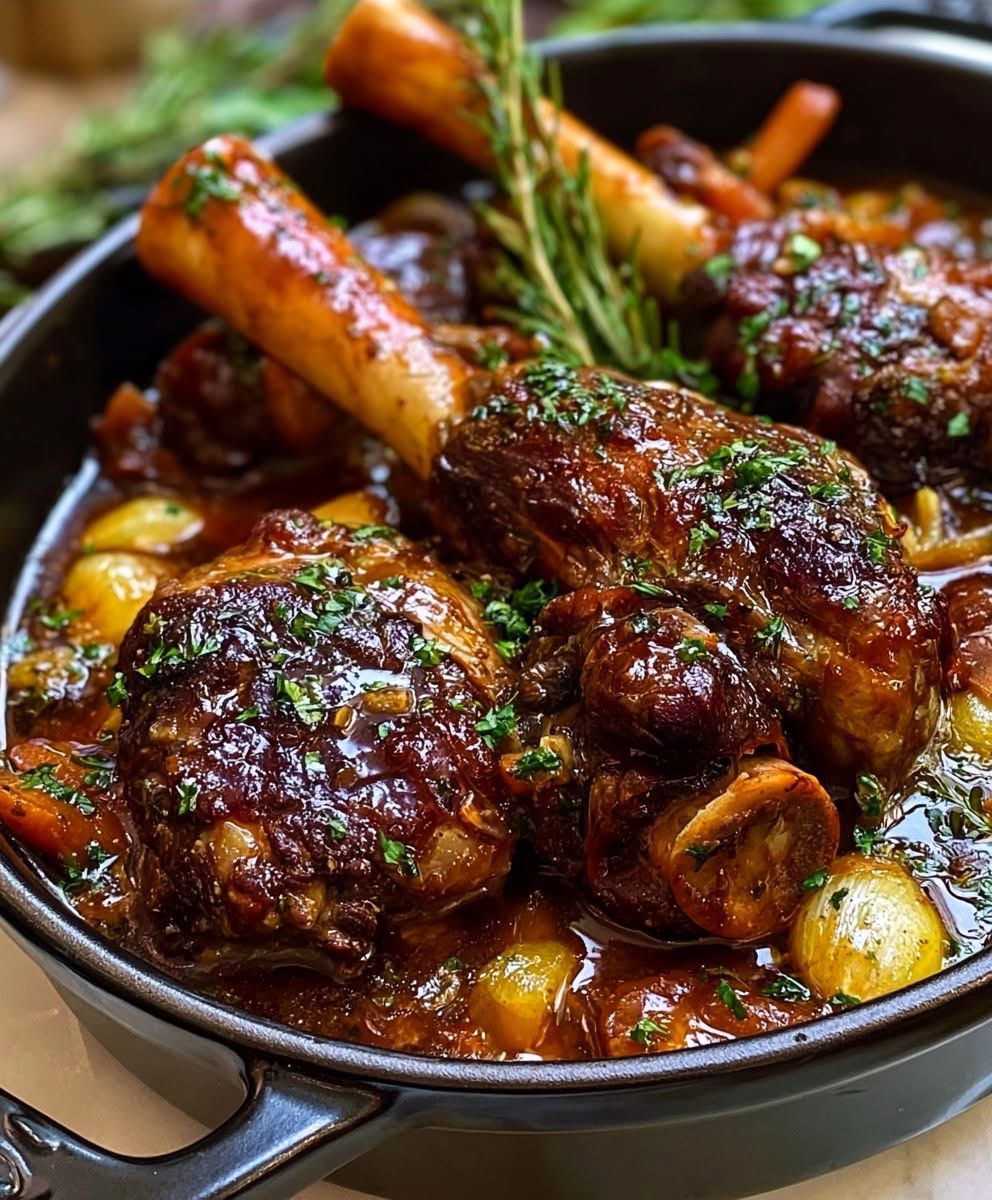
Fall-Off-The-Bone Lamb Shanks Braised in Rich Herb and Garlic Gravy
This comprehensive, definitive guide provides everything needed to master the art of slow-braised lamb shanks. This document covers the history, preparation methods, scientific composition, nutrition, health benefits, and serving styles of this classic comfort dish.
1. Introduction to the Dish
Few culinary creations evoke the deep, comforting satisfaction of a slow-braised lamb shank. The lamb shank is a tough, connective-tissue-heavy cut of meat from the lower leg of the animal. When exposed to low, slow heat in a rich bath of aromatic herbs, garlic, and savory liquids, it undergoes a transformation. The result is a piece of meat so tender it pulls away from the bone with a spoon, swimming in a thick gravy that carries the concentrated essence of rosemary, thyme, and roasted garlic.
Braising bridges the gap between humble, tough cuts of meat and high-end gastronomy. This dish celebrates patience. It cannot be rushed, as the conversion of collagen into gelatin requires time and sustained, gentle thermal energy. The following compendium covers the history, science, nutrition, preparation methods, variations, and cultural impact of this universally adored dish.
2. Cultural and Historical Evolution of Braising and Lamb
To truly appreciate the braised lamb shank, one must examine its deep historical and culinary roots.
The Origin of Braising
The term braising originates from the French word braiser, which traces back to braise (burning embers). Historically, a braising pot (a daubière) was nestled directly into hot coals, with more glowing embers placed on the recessed lid. This dual-directional heat source created a gentle, sealed oven environment, maximizing moisture retention and heat distribution over long stretches of cooking.
Before the invention of modern temperature-controlled ranges, braising was an essential survival strategy. Tough, lean, or working muscle cuts from older livestock were impossible to quick-fry or roast over open flames without turning into leather. By submerging these pieces in water, wine, or verjuice alongside wild roots and herbs, ancient cooks discovered they could render any cut tender, flavorful, and safe to eat.
Lamb Shanks Across Global Civilizations
The lamb shank holds a place of honor across diverse cultures, each utilizing regional aromatics to balance the rich, gamey profiles of the meat.
- The Levant and Middle East: In Persian, Turkish, and Arab culinary traditions, slow-cooked lamb is a centerpiece of hospitality. Dishes like Persian Mahcheh feature lamb shanks slow-simmered with turmeric, saffron, dried lime (limoo amani), and cinnamon. This creates a sweet, sour, and intensely fragrant gravy served alongside dill or fava bean rice.
- The Mediterranean: Across Greece and Italy, shanks are braised with red wine, ripe tomatoes, wild oregano, and lemon peel. Greek Arni Kleftiko (historically cooked in sealed underground pits by bandits) and Italian Stinco d’Agnello highlight how regional wines and tomatoes cut through the unctuous profile of the marrow and fat.
- The British Isles and Northern Europe: In colder climates, the lamb shank became the backbone of rustic pub fare. Simmered in dark stouts, root vegetable broths, and local rosemary, these shanks yielded thick, malty gravies designed to sustain laborers through harsh winters.
3. The Science of the “Fall-Off-The-Bone” Phenomenon
The transformation of a rigid lamb shank into an ultra-tender masterpiece relies on fundamental meat science.
Structural Anatomy of the Shank
The shank is the lower section of the lamb’s leg, extending from the knee or elbow joint to the ankle. Because these muscles constantly support the animal’s weight and facilitate movement, they contain thick sheets of connective tissue, specifically collagen.
Collagen is a rigid, triple-helix protein matrix that binds muscle fibers together. If you grill or pan-sear a lamb shank over high heat, these collagen fibers rapidly contract, squeezing out moisture and turning the meat tightly knotted and virtually unchewable.
The Thermal Breakdown of Collagen
To achieve a fall-off-the-bone texture, you must disrupt this triple-helix structure through a combination of heat, moisture, and time:
- Denaturation (60°C–65°C / 140°F–149°F): Tight collagen strands begin to unwind and lose their structural integrity.
- Gelatin Conversion (70°C–85°C / 158°F–185°F): The tightly wound collagen strands melt down completely into gelatin.
Gelatin is a water-soluble, highly gelatinous protein that can hold up to ten times its weight in water. As gelatin melts throughout the braising liquid, it coats the individual muscle fibers. This coats the meat in a rich, velvety texture, creating a sensation of extreme tenderness even if the meat fibers themselves have technically lost their internal water content.
Why Liquid is Vital
A dry oven cannot dissolve collagen efficiently. The water molecules in a braising liquid act as thermal conductors, breaking down the chemical bonds within the connective tissues. This is why a tightly sealed heavy pot, such as an enameled cast-iron Dutch oven, is essential. It prevents steam from escaping, ensuring the cooking environment remains saturated with moisture.
4. Comprehensive Nutritional Profile
Lamb shanks are highly nutritious, providing an abundance of bioavailable macro- and micronutrients.
Macronutrient Distribution (Per 100g Cooked Meat)
- Calories: ~210–240 kcal
- Protein: 28g–30g (High biological value, containing all 9 essential amino acids)
- Total Fat: 10g–13g
- Saturated Fat: 4.5g
- Monounsaturated Fat: 4.2g (Predominantly oleic acid, the heart-healthy fat found in olive oil)
- Polyunsaturated Fat: 0.8g
- Carbohydrates: 0g
Micronutrient Density and Health Benefits
+-----------------------------------+-----------------------------------+

| Micronutrient                     | Physiological Benefit             |
+-----------------------------------+-----------------------------------+

| Vitamin B12                       | Crucial for red blood cell        |
|                                   | synthesis and neurological health |
+-----------------------------------+-----------------------------------+

| Zinc                              | Optimizes immune function, DNA    |
|                                   | repair, and cellular metabolism   |
+-----------------------------------+-----------------------------------+

| Heme Iron                         | Highly bioavailable iron form,    |
|                                   | combating fatigue and anemia      |
+-----------------------------------+-----------------------------------+

| Selenium                          | Potent antioxidant that protects  |
|                                   | cells from oxidative stress       |
+-----------------------------------+-----------------------------------+

| Conjugated Linoleic Acid (CLA)    | Fatty acid linked to fat loss and |
|                                   | anti-inflammatory mechanisms      |
+-----------------------------------+-----------------------------------+
5. Ingredients and Structural Breakdown
Every component in this recipe serves a functional purpose, contributing to the balance of flavor, acidity, and body in the finished gravy.
The Meat
- 4 Large Hindquarter Lamb Shanks (approx. 400g–500g each): Hindquarter shanks are meatier and more uniform than forequarter shanks, ensuring even cooking and an elegant presentation.
The Searing & Fat Foundation
- 3 tbsp Extra Virgin Olive Oil or Ghee: Provides a high smoke point for browning while contributing rich fat to the base.
The Aromatic Base (Mirepoix / Holy Trinity)
- 1 Large Yellow Onion (finely diced): Provides sweetness through caramelization.
- 2 Large Carrots (finely diced): Delivers natural sugars to balance the acidity of tomatoes and wine.
- 2 Ribs of Celery (finely diced): Adds a clean, savory depth and natural mineral salts.
The Garlic & Herb Powerhouse
- 2 Whole Heads of Garlic:
- 1 Head: Peeled and finely minced to cook into the aromatic base.
- 1 Head: Sliced horizontally across the equator to roasted directly in the braising liquid.
- 4 Sprigs of Fresh Rosemary: Rich in camphoraceous oils that pair beautifully with lamb.
- 6 Sprigs of Fresh Thyme: Adds a subtle earthy flavor.
- 2 Fresh Bay Leaves: Provides an herbal, woodsy undertone that cuts through heavy fats.
The Liquid & Acid Balance
- 2 tbsp Tomato Paste: Double-concentrated paste creates a savory umami base and darkens the gravy.
- 750ml (1 Full Bottle) Dry Red Wine: Varieties like Cabernet Sauvignon, Syrah, or Chianti work best. The tannins and acidity break down meat proteins and cut through the rich fat.
- 500ml Quality Beef Bone Broth or Lamb Stock: Rich in natural gelatin, this forms the structural backbone of the gravy.
- 1 tbsp Worcestershire Sauce: Adds a fermented splash of umami, salt, and complex acidity.
6. Comprehensive Kitchen Methods and Variations
While the oven method is the gold standard for creating a rich gravy, other kitchen appliances can be adapted to fit different schedules.
1. The Dutch Oven Method (Traditional Oven Braise)
- Pros: Even heat distribution, excellent surface browning, and superior liquid reduction.
- Cons: Requires 3 to 4 hours of active home monitoring.
- Mechanics: Uses a heavy-bottomed, tight-fitting cast-iron pot shifted into a static oven ambient environment.
2. The Slow Cooker (Crock-Pot) Method
- Pros: Set-and-forget convenience; highly safe for unattended cooking.
- Cons: Zero liquid evaporation occurs, meaning the gravy can turn out thin and watery unless it is reduced in a separate saucepan before serving.
- Adjustment: Sear the meat and sauté the aromatics in a skillet first. Transfer everything to the slow cooker and cook on Low for 8 hours or High for 5 hours. Use 30% less broth to compensate for the lack of evaporation.
3. The Pressure Cooker (Instant Pot) Method
- Pros: Cuts cooking time down by nearly 70%.
- Cons: Tends to extract less gelatin from the bone, resulting in a slightly lighter mouthfeel.
- Adjustment: Use the “Sauté” function for browning the meat and aromatics. Seal and cook under High Pressure for 45 minutes, followed by a 20-minute natural pressure release. Simmer the remaining liquid on “Sauté” to thicken the gravy.
7. Step-by-Step Cooking Instructions
Follow these instructions exactly to ensure your lamb shanks turn out perfectly tender with a rich, glossy gravy.
Phase 1: Preparation and Searing (The Maillard Reaction)
- Tempering the Meat: Remove the lamb shanks from the refrigerator 45 minutes before cooking. Bringing the meat to room temperature ensures even cooking and prevents the pan temperature from dropping when searing.
- Drying and Seasoning: Thoroughly pat each shank dry with paper towels. Moisture is the enemy of a good sear, as it creates steam. Season generously on all sides with coarse sea salt and freshly cracked black pepper.
- The Sear: Heat 3 tablespoons of olive oil or ghee in a large Dutch oven over medium-high heat. Once the oil shimmering, add the shanks. Do not crowd the pan; sear in batches if necessary. Leave them undisturbed for 3–4 minutes per side until a deep, mahogany crust forms. Remove the shanks and set them aside on a plate.
Phase 2: Building the Aromatic Base
- Sautéing the Mirepoix: Turn the heat down to medium. Add the diced onion, carrots, and celery directly into the rendered lamb fat. Cook for 6–8 minutes, stirring frequently, until the vegetables soften and the onions turn translucent.
- Integrating Aromatics: Add the minced garlic and tomato paste. Stir constantly for 2 minutes, coating the vegetables. The tomato paste should turn from a bright red to a rusty brick color, caramelizing its natural sugars.
Phase 3: Deglazing and Submerging
- Deglazing: Pour in the entire bottle of red wine, using a wooden spoon to vigorously scrape up the browned bits (fond) stuck to the bottom of the pot. These bits are packed with concentrated umami.
- Reducing: Bring the wine to a rolling boil and let it cook down by half, about 8–10 minutes. This burns off the harsh alcohol taste, leaving behind a rich, fruity acidity.
- Constructing the Braise: Pour in the bone broth and Worcestershire sauce. Nestled the seared lamb shanks back into the liquid, along with any resting juices from the plate. Tuck the rosemary sprigs, thyme, bay leaves, and the halved head of garlic deep between the shanks. The liquid should cover about two-thirds of the meat.
Phase 4: The Slow Braise
- Oven Transfer: Preheat your oven to 150°C (300°F). Bring the liquid in the Dutch oven to a gentle simmer on the stovetop.
- Sealing: Cover the pot with a layer of aluminum foil, pressing down slightly, then firmly secure the heavy lid on top. This double-seal keeps the steam locked inside.
- The Long Cook: Place the pot in the oven and bake undisturbed for 3 to 3.5 hours. At the 2.5-hour mark, gently turn the shanks over. The shanks are done when the meat pulls away effortlessly from the bone at the slightest touch of a fork.
Phase 5: Finishing the Gravy
- Separation: Carefully transfer the tender lamb shanks to a warm serving platter and tent them loosely with foil to keep them moist.
- Straining (Optional for a Silky Finish): Strain the remaining braising liquid through a fine-mesh sieve into a saucepan, pressing down on the soft vegetables to extract their juices. Discard the solids and spent herb stems. Alternatively, leave the rustic vegetables in the sauce for a heartier texture.
- Reduction: Skim any excess fat off the top of the liquid. Bring the sauce to a simmer over medium heat for 10–15 minutes until it reduces into a glossy, velvety gravy that coats the back of a spoon. Season with an extra pinch of salt, pepper, or a dash of fresh lemon juice if needed.
8. The Ultimate Pairings for Lamb Shank Enthusiasts
A dish this rich demands side dishes that can absorb the deep gravy while balancing its unctuous texture.
The Foundations (Carbohydrates)
- Robuchon-Style Mashed Potatoes: Prepared with a high butter-to-potato ratio and passed through a ricer, these potatoes create a smooth, buttery canvas for the rich gravy.
- Creamy Polenta: Soft cornmeal whipped with Parmesan cheese and mascarpone offers a smooth texture that pairs beautifully with the tender shredded lamb.
- Saffron Risotto (Risotto alla Milanese): The vibrant, floral notes of saffron cut through the gamey profile of the lamb, adding a bright touch to the plate.
Side Vegetables (Acidity and Crispness)
- Roasted Honey-Glazed Carrots and Parsnips: The caramelized sweetness of root vegetables highlights the natural sugars in the braising sauce.
- Blanched Broccolini or Asparagus: Tossed in fresh lemon juice and sea salt, these bright green greens provide a crisp, refreshing contrast to the rich meal.
9. Conclusion
Braised lamb shanks represent the height of slow-cooking comfort. By understanding the science of collagen breakdown and building layers of flavor with aromatics, wine, and herbs, you can transform a humble cut of meat into a spectacular restaurant-quality meal.
Whether you cook it in a traditional Dutch oven, a slow cooker, or a pressure cooker, this dish rewards patience with incredibly tender, fall-off-the-bone meat and a luxurious gravy. Bring your family and friends together around the table, pour a glass of red wine, and enjoy this timeless culinary classic.
If you would like to customize this recipe, let me know:
- Your preferred cooking appliance (e.g., Instant Pot, Slow Cooker, or traditional oven)
- Any dietary adjustments (e.g., alcohol-free or gluten-free adaptations)
- Ideas for seasonal side dishes to complete your menu