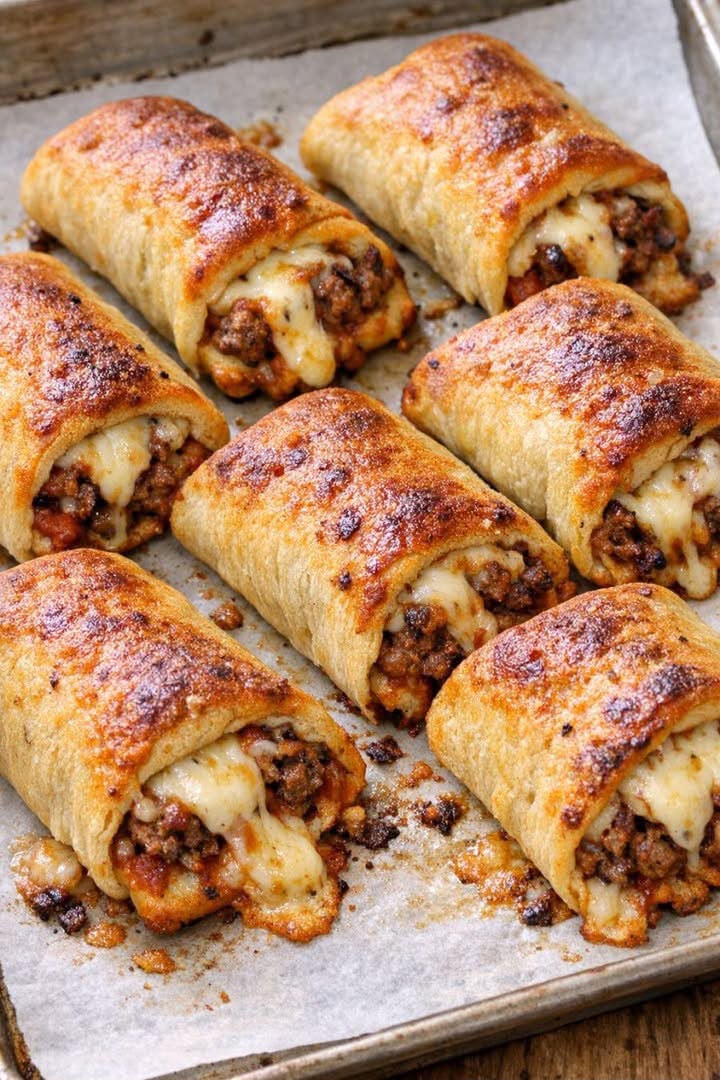
Seasoned ground beef and marinara rolled into crescent dough with melting mozzarella, baked until the outside is deep golden and the cheese runs at the seams. All the flavour of a meat-lover’s pizza in a handheld roll.
The technique that matters here is reducing the marinara before it goes anywhere near the dough. Jarred sauce carries a lot of water, and wrapped raw in pastry that water steams the dough from the inside instead of letting it crisp. Five minutes of simmering solves it completely.
Fifteen minutes of prep, twenty in the oven, and eight rolls off one tray.
Why You Will Love This Recipe
It uses one pound of beef for eight rolls. Inexpensive and it feeds four generously.
The sauce reduction takes five minutes. A quick simmer on the stove while the beef browns in the same pan.
They hold together properly. Thickened sauce and well-drained beef mean no soggy seams.
They reheat well. Unlike a lot of pastry dishes, these come back genuinely crisp the next day.
Kids and adults both eat them without complaint. Familiar pizza flavour in a form that needs no plate.
Recipe Overview
Prep time: 15 minutes
Cook time: 20 minutes
Total time: 35 minutes
Yield: 8 rolls, serving 4
Difficulty: Easy
Best for: Weeknight dinners, lunchboxes, game day, using up ground beef
Ingredients
For the filling
• 1 pound ground beef, 80/20
• ½ small onion, finely diced
• 2 cloves garlic, minced
• 1 teaspoon Italian seasoning
• ½ teaspoon salt
• ¼ teaspoon black pepper
• ¼ teaspoon red pepper flakes, optional
• ¾ cup marinara sauce
• 1½ cups low-moisture mozzarella, freshly grated
For assembly
• 2 tubes refrigerated crescent roll dough, 8 count each
• 1 egg, beaten with 1 tablespoon water
• 2 tablespoons grated parmesan
• 1 teaspoon dried oregano
For serving
• ½ cup warm marinara, for dipping
Choosing the Right Marinara
The sauce is the second most important ingredient here, right after the beef.
Thick, chunky jarred marinara. The best choice. Less water to reduce means a shorter simmer and a lower risk of a soggy roll.
Thin or watery marinara. Workable, but plan on simmering it longer, closer to eight minutes, until it visibly thickens.
Homemade marinara. Excellent if you have it, and usually thicker than jarred to begin with.
Pizza sauce. A good substitute and often thicker than marinara by design, since it is made for exactly this problem.
Vodka sauce or a cream-based sauce. Avoid here. The dairy content makes it harder to reduce properly and changes the flavour significantly.
Whatever you use, the test is simple: a spoonful dragged across the pan should leave a clear trail that does not immediately fill back in.
Why Reducing the Sauce and Draining the Beef Both Matter
Crescent dough is laminated: thin sheets separated by fat, and in the oven the fat melts while the water in the dough flashes to steam, forcing those sheets apart. That is the entire mechanism behind the flaky rise, and it depends on the dough drying and setting as it bakes.
Jarred marinara is largely water, held loosely by tomato solids. Spooned onto raw dough straight from the jar, that water has nowhere to go but into the pastry, and it soaks in exactly while the layers are trying to separate. What comes out of the oven looks golden on top and is pale and gummy on the inside. Simmering the sauce for five minutes drives off a good portion of that water, so what goes onto the dough is a sauce with actual body rather than a thin, loose liquid.
Ground beef adds its own moisture problem on top of that. At 80/20 it renders roughly a quarter cup of fat per pound, and if that fat goes onto the dough along with the meat, it works against the pastry from a second direction. Draining the beef in a colander after browning removes nearly all of it before assembly.
Together, a reduced sauce and drained beef mean the filling going onto the dough is concentrated in flavour and low in the moisture that would otherwise undermine the whole point of using crescent dough in the first place.
How to Make Pizza Beef Crescent Rolls
Step 1: Heat the oven
Preheat to 375°F and line a baking sheet with parchment.
Step 2: Brown the beef
Cook the ground beef and onion in a skillet over medium-high heat, breaking the meat into small crumbles, for 6 to 7 minutes until browned.
Step 3: Season and drain
Add the garlic, Italian seasoning, salt, pepper, and red pepper flakes and cook 1 minute. Drain the mixture in a colander.
Draining matters here as much as anywhere. Skip it and the filling weighs the dough down.
Step 4: Reduce the sauce
Return the drained beef to the pan, add the marinara, and simmer 5 minutes, stirring occasionally, until visibly thickened.
You want a sauce that clings to the meat rather than pools around it.
Step 5: Cool slightly
Remove from the heat and let the mixture cool for 5 to 10 minutes.
Hot filling melts the cold dough before it even reaches the oven, which makes rolling difficult and the finished crust denser.
Step 6: Separate the dough
Unroll both tubes of crescent dough and separate into 8 triangles total, discarding or using the extra pieces for a small additional roll.
Work quickly while the dough is cold.
Step 7: Fill and roll
Spoon a heaped tablespoon of the beef mixture onto the wide end of each triangle, top with a small handful of mozzarella, and roll up toward the point.
Keep the filling half an inch from the edges so the dough can seal against itself.
Step 8: Egg wash and season
Place the rolls seam side down on the tray, brush with egg wash, and sprinkle with parmesan and oregano.
Step 9: Bake and rest
Bake for 16 to 18 minutes, until deep golden. Rest 5 minutes, then serve with warm marinara for dipping.
Tips for the Best Pizza Beef Rolls
Do not overfill. A heaped tablespoon per roll. More than that and the seams fail to seal.
Keep the dough cold until you fill it. Warm dough tears and will not hold a tight roll.
Grate your own mozzarella. Pre-shredded cheese is coated in cellulose and melts less smoothly.
Space the rolls two inches apart. Crowded rolls steam each other and the sides stay pale.
Serve them hot. These are best in the first fifteen minutes off the tray.
Easy Variations
• Add mini pepperoni pieces alongside the beef
• Swap the ground beef for Italian sausage
• Add diced bell pepper and onion for a supreme-style filling
• Use pizza dough instead of crescent dough for a chewier result
• Add a few sliced black olives to the filling
• Finish with a drizzle of ranch or garlic butter after baking
What to Serve With It
Warm marinara for dipping is close to essential, and a simple green salad with Italian dressing balances the richness. Garlic knots alongside make it a full pizza-night spread.
For a party, cut each roll in half and serve with marinara and ranch side by side so people can choose.
Make-Ahead and Storage
Make ahead. Cook the filling up to 2 days in advance and keep refrigerated. Assemble and bake fresh.
Fridge. Store baked rolls in an airtight container for up to 3 days.
Freezer. Freeze assembled unbaked rolls on a tray, then bag them for up to 2 months. Bake from frozen at 375°F for 25 to 28 minutes.
Reheating. A 350°F oven for 8 to 10 minutes, or an air fryer at 350°F for 4 minutes. The microwave makes the pastry soft.
Frequently Asked Questions
Can I use pizza dough instead of crescent rolls?
Yes. Cut it into rectangles, fill, and roll up, then bake at 400°F for about 15 minutes.
Why did my rolls open in the oven?
The filling likely reached the edges, or the seam was not pressed firmly enough. Leave a half-inch border and press hard.
Can I use a different meat?
Italian sausage, ground turkey, or ground chicken all work with the same method.
Do I have to reduce the sauce?
It is the step that keeps the rolls from turning soggy. A thicker jarred sauce needs less time; a thin one needs more.
Can I make these vegetarian?
Yes. Substitute sautéed mushrooms and bell peppers for the beef, using the same seasoning and sauce reduction.
Can I air fry these?
Yes. Cook at 330°F for 10 to 12 minutes in a single layer, checking at eight.
Nutrition Information
• Calories: 315 per roll
• Protein: 15g
• Fat: 20g
• Carbohydrates: 19g
• Fiber: 1g
• Sodium: 620mg
Nutrition is estimated and will vary with portion size and brands used.
Final Thoughts
Two rules make these work. Reduce the marinara before it meets the dough, and drain the beef thoroughly after browning. Both address the same problem of excess moisture undermining the pastry, from two different directions.
The sauce-reduction principle applies to anything wrapped in dough with a wet filling. Pizza rolls, calzone-style hand pies, and stuffed breads all face it, and five extra minutes on the stove is almost always the difference between a crisp result and a soggy one.