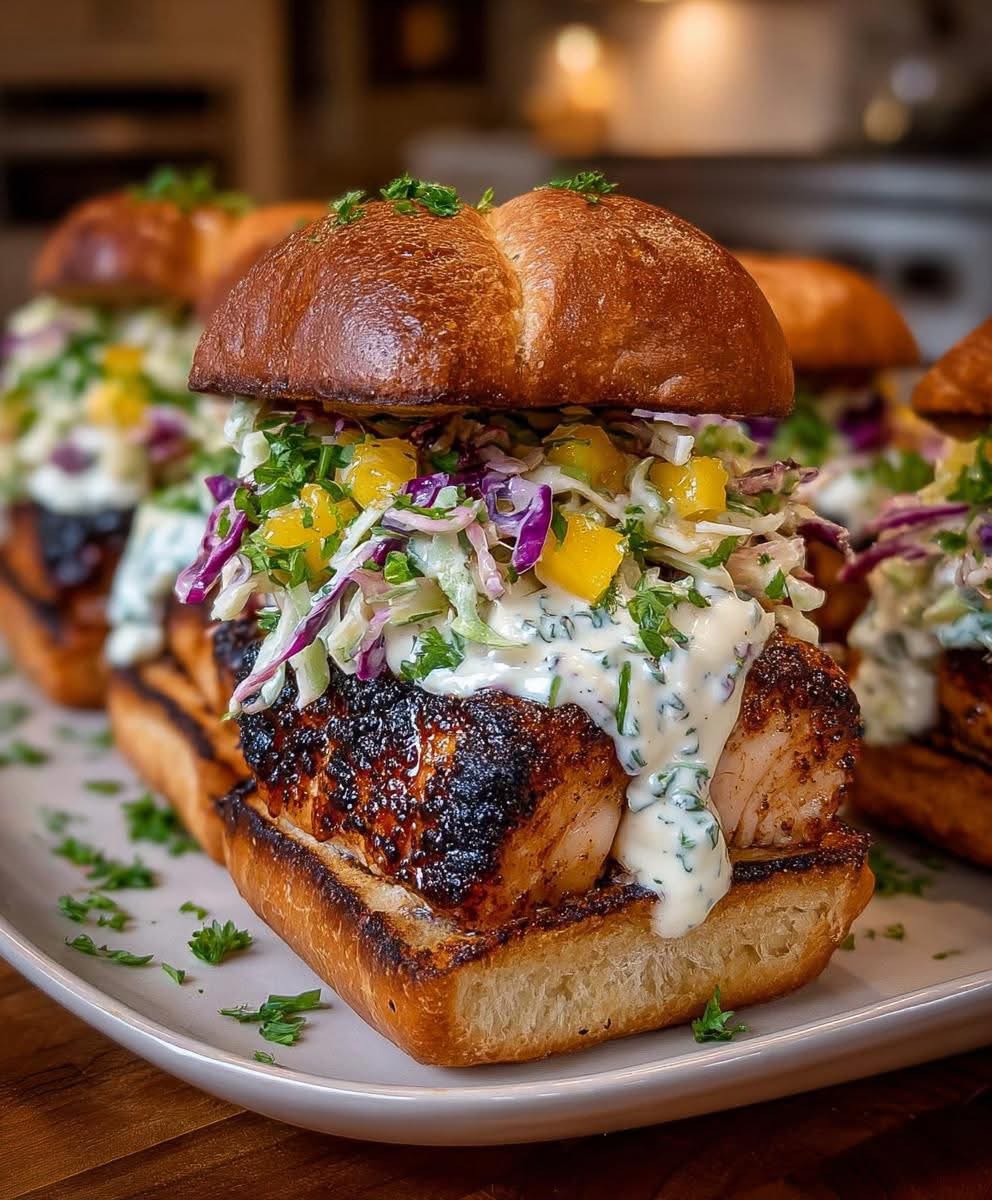
The Ultimate Guide to Sheet Pan Blackened Mahi-Mahi Sliders
Sheet Pan Blackened Mahi-Mahi Sliders with High-Protein Coconut-Lime Crema & Mango Slaw offer a perfect balance of bold Cajun spice, tropical sweetness, and rich, macro-friendly creaminess. This comprehensive guide covers everything from the historical evolution of blackening seafood to the structural science of building the perfect slider, complete with exact nutritional profiles, culinary methods, and health benefits.
1. Introduction & Culinary Concept
This recipe reimagines the traditional coastal fish sandwich into a high-protein, meal-prep-friendly slider. By utilizing a high-heat sheet pan roasting method, you achieve the charred crust characteristic of cast-iron blackening without filling your kitchen with smoke.
The dish functions on a contrast of temperatures, textures, and flavors:
- The Protein: Firm, lean Mahi-Mahi holds its shape perfectly and acts as a neutral canvas for robust spices.
- The Slaw: Crisp, acidic, and naturally sweet mango slaw cuts through the heat of the fish.
- The Crema: A high-protein Greek yogurt and coconut cream base provides a cooling, velvety finish.
- The Vessel: Soft, toasted brioche or Hawaiian sweet rolls compress slightly to absorb the dripping juices.
2. Historical Context & Culinary Evolution
The Origin of Blackening
The blackening technique is a hallmark of Louisiana Creole and Cajun cuisine, popularized in the late 1970s and early 1980s by legendary Chef Paul Prudhomme at his New Orleans restaurant, K-Paul’s Louisiana Kitchen.
Originally applied to redfish, the technique involves dipping a firm fish fillet in melted butter, dredging it in a heavy blend of paprika, cayenne, garlic, onion, and herbs, and searing it in an intensely hot cast-iron skillet. The milk solids in the butter and the sugars in the spices char instantly, creating a dark, deeply flavorful, and aromatic crust that seals in the fish’s natural moisture.
[Traditional Cast Iron Blackening] ──► Smoke & High Surface Contact
[Modern Sheet Pan Blackening]     ──► High-Heat Convection & Uniform Cooking
The Adaptation of Mahi-Mahi
As redfish faced overfishing in the 1980s, chefs looked for sustainable alternatives with similar structural integrity. Mahi-Mahi (Coryphaena hippurus), also known as dolphinfish, became the premier choice. Found globally in tropical and subtropical waters, its dense, large-flaked flesh adapts perfectly to robust seasoning blends without falling apart on the pan.
The Rise of the High-Protein Crema
Traditional Mexican and Southwestern cremas rely on heavy sour cream (crema agria) or mayonnaise. The modern fitness and functional nutrition movements drove the adaptation of these sauces. By substituting portions of fat with strained Greek yogurt or blended cottage cheese, contemporary recipes maintain the emulsified mouthfeel of a classic crema while exponentially increasing the casein and whey protein content.
3. Comprehensive Ingredients List
To ensure structural success, source fresh, high-quality items. This recipe yields 12 sliders (serving 4 to 6 people).
A. The Blackened Mahi-Mahi
- Mahi-Mahi Fillets: 1.5 lbs (approx. 680g), fresh or completely thawed, cut into 12 equal slider-sized squares.
- Avocado Oil or Ghee: 3 tablespoons (chosen for high smoke points above 450°F / 232°C).
- Smoked Paprika: 2 tablespoons (gives the signature red-black hue).
- Cayenne Pepper: 1 teaspoon (adjust for desired heat level).
- Garlic Powder: 1.5 teaspoons.
- Onion Powder: 1.5 teaspoons.
- Dried Oregano: 1 teaspoon.
- Dried Thyme: 1 teaspoon.
- Kosher Salt: 1.5 teaspoons.
- Coarse Black Pepper: 1 teaspoon.
B. The High-Protein Coconut-Lime Crema
- Plain Greek Yogurt (0% or 2% Fat): 1 cup (240g), strained.
- Unsweetened Coconut Cream: 1/4 cup (60ml), chilled (skimmed from the top of a can of full-fat coconut milk).
- Fresh Lime Juice: 2 tablespoons (approx. 1 large lime).
- Lime Zest: 1 teaspoon.
- Garlic: 1 small clove, microplaned or finely grated.
- Honey or Agave Nectar: 1 teaspoon (to balance the acidity).
- Sea Salt: 1/2 teaspoon.
C. The Tropical Mango Slaw
- Shredded Green Cabbage: 2 cups.
- Shredded Red Cabbage: 1 cup (for vibrant visual contrast).
- Ripe Mango: 1 large, peeled, pitted, and julienned into matchsticks.
- Fresh Cilantro: 1/2 cup, finely chopped.
- Jalapeño Pepper: 1 small, deseeded and finely minced.
- Apple Cider Vinegar: 2 tablespoons.
- Extra Virgin Olive Oil: 1 tablespoon.
- Salt and Pepper: To taste.
D. The Slider Assembly
- Slider Buns: 12 pack of Brioche or Hawaiian Sweet Rolls.
- Unsalted Butter: 2 tablespoons, melted (for toasting the buns).
4. Deep-Dive Culinary Methods & Science
Executing this recipe perfectly requires understanding the physical changes occurring during cooking.
Step 1: Dredge & Oil Fish ──► Step 2: High-Heat Convection (450°F) ──► Step 3: Maillard Reaction & Char
Method 1: Sheet Pan Convection Blackening
Traditional pan-searing transfers heat through direct contact (conduction). Sheet pan blackening at high temperatures (450°F / 232°C) relies on hot air circulation (convection).
- The Moisture Factor: Fish must be dried meticulously with paper towels before oiling. Excess surface water creates steam. Steam prevents the temperature from rising above 212°F (100°C), blocking the Maillard reactionand leaving the spice rub soggy rather than crusted.
- The Oil Matrix: Coating the fish in oil before applying the spice mix ensures the fat-soluble compounds in paprika, cayenne, and pepper dissolve uniformly. This creates an even barrier that traps internal moisture.
Method 2: Acid-Driven Slaw Maceration
When raw cabbage is mixed with salt and vinegar, osmosis draws out excess water. This softens the cell walls of the cabbage, transforming it from aggressively crunchy to pleasantly crisp. Adding the mango late in the process prevents its natural sugars and soft fibers from breaking down into a mushy texture.
Method 3: Crema Emulsification
Greek yogurt is an oil-in-water emulsion naturally stabilized by milk proteins (casein). When adding acidic lime juice, the pH drops. If introduced too rapidly, the proteins can clump, causing the sauce to curdle or separate. Whisking the lime juice gradually into the dense coconut cream first, then folding it into the yogurt, protects the emulsion structure.
5. Step-by-Step Instructions
Follow these chronological steps for optimal workflow efficiency.
Step 1: Prep and Marinate the Slaw
- In a large non-reactive glass bowl, combine the green cabbage, red cabbage, minced jalapeño, and cilantro.
- Whisk together the apple cider vinegar, extra virgin olive oil, salt, and pepper in a small cup.
- Pour the dressing over the cabbage mixture and toss thoroughly using tongs.
- Gently fold in the julienned mango matchsticks.
- Cover the bowl and refrigerate for at least 30 minutes. This allows the flavors to meld and the cabbage to soften slightly.
Step 2: Construct the High-Protein Crema
- In a medium mixing bowl, whisk the chilled coconut cream until smooth.
- Slowly stream in the lime juice while continuously whisking.
- Add the Greek yogurt, lime zest, microplaned garlic, honey, and sea salt.
- Whisk vigorously for 60 seconds until completely uniform and creamy.
- Taste and adjust seasoning if necessary. Keep refrigerated until ready to assemble.
Step 3: Season and Roast the Mahi-Mahi
- Preheat your oven to 450°F (232°C). For convection ovens, set to 425°F (218°C).
- Line a heavy-duty half-sheet pan with aluminum foil or parchment paper. Brush lightly with half a tablespoon of avocado oil to prevent sticking.
- Pat the Mahi-Mahi portions completely dry with paper towels.
- In a shallow dish, combine the smoked paprika, cayenne, garlic powder, onion powder, oregano, thyme, kosher salt, and black pepper. Mix thoroughly.
- Brush all sides of the fish pieces with the remaining avocado oil.
- Dredge each piece of fish generously in the spice blend, pressing firmly so the spices form a thick, uniform coating on all sides.
- Arrange the seasoned fish on the prepared sheet pan, leaving at least 1 inch of space between each piece to ensure proper air circulation.
- Roast for 8 to 10 minutes, depending on thickness. The fish is done when the internal temperature reaches 137°F (58°C) on an instant-read thermometer and the flesh flakes easily with a fork. Optional: Turn on the broiler for the last 60 seconds for an extra charred appearance.
Step 4: Toast the Slider Buns
- Slice the slider rolls horizontally if they are not pre-split.
- Brush the cut sides lightly with melted unsalted butter.
- Place the buns cut-side up on a separate small baking sheet or directly onto the oven rack during the last 3 minutes of the fish roasting cycle. Toast until the edges are golden brown and crisp.
Step 5: Assembly
- Spread a generous tablespoon of the High-Protein Coconut-Lime Crema onto the bottom half of each toasted roll.
- Place one warm piece of blackened Mahi-Mahi on top of the crema.
- Pile a hefty tongful of the Mango Slaw directly over the fish.
- Smear another teaspoon of crema on the top bun, close the slider, press down gently, and secure with a bamboo skewer if serving to guests.
6. Structural Formation & Layout of the Slider
The order of layers in a slider determines its structural stability and flavor delivery. The diagram below illustrates how to build the slider to prevent the bottom bun from getting soggy:
┌──────────────────────────────────────┐
│             TOP BUN                  │
├──────────────────────────────────────┤
│  High-Protein Coconut-Lime Crema    │
├──────────────────────────────────────┤
│             MANGO SLAW               │
├──────────────────────────────────────┤
│       BLACKENED MAHI-MAHI            │
├──────────────────────────────────────┤
│  High-Protein Coconut-Lime Crema    │
├──────────────────────────────────────┤
│            BOTTOM BUN                │
└──────────────────────────────────────┘
By placing the high-protein crema directly on the bottom bun, the fat content in the yogurt and coconut cream creates a hydrophobic barrier. This prevents the moisture and acid from the fish and mango slaw from soaking into the bottom bun, ensuring the slider retains its shape from the first bite to the last.
7. Comprehensive Nutritional Profile
The following values are calculated for a standard serving size of 3 sliders, assuming the use of 2% Greek yogurt and standard brioche slider buns.
| Nutrient Component | Amount Per Serving (3 Sliders) | Daily Value Percentage (% DV) |
|---|---|---|
| Calories | 540 kcal | 27% |
| Protein | 46 g | 92% |
| Total Fat | 14 g | 18% |
| Saturated Fat | 5 g | 25% |
| Trans Fat | 0 g | 0% |
| Cholesterol | 115 mg | 38% |
| Sodium | 890 mg | 39% |
| Total Carbohydrates | 52 g | 19% |
| Dietary Fiber | 4 g | 14% |
| Total Sugars | 14 g | — |
| Vitamin D | 1.2 mcg | 6% |
| Calcium | 140 mg | 11% |
| Iron | 3.8 mg | 21% |
| Potassium | 780 mg | 17% |
Macro-Nutrient Split Analysis
- Protein (35%): Primarily driven by the lean Mahi-Mahi and reinforced by the strained Greek yogurt base.
- Carbohydrates (40%): Derived from the complex carbohydrates in the cabbage, simple natural sugars in the mango, and starch in the slider buns.
- Fats (25%): Sourced from healthy medium-chain triglycerides (MCTs) in coconut cream, monounsaturated fats in avocado oil, and essential fatty acids within the fish.
8. Health & Functional Benefits
Consuming this dish regularly supports muscle repair, cardiovascular health, and metabolic efficiency.
Lean Protein Synthesis
Mahi-Mahi provides a dense source of complete protein containing all nine essential amino acids. Combined with the whey and casein proteins from Greek yogurt, a single serving delivers 46 grams of protein. This high concentration stimulates Muscle Protein Synthesis (MPS) via the mTOR pathway, making it an excellent recovery meal post-resistance training.
Cardiovascular Protection via Selenium
Mahi-Mahi is exceptionally high in selenium, a trace mineral that acts as a powerful antioxidant. Selenium neutralizes free radicals, reduces systemic inflammation, and protects the cardiovascular lining. A single serving of this fish easily fulfills 100% of your recommended daily allowance for selenium.
Metabolic Support from Capsaicin
The cayenne pepper and paprika used in the blackening spice rub contain capsaicin. Capsaicin interacts with TRPV1 receptors in the body, which can slightly elevate core temperature and temporarily increase metabolic rate through diet-induced thermogenesis. It also acts as a natural appetite suppressant by regulating hunger hormones.
Digestive Optimization
The mango slaw provides rich amounts of soluble and insoluble dietary fiber, alongside the enzyme amylase, which aids in breaking down complex carbohydrates. Additionally, unpasteurized Greek yogurt contains live probiotic cultures that support the gut microbiome, improving nutrient absorption and strengthening the immune system.
9. For the Lovers of Culinary Art (The Connoisseur’s Perspective)
This dish appeals directly to food enthusiasts who appreciate balance, texture, and sensory interplay:
- The Sensation of Heat and Cool: The first flavor note to hit the palate is the rich creaminess of the coconut crema. This is quickly followed by the sharp, earthy heat of the Cajun blackening rub. As the capsaicin warms the mouth, the cooling properties of the yogurt and the sweet juice of the mango soothe the palate, creating an enjoyable sensory loop.
- Textural Variation: Each bite delivers a sequence of contrasting textures. It moves from the soft pillowness of toasted brioche to the crisp snap of fresh cabbage, through the velvety crema, and finishes with the tender flake of properly roasted fish.
- Visual Appeal: The presentation is striking. The dark, textured surface of the blackened fish creates a dramatic backdrop for the bright purple of the red cabbage, the deep green of the cilantro, the golden yellow of the mango, and the ivory drizzle of the crema.
10. Conclusion & Recipe Summary
Sheet Pan Blackened Mahi-Mahi Sliders represent a smart convergence of classic flavor profiles and modern cooking methods. Moving the blackening process from a smoky skillet to a high-heat sheet pan simplifies cleanup and lets you cook large batches simultaneously, making this recipe perfect for hosting or meal prepping. By balancing lean protein, healthy fats, and vibrant fresh produce, these sliders prove that nutritional optimization does not require sacrificing flavor, complexity, or culinary heritage.
If you’d like to customize this recipe, let me know:
- If you have any dietary restrictions (e.g., gluten-free buns, dairy-free alternatives for yogurt).
- Your preferred spice tolerance so we can fine-tune the cayenne and jalapeño levels.
- If you plan to scale this up for large-batch meal prep or a party.
I can easily tailor the ingredient ratios and preparation methods to match your specific needs!