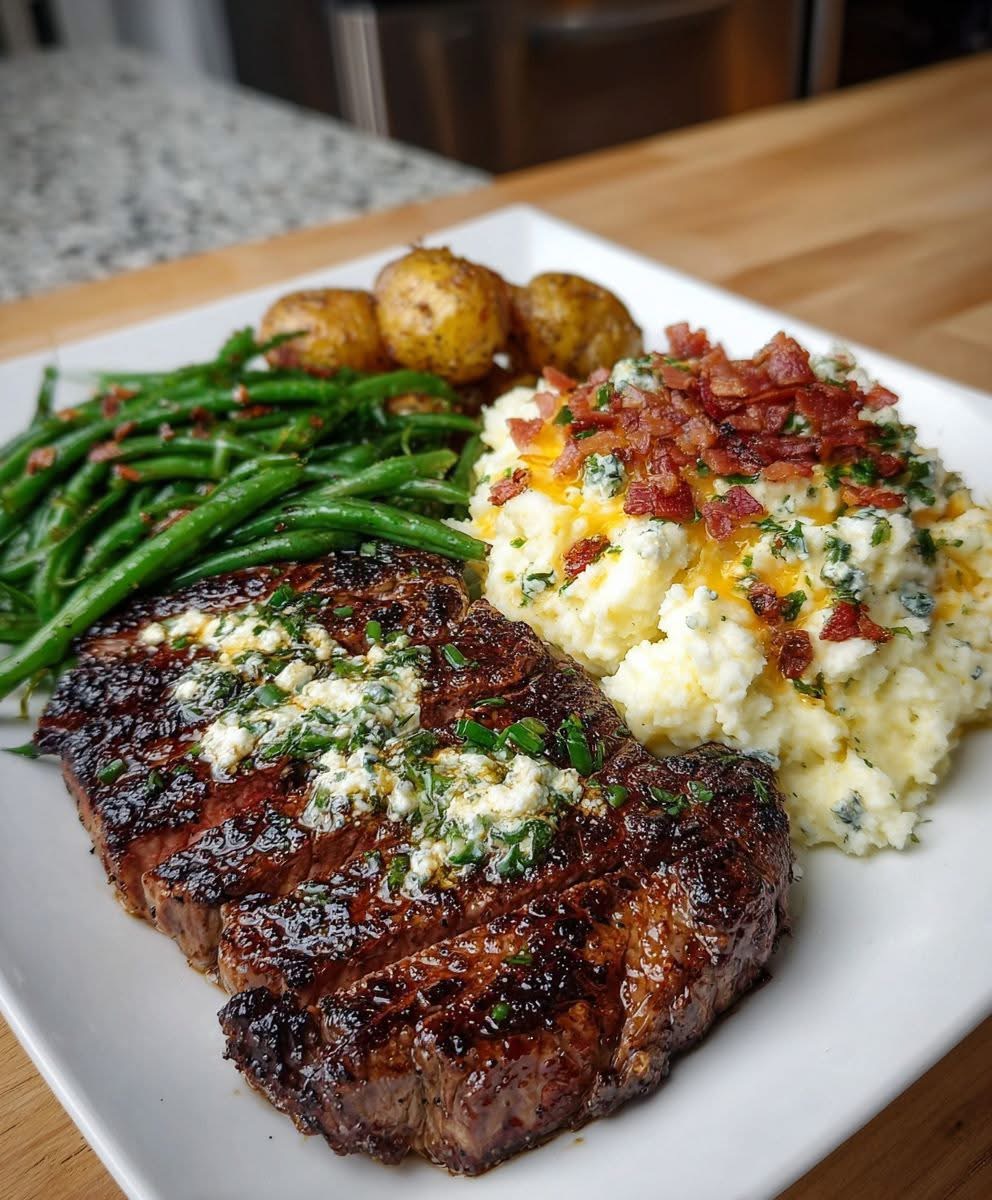
Ultimate Culinary Guide: Garlic Butter Steak with Loaded Mashed Potatoes & Green Beans
This comprehensive culinary guide provides an in-depth breakdown of Garlic Butter Steak with Loaded Mashed Potatoes and Crisp Green Beans, covering everything from technical culinary methods to deep historical origins, nutritional analysis, and expert execution.
1. Introduction
Few culinary combinations evoke the same sense of comfort, luxury, and universal satisfaction as a perfectly seared steak paired with rich, structured side dishes. This iconic trio—consisting of a pan-seared steak basted in aromatic compound garlic butter, velvety mashed potatoes folded with classic loaded ingredients, and vibrant, snap-fresh green beans—represents the pinnacle of western comfort dining.
       [ THE PERFECTLY BALANCED TRIO ]
                     |
       +-------------+-------------+

       |             |             |
[ THE PROTEIN ] [ THE CARBO-HYDRATE ] [ THE GREEN SIDES ]
 Pan-Seared      Loaded Mashed      Garlic Sautéed
 Garlic Steak      Potatoes          Green Beans
Achieving steakhouse-quality results at home requires an understanding of thermodynamics, emulsification, and ingredient structure. This guide breaks down each element to ensure professional results in your kitchen.
2. Historical Context & Evolution
The development of this plate spans multiple centuries, combining European refinement with American traditions.
The Evolution of Steak & Compound Butter
- Ancient Origins: Large-scale cattle domestication in Europe established beef as a status symbol.
- The French Influence: The technique of finishing meats with compound butter (beurre composé) originated in French bistro culture. Chefs utilized Beurre Maître d’Hôtel (butter, parsley, lemon, salt) to enrich lean cuts.
- The Steakhouse Era: In 19th-century New York City, chophouses integrated the French method of pan-basting (arroser) with heavy cast-iron cooking, standardizing garlic-herb butter as a universal finishing mechanism.
The Genesis of Loaded Mashed Potatoes
- The Inception: Originating in Peru, the potato (Solanum tuberosum) was embraced by European cultures in the late 16th century.
- The Irish and French Perfection: Parmentier promoted potato cultivation in France, while Ireland integrated potatoes into daily sustenance via dishes like Colcannon (potatoes mashed with butter and greens).
- The American Transformation: In mid-20th-century America, the baked potato lounge concept introduced toppings like cheddar cheese, soured cream, green scallions, and cured bacon pieces. These elements were subsequently integrated directly into mashed potatoes to optimize texture and flavor distribution.
The Role of Green Beans in Modern Culinary History
- The Migration: Cultivated across Central and South America, green beans (Phaseolus vulgaris) were brought to Europe by Spanish explorers.
- The French Technique: French culinary arts prioritized cooking haricots verts until perfectly tender-crisp.
- The Balance Component: In modern dining, the green bean serves a crucial role: its clean, vegetative snap and bright acidity cut through the heavy, lipid-dense matrix of beef fat and emulsified potato starch.
3. Core Culinary Formation & Structural Dynamics
A successful dish relies on balancing three distinct physical structures:
+-------------------------------------------------------------------------+

|                      CULINARY DISH ARCHITECTURE                        |
+-----------------------------------------+-------------------------------+

| CRUST & CORE:                           | EMULSIFICATION STRUCTURE:     |
| • Deep Maillard browning                | • Starch granule stabilization|
| • High-heat surface sear                | • Interlocking lipid networks |
| • Internal thermal gradient control     | • Dairy-to-moisture ratios    |
+-----------------------------------------+-------------------------------+

|                      VIBRANT ACIDITY BALANCE:                           |
|                      • Bright green chlorophyll retention        |
|                      • Clean, vegetative cellular snap          |
|                      • Acidity to cut heavy lipids              |
+-------------------------------------------------------------------------+
1. The Crust and Core (The Steak)
The exterior must feature a deep Maillard browning, achieved via a high-heat surface sear. The interior requires careful thermal gradient control to keep the muscle fibers tender.
2. The Emulsified Matrix (The Potatoes)
Mashed potatoes are a delicate balance of science. Overworking them releases excessive intracellular amylose, turning the dish gluey. Proper technique requires breaking down cell walls while coating starch granules in fat to lock in a smooth, velvety texture.
3. The Chlorophyll Snap (The Green Beans)
Green beans must retain their vibrant color and structural snap. Quick heat application preserves the plant’s cell walls, while avoiding acidic environments during early cooking keeps the chlorophyll from breaking down into dull pheophytin.
4. Comprehensive Ingredients List
For the Garlic Butter Steaks
- Steak Selection: 2 thick-cut Bone-in or Boneless Ribeye or New York Strip steaks (approx. 14–16 oz each, 1.5 to 2 inches thick).
- Salting: 1.5 tbsp Coarse Kosher salt.
- Pepper: 1 tbsp Freshly cracked black peppercorns.
- Searing Fat: 2 tbsp High-smoke point oil (Avocado or refined Grapeseed oil).
- The Butter Matrix: 4 tbsp Unsalted high-fat European-style butter.
- Aromatics: 6 cloves Fresh garlic, smashed but intact; 4 sprigs Fresh rosemary; 6 sprigs Fresh thyme.
For the Loaded Mashed Potatoes
- The Base: 3 lbs Russet or Yukon Gold potatoes, peeled and cut into uniform 1-inch cubes.
- Boiling Agent: 2 tbsp Sea salt (for potato boiling water).
- Dairy Fats: 1/2 cup Unsalted butter, room temperature; 3/4 cup Heavy cream or half-and-half, warmed.
- Acidity & Tang: 1/2 cup Cultured sour cream, room temperature.
- The Cheese Component: 1.5 cups Sharp cheddar cheese, freshly grated.
- The Allium Accent: 1/2 cup Fresh green onions (scallions), finely sliced.
- The Crunch: 6 slices Thick-cut smoked bacon, rendered crisp and chopped into small bits.
- Seasoning: 1 tsp Garlic powder; 1/2 tsp White pepper; Coarse salt to taste.
For the Skillet Green Beans
- The Vegetable: 1 lb Fresh French green beans (haricots verts), trimmed.
- Fat Source: 1 tbsp Extra virgin olive oil; 1 tbsp Unsalted butter.
- Alliums: 3 cloves Fresh garlic, microplaned or minced fine.
- Acid Component: 1 tsp Fresh lemon juice or premium white wine vinegar.
- Finishing: Salt and freshly ground black pepper to taste.
5. Technical Preparation Methods
Before turning on the heat, use these four preparatory techniques to ensure your ingredients are ready for cooking.
       [ STEP 1: DRY BRINING ]           ---->      [ STEP 2: STARCH ISOLATION ]
       Draws out moisture, concentrates              Rinses excess surface amylose
       flavors, and ensures a crisp sear.            to prevent sticky potatoes.

              |                                                   |
              v                                                   v
       [ STEP 4: ALLIUM MINCING ]        <----      [ STEP 3: PROTEIN RENDERING ]
       Releases sulfur compounds for                 Cooks bacon low and slow for a
       a balanced, aromatic finish.                  perfectly crisp crunch.
Dry Brining the Beef
- Pat steaks dry with a clean paper towel.
- Apply kosher salt evenly across all surfaces, including the edges.
- Place on a wire rack set inside a sheet pan.
- Refrigerate uncovered for 12 to 24 hours. This draws out moisture, concentrates flavors, and dries the surface to ensure a superior, crisp sear.
Starch Isolation for Potatoes
- Rinse peeled, cubed potatoes in cold running water for 2 minutes to remove excess surface starch.
- Keep submerged in cold water until ready to boil. This stops oxidation and keeps the potato starch from turning sticky.
Crisp Protein Rendering (Bacon)
- Place cold chopped bacon into a cold skillet.
- Bring to medium-low heat. Cooking low and slow melts the fat evenly, yielding perfectly crisp bacon pieces without burning.
- Drain the bacon on a paper towel, reserving 1 tablespoon of bacon fat for the green beans if desired.
Allium Mincing and Maceration
- Mince garlic for the green beans and mash the garlic for the steak.
- Letting minced garlic rest for 10 minutes before cooking activates allicin, maximizing its savory flavor.
6. Comprehensive Step-by-Step Cooking Instructions
Phase 1: The Loaded Potatoes Masterclass
- The Cold Start: Place potato cubes into a large pot. Cover with cold water until submerged by at least one inch. Add 2 tablespoons of sea salt. Bringing the water to a boil with the potatoes already in it ensures they cook evenly from edge to center.
- The Simmer: Bring to a rolling boil over high heat, then reduce to a steady simmer. Cook for 15–20 minutes until a fork slides easily into the center of a potato cube without breaking it apart.
- The Dehydration Step: Drain the potatoes thoroughly in a colander. Return the hot potatoes to the warm pot off the heat. Let them rest for 3 minutes to allow excess trapped steam to evaporate. Dry potatoes absorb dairy fat much better.
- The Starch Breakdown: Pass the potatoes through a potato ricer or food mill back into the pot. Avoid using a food processor or blender, as the rapid spinning blades slice through potato cells and release excess starch, making them sticky.
- The Lipid Incorporation: Pour in the melted butter and warm heavy cream. Fold gently with a silicone spatula until just combined.
- The Loaded Fold: Add the sour cream, grated cheddar cheese, crisp bacon bits, and sliced scallions. Season with garlic powder, white pepper, and salt. Fold gently until the cheese melts completely. Cover to keep warm.
+--------------------------------------------------------------------------+

|                       POTATO PROCESSING LIFECYCLE                        |
+---------------------+---------------------+------------------------------+

| 1. COLD WATER START | 2. STEAM EVAPORATION| 3. MECHANICAL RICING         |
| • Prevents uneven   | • Drives out excess | • Breaks down potato cells   |
|   outer cooking     |   moisture matrix   |   without shearing starch    |
+---------------------+---------------------+------------------------------+
Phase 2: The Perfect Steak Execution
- Thermal Equalization: Remove your dry-brined steaks from the refrigerator 45 minutes before cooking to bring them to room temperature. This minimizes the internal cold core and ensures an even cook. Season with black pepper just before cooking.
- The Pan Charge: Heat a heavy cast-iron skillet over high heat until it begins to smoke. Pour in 2 tablespoons of high-smoke point oil, swirling it to coat the bottom of the pan.
- The Initial Sear: Lay the steaks into the pan away from you to avoid oil splatters. Sear without moving for 2 to 3 minutes until a rich, deep golden-brown crust forms. Flip and repeat on the other side.
- The Arroser (Pan-Basting) Protocol: Turn the heat down to medium. Tilt the pan slightly toward you and add the butter, smashed garlic cloves, rosemary, and thyme to the top of the pan.
- The Basting Technique: Use a large, long-handled spoon to continuously scoop the hot, foaming, herb-infused butter over the top of the steaks. This surrounds the meat in heat, cooking it evenly while locking in moisture and rich flavor.
                  [ TILT PAN SLIGHTLY TOWARD YOU ]
                                |
         +----------------------+----------------------+

         |                                             |
[ SCOOP FOAMING BUTTER ]                     [ POUR OVER TOP OF STEAK ]
Continuous movement infuses                  Distributes thermal energy
aromatics into the crust.                    evenly down into the meat.
- Thermal Targeting: Use a digital probe thermometer to check the center of the meat. Pull the steaks when they hit your target temperature:
- Rare: 120°F (49°C)
- Medium-Rare: 130°F (54°C) (Highly Recommended)
- Medium: 140°F (60°C)
- The Redistribution Rest: Transfer the steaks to a clean warm board or plate. Spoon a bit more pan butter over the top and tent loosely with foil. Let rest for 8 to 10 minutes. This allows the muscle fibers to relax, redistributing the savory juices evenly throughout the meat instead of spilling onto the cutting board.
Phase 3: The Sautéed Green Beans
- The Skillet Charge: Heat olive oil and butter over medium heat in a skillet.
- The Sauté: Add the trimmed green beans. Toss frequently for 4 to 5 minutes until they turn bright green and soften slightly while keeping a crisp bite.
- The Allium Finish: Push the beans to the edge of the pan. Add the minced garlic to the center and cook for 30 to 60 seconds until fragrant, taking care not to burn it. Toss the beans to coat them evenly in the garlic butter.
- The Acid Flash: Remove from heat. Squeeze fresh lemon juice over the top and season with salt and pepper to taste. The splash of fresh acidity brightens the dish and cuts through the rich flavors of the meal.
7. Comparative Methodologies
Understanding alternative preparation methods allows you to customize the dish based on your available equipment and time constraints.
| Component | Primary Method (Recommended) | Alternative Method A | Alternative Method B | Strategic Trade-offs |
|---|---|---|---|---|
| Steak Cooking | Pan-Searing & Basting (Cast Iron) | Reverse Sear (Oven then Sear) | Sous Vide (Water Bath then Sear) | Pan-searing delivers an excellent crust and classic flavor, while reverse-searing provides edge-to-edge doneness for thick cuts. |
| Potato Processing | Mechanical Ricing | Manual Wire Masher | Hand Electric Mixer | Ricing keeps the potatoes light and velvety. Wire mashing leaves a rustic texture, while electric mixers risk turning them sticky if overworked. |
| Green Bean Prep | Direct Pan Sautéing | Blanching followed by Ice Bath | Steam Bag Prep | Direct sautéing locks in flavor and a crisp snap. Blanching yields bright green beans, while steaming is quick but can easily overcook them. |
8. Comprehensive Nutritional Profile
This nutritional profile estimates values for one standard, chef-plated serving of steak, loaded potatoes, and green beans.
       [ TOTAL CALORIC PAYLOAD: ~1,180 KCAL ]
                          |
         +----------------+----------------+

         |                |                |
   [ PROTEIN ]       [ LIPIDS ]       [ CARBOHYDRATES ]
  58g (20% DV)      82g (62% DV)       52g (18% DV)
Macronutrient Breakdown
- Total Energy: ~1,180 Calories (kcal)
- Protein: 58 grams
- Lipids (Fats): 82 grams
- Saturated Fat: 41 grams
- Cholesterol: 215 milligrams
- Carbohydrates: 52 grams
- Dietary Fiber: 7 grams
- Sugars: 4 grams
Micronutrients and Vital Minerals
- Vitamin A: 45% of Daily Value (DV) (Mainly from dairy fats and green beans)
- Vitamin C: 35% DV (From potatoes and fresh lemon juice)
- Calcium: 25% DV (From sharp cheddar cheese)
- Iron: 40% DV (High-bioavailability heme iron from beef)
- Sodium: ~1,150 mg (Can vary based on dry-brining and seasoning choices)
9. Comprehensive Health & Dietary Benefits
While this meal is rich and satisfying, its high-quality whole food ingredients offer excellent nutritional value.
+--------------------------------------------------------------------------+

|                       DIETARY BENEFIT FACTORMATRIX                       |
+------------------------+------------------------+------------------------+

| 1. HEME-IRON DELIVERY  | 2. BIOAVAILABLE PROTEIN| 3. PHYTONUTRIENT SHIELD|
| • Optimizes cellular   | • Contains all vital   | • High-fiber content   |
|   oxygen transport     |   amino acids          |   supports digestion   |
+------------------------+------------------------+------------------------+
High-Bioavailability Heme Iron
Beef provides an excellent source of heme iron, which is absorbed much more efficiently by the human body than plant-based non-heme iron. This essential mineral plays a key role in oxygen transport and cellular energy production.
Complete Essential Amino Acids
The proteins found in ribeye and strip steaks contain all nine essential amino acids required for muscle growth, tissue repair, and immune health.
Phytonutrient Protection & Digestive Health
Green beans provide a healthy dose of fiber, silica, and vitamin K, which help support bone health and digestion. The garlic used throughout the meal also contains allicin, a powerful compound known for its natural antioxidant and anti-inflammatory properties.
10. For the True Lovers of This Dish
This dish has a dedicated global following. It satisfies both the primal love for a perfectly cooked steak and the comforting appeal of classic sides.
Why Enthusiasts Revere This Combination
- The Flavor Balance: This trio creates a perfect contrast of flavors—rich savory beef, creamy tangy potatoes, and bright, crisp green beans.
- The Sensory Experience: Every bite offers a satisfying mix of textures, from the crunch of the steak’s seared crust and crispy bacon to the smooth, velvety potatoes and snap-fresh green beans.
- The Reward of Craftsmanship: Making this meal well requires mastering fundamental culinary skills, turning fresh ingredients into a restaurant-quality dinner right in your own kitchen.
11. Conclusion
Mastering this classic steak dinner comes down to respecting technique, timing, and temperature. By dry-brining the beef to ensure a beautiful sear, ricing the potatoes to keep them light and fluffy, and quick-sautéing the green beans to preserve their fresh snap, you create a harmonious, restaurant-quality meal at home. Treat this guide as a foundation, refine your skills with practice, and enjoy the process of crafting a Truly exceptional dinner.
If you would like to customize this recipe further, let me know:
- Your preferred doneness for the steak (e.g., Rare, Medium-Rare, Medium).
- Any dietary restrictions (e.g., gluten-free, dairy-free alternatives).
- The specific cut of beef you plan to use so we can adjust cooking times.
I can also help you choose a beverage pairing or share tips for cooking with a different pan type.