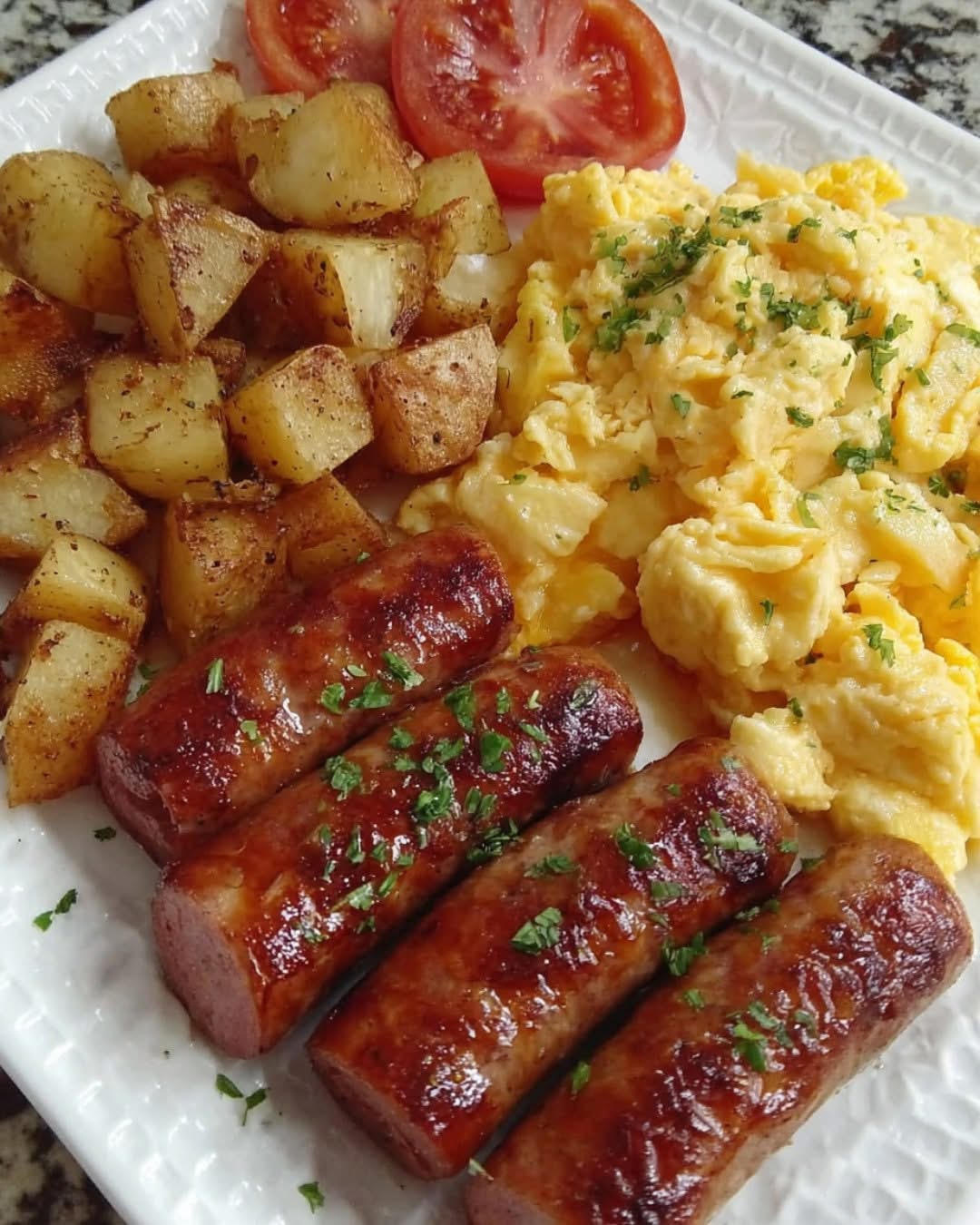
The Ultimate Guide to Homestyle Breakfast with Herbed Scrambled Eggs & Sausages
A classic Homestyle Breakfast with Herbed Scrambled Eggs & Sausages is the definitive comfort meal, combining velvety textures, savory meats, and fresh aromatic herbs. This comprehensive guide provides an exhaustive look into the culinary creation, history, nutrition, science, and cultural appreciation of this iconic breakfast platter.
1. Introduction: The Anatomy of Comfort Food
Breakfast is often hailed as the most important meal of the day, but a homestyle breakfast is something more—it is a sensory ritual. The combination of perfectly curdled, soft-scrambled eggs infused with fresh garden herbs alongside deeply browned, savory breakfast sausages forms a foundational pillar of morning gastronomy.
What makes this specific combination a masterpiece is the balance of flavors and textures:
- The Eggs: Act as a rich, creamy, and delicate canvas.
- The Herbs: Cut through the dense fat with bright, clean, and volatile aromatic oils.
- The Sausages: Provide a robust, salty, and spiced counterpoint with a snap of caramelization.
To elevate a basic morning routine into an artisanal culinary experience, understanding the quality of your ingredients and the physics of heat management is essential.
2. Culinary History & Global Traditions
The Evolution of the Breakfast Platter
The concept of a substantial, cooked morning meal featuring meats and eggs has deep roots in agrarian societies.
[Medieval European Peasant Diets] ➔ [19th Century British Fry-Up] ➔ [Modern North American Homestyle Plate]
- Agrarian Roots: Farm workers required calorie-dense meals at dawn to fuel hours of intense physical labor.
- The English Gentry: During the Industrial Revolution, the traditional “Full English Breakfast” became a status symbol of wealth and hospitality.
- The American Diner: Immigrants brought these traditions to North America, streamlining them into the beloved skillet breakfasts, hash houses, and homestyle combinations found across diners today.
A Brief History of Scrambled Eggs
Scrambling eggs is an ancient practice dating back to the Roman Empire. The Apicius, a collection of Roman cookery recipes compiled in the late 4th or early 5th century, describes Ova Sphongia ex Lacte—a dish of eggs beaten with milk, fried, and served with honey and pepper.
By the 17th century, French chefs refined egg cookery, introducing the concepts of slow-cooking over indirect heat and enriching the curds with cold butter, creating the foundation for modern soft-scrambled eggs.
The Sausage Timeline
Sausage making is one of the oldest forms of food preservation, born out of the necessity to utilize every scrap of meat from a slaughtered animal.
- Ancient Greece & Rome: Mentioned in Homer’s Odyssey, sausages were a staple street food.
- Germanic Mastery: Germany became the epicenter of sausage innovation, creating hundreds of regional varieties (Würste) utilizing different grinds, spices, and smoking techniques.
- The New World: European settlers in the American South adapted these techniques using native sage and red pepper flakes, producing the distinct “country sausage” flavor profile used in this recipe today.
3. Culinary Formation & Science
The success of this dish relies heavily on culinary chemistry. Understanding how proteins, fats, and volatile compounds interact allows you to achieve the perfect texture every time.
       [Raw Proteins in Eggs]
                 │
                 ▼ (Apply Low Heat)
   [Denaturation & Loose Webbing] ◄─── (Milk/Butter traps steam)
                 │
                 ▼
     [Velvety, Soft-Scrambled Curds]
The Macromolecular Structure of an Egg
An egg is a complex emulsion of water, lipids, and proteins. When you scramble an egg, you manipulate these proteins through mechanical action (whisking) and thermal energy (cooking).
- Denaturation: As heat is applied, the tightly coiled protein strands in the egg whites and yolks begin to uncoil.
- Coagulation: The uncoiled proteins bond with one another, forming a three-dimensional matrix that traps water.
- The Danger of High Heat: If cooked too fast or over high heat, the proteins contract tightly, squeezing out the trapped water. This results in dry, rubbery, weeping eggs.
- The Role of Lipids: Adding fats like heavy cream, whole milk, or butter coats the protein molecules. This insulation slows down coagulation, yielding a significantly softer curd.
The Maillard Reaction in Sausages
Cooking the sausages introduces the Maillard reaction—a chemical reaction between amino acids and reducing sugars that gives browned food its desirable flavor.
- Temperature Threshold: This reaction accelerates between 140°C to 165°C (284°F to 330°F).
- The Casing Dynamics: High-quality sausages utilize natural collagen or cellulose casings. When exposed to heat, the internal juices boil, creating steam that plumps the sausage, while the exterior dries and crisps into a snappy shell.
Volatile Compound Extraction in Herbs
Herbs contain essential oils stored within specialized glandular structures on their leaves.
- Thermal Degradation: Soft herbs like chives, parsley, and tarragon possess highly volatile oils that break down quickly under heat. They must be added at the very end of cooking to preserve their bright flavor and emerald green color.
- Fat Solubility: The aromatic compounds in herbs are fat-soluble. Infusing them into melted butter or egg lipids coats the palate, lengthening the finish of the flavor.
4. Comprehensive Ingredients List
To achieve restaurant-quality results, souring fresh, high-quality ingredients is paramount. Below is the precise breakdown for a feast serving four adults.
For the Herbed Scrambled Eggs
- 8 Large Pasture-Raised Eggs: Look for deep amber yolks, indicating a diet rich in carotenoids.
- 2 Tablespoons Unsalted European-Style Butter: Higher fat content (82%+ butterfat) yields creamier eggs.
- 2 Tablespoons Heavy Cream or Whole Milk: Adds necessary moisture to cushion the protein matrix.
- 2 Tablespoons Fresh Chives: Finely minced for a mild, delicate onion flavor.
- 1 Tablespoon Fresh Italian Flat-Leaf Parsley: Finely chopped for an earthy, clean top note.
- 1 Teaspoon Fresh Tarragon: Finely minced to introduce a subtle, sophisticated anise undertone.
- ½ Teaspoon Flaky Sea Salt: For clean salinity without chemical aftertastes.
- ¼ Teaspoon Freshly Cracked White Pepper: Maintains a pristine appearance without the black specks of traditional pepper.
For the Homestyle Sausages
- 8 Premium Pork Sausage Links: High-quality country style, sweet Italian, or Cumberland sausage links.
- 1 Tablespoon Neutral Cooking Oil: Grapeseed or canola oil, used only to prime the pan.
- 2 Tablespoons Water: For the dual-stage steam-and-sear cooking method.
Optional Homestyle Accompaniments
- 4 Thick Slices of Artisanal Sourdough or Brioche Bread: For making golden, buttered toast.
- 1 Cup Vine-Ripened Cherry Tomatoes: Blistered in the sausage fat for a bright, acidic contrast.
5. Preparation & Cooking Methods
Achieving perfect synchronicity so that both the eggs and sausages finish cooking at the exact same moment requires a structured approach. Follow this step-by-step breakdown.
Step 1: Pre-Whisking and Salting (The Secret Weapon)
Crack the eggs into a non-reactive glass bowl. Add the heavy cream and flaky sea salt. Whisk vigorously with a balloon whisk or fork for a full 60 seconds until the mixture is uniform, completely aerated, and no distinct streaks of egg white remain.
Let the mixture sit at room temperature for 10 minutes. This pre-salting step alters the electrical charge on the egg proteins, preventing them from bonding too tightly when heated, guaranteeing a more tender curd.
[Crack Eggs] ➔ [Add Cream & Salt] ➔ [Whisk 60 Seconds] ➔ [Rest 10 Minutes]
Step 2: The Dual-Stage Sausage Method
To ensure your sausages are thoroughly cooked through while maintaining a perfectly browned, snappy casing without bursting, use the classic skillet poaching method:
- Place a heavy cast-iron or stainless steel skillet over medium heat. Add the neutral oil and the sausage links.
- Pour in two tablespoons of water and immediately cover the skillet with a tight-fitting lid.
- Allow the sausages to steam for 5 to 6 minutes. This gently cooks the interior pork evenly.
- Remove the lid. The remaining water will quickly evaporate, leaving behind the rendered pork fat.
- Cook the sausages for another 6 to 8 minutes, turning frequently, until the casings turn a deep mahogany brown and the internal temperature reaches 71°C (160°F).
- Remove the sausages and tent them loosely with aluminum foil to rest. Keep the pan drippings if you wish to blister tomatoes or fry bread.
Step 3: Low and Slow French-Style Scrambled Eggs
- Place a cold, high-quality 10-inch non-stick skillet over low heat. Add the two tablespoons of unsalted European-style butter.
- Allow the butter to melt slowly until it begins to foam slightly. Do not let it brown.
- Pour in the pre-whisked egg mixture.
- Using a flexible silicone spatula, immediately begin continuously sweeping across the bottom and sides of the pan.
- As thin layers of cooked egg form on the bottom, the spatula sweeps them off, forming delicate ribbons.
- If the eggs begin to cook too quickly, lift the pan completely off the heat source for 10 seconds while continuing to stir, then return it to low heat.
- When the eggs look like thick, custard-like ribbons with a glossy, wet sheen (roughly 4 to 5 minutes into cooking), pull the pan off the heat permanently. The residual heat of the pan will complete the cooking process.
- Instantly fold in the finely minced chives, flat-leaf parsley, and tarragon. The ambient heat will bloom the essential oils without dampening their fresh color.
6. Detailed Cooking Methods Comparison
There are several ways to execute these breakfast components depending on your kitchen setup and equipment preference.
| Component | Method | Equipment | Target Temp / Time | Texture Profile | Pros & Cons |
|---|---|---|---|---|---|
| Eggs | Low & Slow (Recommended) | Non-Stick Skillet + Silicone Spatula | Low Heat / 5 Mins | Silky, custard-like, fine curds | Pros: Ultimate tenderness. Cons: Requires constant attention. |
| Eggs | Bain-Marie (Classic French) | Double Boiler + Whisk | Indirect Steam / 12 Mins | Porridge-smooth, ultra-creamy | Pros: Impossible to overcook. Cons: Very time-consuming. |
| Sausages | Steam-and-Sear (Recommended) | Cast Iron Skillet + Lid | Medium Heat / 12 Mins | Plump, juicy interior, snappy skin | Pros: Cooks evenly, won’t burst. Cons: Requires monitoring. |
| Sausages | Oven Roasting | Sheet Pan + Wire Rack | 200°C (400°F) / 20 Mins | Uniform browning, hands-off | Pros: Great for large crowds. Cons: Can dry out if left too long. |
7. Comprehensive Nutritional Analysis
A homestyle breakfast is a nutritional powerhouse, offering dense macro and micronutrients that support sustained physical output and metabolic health. Below is the nutritional breakdown for one standard serving (consisting of 2 large eggs, 2 pork sausage links, cooked with associated butter and herbs).
Macronutrient Distribution
- Total Calories: Approximately 520 kcal
- Protein: 28 grams (high biological value, containing all 9 essential amino acids)
- Total Carbohydrates: 2 grams (virtually carbohydrate-free, making it ideal for low-carb and ketogenic lifestyles)
- Total Dietary Fat: 44 grams
- Saturated Fat: 16 grams
- Monounsaturated Fat: 20 grams
- Polyunsaturated Fat: 6 grams
- Cholesterol: 430 milligrams
Micronutrient Profiles & Daily Values (DV)
[Vitamin B12] ═════════════════════════ 65% DV
[Selenium]    ═══════════════════════ 55% DV
[Choline]     ═════════════════════ 50% DV
[Zinc]        ═════════════════ 35% DV
[Vitamin D]   ═══════════ 20% DV
- Choline (50% DV): Essential for structural integrity of cell membranes, neurotransmitter synthesis (acetylcholine), and brain health.
- Selenium (55% DV): A critical antioxidant enzyme cofactor that safeguards thyroid function and neutralizes free radicals.
- Vitamin B12 (65% DV): Essential for nerve tissue health, cognitive function, and red blood cell production.
- Zinc (35% DV): Found heavily in pork sausage, it fortifies the immune system and aids DNA synthesis.
- Vitamin D (20% DV): Pasture-raised egg yolks are one of the few natural dietary sources of bioavailable Vitamin D3, vital for bone health and immune regulation.
8. Health & Metabolic Benefits
Consuming a savory, protein-forward breakfast like herbed scrambled eggs and sausages offers distinct metabolic advantages over traditional high-carbohydrate breakfast options like cereal or pastries.
Sustained Satiety and Ghrelin Suppression
Protein and dietary lipids stimulate the secretion of satiety hormones, including peptide YY (PYY) and cholecystokinin (CCK), while actively suppressing ghrelin—the primary hunger hormone. This chemical cascade blunt morning appetite cravings, leading to a natural reduction in caloric intake throughout the remainder of the afternoon.
Attenuation of the Postprandial Glucose Spike
Unlike carbohydrate-laden breakfasts that induce rapid blood glucose spikes followed by an insulin surge and subsequent energy crash, an egg-and-sausage breakfast maintains stable, flat-line blood glucose kinetics. This steady state preserves insulin sensitivity and avoids energy crashes, making it an excellent protocol for managing metabolic syndrome or Type 2 diabetes.
Blood Glucose Level
  ▲
  │     /¯¯\      <-- High-Carb Breakfast (Spike & Crash)
  │    /    \
  │───/──────\───────
  │  /        \   /¯¯¯¯¯¯¯¯¯¯¯¯¯¯¯ <-- Protein & Fat Breakfast (Stable Energy)
  │ /          \_/
  └───────────────────► Time
Bioactive Benefits of Fresh Herbs
The inclusions of fresh culinary herbs provide more than just flavor. They are dense sources of wellness-promoting compounds:
- Chives: Contain allicin, which demonstrates cardiovascular benefits by reducing arterial stiffness and blood lipid levels.
- Parsley: Rich in apigenin, a potent plant flavonoid with powerful antioxidant and anti-inflammatory properties.
- Tarragon: Contains coumarinic derivatives that assist in improving insulin sensitivity and enhancing glycogen storage capacities.
9. For the Breakfast Lovers: Cultural Impact & Variations
For breakfast lovers, this dish represents the pinnacle of morning comfort. It bridges the gap between home-cooked simplicity and refined restaurant culinary arts.
Across the world, breakfast communities customize this template to match their regional palettes:
The Anglo-Irish Adaptation
Lovers of the British fry-up substitute country sausage links for thick-cut back bacon, Cumberland rounds, and slices of black or white pudding. The herbed eggs are swapped for simple fried eggs, and the plate is filled out with warm baked beans, grilled mushrooms, and fried bread.
The Tex-Mex Skillet
In the American Southwest, this combo is transformed into a breakfast skillet. The country sausages are replaced with spicy, loose chorizo. The scrambled eggs are tossed with cilantro, onions, and jalapeños, then wrapped inside warm flour tortillas with cotija cheese and fresh salsa verde.
The Parisian Bistro Style
French breakfast lovers demand an ultra-refined presentation. The eggs are whisked incessantly in a double boiler over a low flame until they achieve a smooth pouring consistency, similar to a rich fondue. They are heavily accented with fresh tarragon and chervil, then served in porcelain ramekins alongside delicate, pan-seared chipolata sausages and crisp croutons.
10. Conclusion & Final Culinary Verdict
The Homestyle Breakfast with Herbed Scrambled Eggs & Sausages is an enduring classic because it honors the natural chemistry of simple ingredients. By utilizing low, controlled heat to cook your eggs and a dual-stage technique to brown your sausages, you turn ordinary pantry items into an exceptional, comforting meal.
Whether you enjoy this platter as a quiet weekend reward or cook it to bring family and friends together around the morning table, mastering these foundational techniques elevates your cooking and pays homage to a timeless culinary tradition.
Cooking Consultation
If you would like to customize this meal, please share your preferences:
- What style of sausage do you prefer? (e.g., pork, chicken, turkey, or plant-based)
- Do you have any dietary adjustments we should consider? (e.g., keto, low-sodium, dairy-free)
- Would you like suggestions for matching side dishes? (e.g., crispy hash browns, roasted mushrooms)