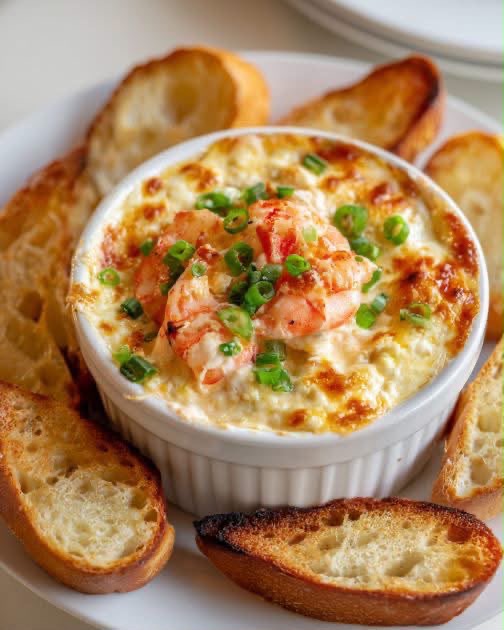
Chopped shrimp folded into a cream cheese and Monterey Jack base, baked until the top browns in patches and the edges bubble. Served in the dish it baked in with toasted baguette rounds around the edge.
The technique that decides everything is cooking the shrimp before it goes into the dip. Raw shrimp releases a surprising amount of water as it cooks, and inside a baked dip that water has nowhere to go. It thins the base into something loose and watery under the browned surface. Two minutes in a hot skillet first, drained, and the problem disappears.
Fifteen minutes of prep, twenty in the oven, and it goes straight to the table.
Why You Will Love This Recipe
The base stays thick. Pre-cooking and draining the shrimp is what keeps it scoopable rather than soupy.
It bakes in the serving dish. One ramekin or small baking dish, straight from the oven to the table.
It suits any occasion. Elegant enough for guests, easy enough for a Friday evening.
It uses frozen shrimp perfectly well. No need for fresh, which matters if you are inland or out of season.
It assembles ahead. Mix it in the morning, bake it when people arrive.
Recipe Overview
Prep time: 15 minutes
Cook time: 20 minutes
Total time: 35 minutes
Yield: Serves 6 as an appetiser
Difficulty: Easy
Best for: Dinner parties, holidays, game day, last-minute guests
Ingredients
For the dip
• 1 pound raw shrimp, peeled and deveined
• 1 tablespoon butter
• 2 cloves garlic, minced
• 8 ounces cream cheese, fully softened
• ½ cup sour cream
• ¼ cup mayonnaise
• 1½ cups Monterey Jack, freshly grated
• ½ cup parmesan, freshly grated
• 2 tablespoons lemon juice
• 1 teaspoon Worcestershire sauce
• ½ teaspoon Old Bay seasoning
• ¼ teaspoon cayenne, optional
• ½ teaspoon black pepper
• ¼ teaspoon salt
• 3 green onions, sliced
For the top
• ¼ cup parmesan, freshly grated
• 4 whole cooked shrimp, reserved
• 2 green onions, sliced, to finish
For serving
• 1 baguette, sliced and toasted
• Olive oil, for brushing
Choosing the Right Shrimp
Size and preparation both matter more than people expect.
Medium shrimp, 41 to 50 count. The best choice for the dip itself. Small enough to chop into pieces that distribute through every scoop.
Large shrimp, 26 to 30 count. Better for the whole ones on top, where you want them visible. Chop the rest.
Frozen raw shrimp. Entirely fine and often better quality than the thawed shrimp at the counter, which is usually frozen shrimp anyway. Thaw in cold water for fifteen minutes.
Pre-cooked shrimp. Convenient, but it toughens in the oven since it has already been through one cooking. Use it if that is what you have and reduce the bake by five minutes.
Shell-on shrimp. More work but better flavour, and the shells make a quick stock if you want one.
Look for shrimp that smells of the sea and nothing else. Any ammonia note means it has turned.
Why Pre-Cooking the Shrimp and Grating Your Own Cheese Both Matter
Shrimp is roughly 75% water, and cooking drives a good deal of it out. That is why shrimp shrinks so noticeably in a pan. In an open skillet the water evaporates immediately and you never see it, but folded raw into a dip and baked, it has nowhere to escape to. It thins the cream cheese base from within, and the dish comes out with a browned top over something closer to a sauce than a dip.
Cooking the shrimp for two minutes in butter beforehand, then draining off what collects in the pan, removes that liquid entirely. It also means the shrimp is only warmed through during the bake rather than cooked twice, which keeps it tender. Shrimp toughens quickly, and twenty minutes of oven time on raw shrimp overcooks it badly.
The cheese follows the same rule as any melted-cheese dish. Pre-shredded cheese is dusted with cellulose or potato starch to keep the shreds separate in the bag, and that coating physically interferes with the proteins rejoining as they melt. What you get is fat separating out as oil on the surface with a grainy layer underneath. Two minutes with a box grater removes the problem completely.
How to Make Hot Shrimp Dip
Step 1: Heat the oven
Preheat to 375°F and butter a small baking dish or a large ramekin.
Step 2: Cook the shrimp
Melt the butter in a skillet over medium-high heat, add the shrimp and garlic, and cook 2 minutes until just pink. Do not cook them through.
They finish in the oven. Fully cooked now means rubbery later.
Step 3: Drain and chop
Tip the shrimp into a colander and let them drain, then set aside four whole ones and chop the rest into rough pieces.
Draining is the step that keeps the dip thick. Do not skip it.
Step 4: Beat the base smooth
Beat the softened cream cheese, sour cream, and mayonnaise together until completely smooth with no lumps.
Get this smooth first. Lumps at this stage stay lumps through the bake.
Step 5: Season the base
Stir in the lemon juice, Worcestershire, Old Bay, cayenne, pepper, and salt.
Seasoning the smooth base distributes it far better than sprinkling over the cheese.
Step 6: Fold in the cheese and shrimp
Add the Monterey Jack, ½ cup parmesan, the chopped shrimp, and the green onions. Fold until evenly combined.
Step 7: Fill the dish
Spread the mixture into the dish in an even layer, about an inch and a half deep.
An even layer bakes evenly. A mounded centre stays cool while the edges overcook.
Step 8: Top and bake
Scatter the remaining parmesan over the surface and arrange the whole shrimp on top. Bake 18 to 20 minutes until bubbling at the edges and golden in patches.
Step 9: Toast the bread and rest
While it bakes, brush baguette slices with olive oil and toast them under the broiler for 2 minutes a side. Rest the dip 5 minutes before serving and finish with green onion.
Tips for the Best Shrimp Dip
Soften the cream cheese completely. Thirty to forty minutes at room temperature, or short bursts in the microwave. Cold cream cheese will not blend.
Do not overbake. Twenty minutes is the limit. Longer and the fat separates and the shrimp goes tough.
Chop the shrimp small. Half-inch pieces mean every scoop has some. Large chunks make the dip uneven.
Use a shallow dish. Wide and shallow gives more browned surface and heats through faster than a deep bowl.
Serve it hot. This dip thickens considerably as it cools and is at its best in the first twenty minutes.
Easy Variations
• Add ½ cup of lump crab meat alongside the shrimp
• Swap the Monterey Jack for gruyère for a nuttier, more savoury dip
• Stir in a diced jalapeño or a spoonful of hot sauce for heat
• Add ½ cup of chopped artichoke hearts, well drained
• Use Cajun seasoning in place of Old Bay for a different profile
• Finish with a squeeze of fresh lemon over the top just before serving
What to Serve With It
Toasted baguette rounds are the natural partner, sturdy enough for a heavy scoop. Buttery crackers and pita chips both work well.
For something lighter alongside, set out celery sticks, cucumber rounds, and sliced bell peppers. On a larger spread this sits comfortably next to a cheese board or a bowl of olives.
Make-Ahead and Storage
Make ahead. Assemble the dip in its dish up to 24 hours in advance, cover, and refrigerate unbaked. Add 8 to 10 minutes to the bake from cold.
Fridge. Store leftovers covered for up to 3 days. Seafood dips are best eaten sooner rather than later.
Freezer. Not recommended. Cream cheese separates on thawing and shrimp turns rubbery.
Reheating. Cover and warm in a 350°F oven for 12 to 15 minutes. Avoid the microwave, which toughens the shrimp.
Frequently Asked Questions
Can I use pre-cooked shrimp?
Yes. Skip step 2, chop them, and reduce the bake to about 15 minutes so they do not toughen further.
Can I make this in a slow cooker?
Yes, on low for 90 minutes, stirring occasionally. You lose the browned top, which is much of the appeal.
Why did my dip turn watery?
The shrimp was added raw, or it was not drained after cooking. Both release water into the base.
What can I use instead of Old Bay?
A mix of paprika, celery salt, and a pinch of cayenne, or any Cajun seasoning blend.
Can I use frozen shrimp?
Yes, and it works perfectly well. Thaw it in cold water, then pat it thoroughly dry before cooking.