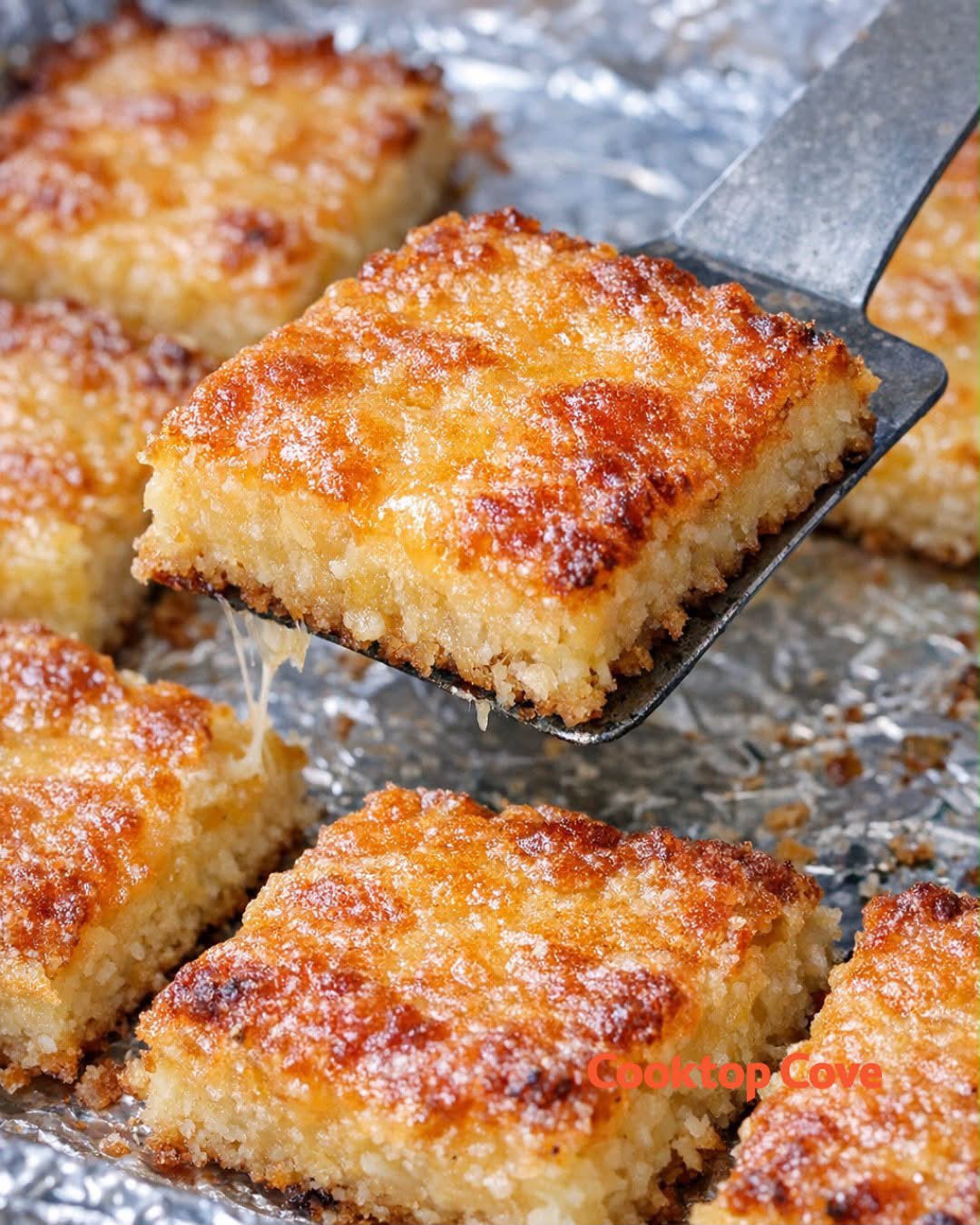
A dense, buttery coconut bar with a crackled caramelised top and a custardy centre that holds together in a neat square. One bowl, one whisk, and no crust to press or par-bake.
The technique that matters is understanding that this is a custard, not a cake. The centre sets by egg protein coagulating rather than by flour structure, which means it comes out of the oven still soft and firms up entirely as it cools. Cut it warm and you get a spoonable mess; cut it cold and you get clean squares.
Fifteen minutes of prep, forty in the oven, and two hours of patience.
Why You Will Love This Recipe
Everything goes in one bowl. Whisk the wet, add the dry, pour into the pan. There is no creaming and no mixer.
The top caramelises on its own. The sugar in the batter rises and browns into a crackled surface with no glaze or topping needed.
It uses store cupboard ingredients. Eggs, butter, sugar, flour, milk, and a bag of coconut.
It keeps for days. The texture improves overnight as the custard fully sets.
It cuts cleanly. Once properly cooled, the squares hold sharp edges and travel well.
Recipe Overview
Prep time: 15 minutes
Cook time: 40 minutes
Cooling time: 2 hours
Total time: 2 hours 55 minutes
Yield: 12 to 16 bars
Difficulty: Easy
Best for: Afternoon tea, potlucks, bake sales, making ahead
Ingredients
For the bars
• 4 large eggs
• 1¼ cups granulated sugar
• ½ cup unsalted butter, melted and slightly cooled
• 1 cup whole milk
• 2 teaspoons vanilla extract
• ½ teaspoon almond extract, optional
• ¾ cup all-purpose flour
• ½ teaspoon baking powder
• ½ teaspoon salt
• 2 cups sweetened shredded coconut
For the top
• 2 tablespoons granulated sugar, for sprinkling
• 2 tablespoons melted butter, for brushing
Choosing the Right Coconut
The type of coconut changes both the sweetness and how much liquid the batter needs.
Sweetened shredded coconut. The standard choice and what gives this bar its familiar flavour. It is moist, it holds its texture, and it browns beautifully on top.
Unsweetened desiccated coconut. Drier and much finer, so it absorbs more liquid. Add 2 tablespoons of extra milk and an extra tablespoon of sugar if you use it.
Flaked or chip coconut. Large pieces that stay distinct and toast dramatically on top. Attractive but the texture is less uniform through the bar.
Fresh grated coconut. Excellent flavour but high in moisture. Reduce the milk by ¼ cup and expect a softer set.
Coconut flour. Not a substitute. It is extremely absorbent and will turn the batter to paste.
Check the bag for softness. Coconut that has dried out in the cupboard makes a tough, chewy bar rather than a tender one.
Why This Sets by Cooling Rather Than by Baking
A cake sets in the oven. Flour proteins and starch build a structure that is essentially final by the time it comes out, which is why a cake tester works and why a cake can be cut warm.
This bar works differently. With only three quarters of a cup of flour against four eggs and a cup of milk, there is not nearly enough flour to build that structure. What holds it together is egg protein, and egg protein behaves like a custard: it coagulates in the oven into a soft, wobbling set, and it firms substantially further as it drops back to room temperature.
That is why the standard doneness test misleads here. A skewer will come out slightly moist even when the bar is perfectly done, and baking on until it comes out clean overcooks the custard, which then weeps liquid and goes rubbery. The right signal is the edges pulling away, the top deeply golden, and the centre showing a slight wobble when the pan is nudged.
The cooling time is not a suggestion. Two hours at room temperature is the minimum, and an hour in the fridge afterwards gives the cleanest cuts of all. The flavour is also noticeably better on day two, once the coconut has fully hydrated in the custard around it.
How to Make Coconut Custard Bars
Step 1: Prepare the pan
Line a 9×9 pan with parchment, leaving an overhang on two sides. Preheat the oven to 350°F.
The overhang lets you lift the whole slab out. Cutting in the pan gives ragged edges.
Step 2: Whisk the eggs and sugar
Whisk the eggs and sugar together for about a minute, until pale and slightly thickened.
You are dissolving the sugar, not beating in air. This is not a cake batter.
Step 3: Add the melted butter
Whisk in the melted butter in a steady stream.
Let the butter cool for a few minutes first. Hot butter poured into eggs starts to cook them.
Step 4: Add the milk and extracts
Whisk in the milk, vanilla, and almond extract if using.
The batter will look very thin at this stage. That is correct.
Step 5: Fold in the dry ingredients
Sift the flour, baking powder, and salt over the top and whisk just until smooth with no dry patches.
Stop as soon as it comes together. Overmixing develops gluten and makes the bar tough.
Step 6: Stir in the coconut
Fold in the shredded coconut until evenly distributed.
The mixture will still be loose and pourable. It thickens in the oven.
Step 7: Pour and top
Pour into the lined pan, brush the surface with the melted butter, and sprinkle the sugar evenly over the top.
That sugar is what creates the crackled caramelised crust. Do not skip it.
Step 8: Bake
Bake for 38 to 42 minutes, until the top is deeply golden, the edges have pulled away slightly, and the centre wobbles just faintly when nudged.
Do not bake until a skewer comes out clean. It will be overcooked by then.
Step 9: Cool completely
Cool in the pan for at least 2 hours before lifting out and cutting. Chill for an hour more if you want very sharp edges.
The bar firms as it cools. Cutting warm gives you a soft, spreading mess.
Tips for the Best Coconut Bars
Use room-temperature eggs. They emulsify with the melted butter far better than cold ones and give a smoother custard.
Melt the butter and let it stand. Five minutes off the heat is enough to stop it scrambling the eggs.
Watch the top, not the clock. Ovens vary. Deep golden with a slight centre wobble is the target.
Cover with foil if it browns too fast. If the top is dark at thirty minutes, tent it loosely and finish the bake.
Wipe the knife between cuts. A clean warm blade gives the sharpest squares.
Easy Variations
• Add the zest of one lime for a sharper, tropical version
• Fold ½ cup of chopped toasted almonds into the batter
• Drizzle melted dark chocolate over the cooled bars
• Swap half the milk for coconut milk for a stronger coconut flavour
• Add ½ teaspoon of cinnamon and a pinch of nutmeg for a warmer bar
• Scatter flaked coconut over the top before baking for a more dramatic finish
What to Serve With It
These are made for coffee or strong black tea, and that is how most of them get eaten. A squeeze of lime over a warm square cuts the sweetness nicely.
As a dessert, serve them slightly warmed with vanilla ice cream or a spoonful of lightly whipped cream. Fresh mango or pineapple alongside works particularly well.
Make-Ahead and Storage
Make ahead. These are better on day two. Bake a day in advance and keep covered at room temperature.
Room temperature. Store in an airtight container for up to 3 days.
Fridge. Up to 5 days. Take them out 20 minutes before serving, since cold flattens the flavour.
Freezer. Freeze cut bars, well wrapped, for up to 2 months. Thaw at room temperature for a couple of hours.
Frequently Asked Questions
Why is my centre still wet?
It may simply be undercooled rather than underbaked. Give it the full two hours before judging, and if it is still loose, add 5 minutes to the bake next time.
Can I use unsweetened coconut?
Yes. Add 2 tablespoons of milk and an extra tablespoon of sugar to compensate for the drier, less sweet coconut.
Can I double this in a 9×13 pan?
Yes. Double everything and bake for 45 to 50 minutes, watching the top closely.
Why did my top not brown?
The sugar sprinkle was likely skipped or too light. Two tablespoons spread evenly is what forms the crust.
Can I make these dairy free?
Substitute coconut milk for the milk and a neutral oil or vegan butter for the butter. The texture is slightly softer.
Is a skewer test reliable here?
No. This is a custard, and a skewer comes out slightly moist even when it is perfectly done. Judge by the edges and the wobble.
Nutrition Information
• Calories: 265 per bar, based on 14 bars
• Protein: 4g
• Fat: 15g
• Carbohydrates: 30g
• Fiber: 1g
• Sugar: 22g
Nutrition is estimated and will vary with portion size and brands used.
Final Thoughts
Two rules make these work. Pull them from the oven while the centre still has a faint wobble, and give them two full hours to cool before the knife goes in. Both come from the same fact, which is that this is a custard and custards set as they cool.