Table of Contents
• Why You Will Love This Recipe
• Recipe Overview
• Ingredients You Will Need
• How to Keep Chicken Breast Juicy in a Casserole
• The Secret to a Cream Sauce That Never Splits
• How to Make Creamy Chicken and Asparagus Bake
• Tips for the Best Results
• Variations to Try
• What to Serve With Creamy Chicken Bake
• Make-Ahead and Storage
• Frequently Asked Questions
• Nutrition Information
• Final Thoughts
[AD PLACEMENT 1 — after the table of contents]
Why You Will Love This Recipe
Everything bakes in one dish, which means dinner and cleanup take up the same twenty minutes of your evening. There is no separate pot for the sauce and no blanching step for the vegetables.
The flavor reads as far more complicated than the ingredient list suggests. Garlic, cream, parmesan, and a squeeze of lemon do most of the work, and the asparagus contributes its own grassy sweetness as it roasts into the sauce.
It also solves the eternal chicken breast problem. Baked in cream rather than dry heat, the meat stays genuinely tender instead of turning into the chalky disappointment most casseroles produce.
Kids eat it without negotiation. Something about melted cheese and sweet peas makes green vegetables far less controversial at the table.
Recipe Overview
Prep time: 15 minutes
Cook time: 35 minutes
Total time: 50 minutes
Servings: 6
Course: Main dish
Cuisine: American
Difficulty: Easy
Equipment: 9×13-inch baking dish, mixing bowl, whisk, sharp knife, meat thermometer
[AD PLACEMENT 2 — after the recipe overview]
Ingredients You Will Need
• 2 pounds boneless skinless chicken breasts (about 4 large), halved horizontally
• 1 bunch fresh asparagus (about 1 pound), woody ends trimmed
• 1 cup frozen peas, no need to thaw
• 1 1/2 cups heavy cream
• 1 cup whole milk
• 6 garlic cloves, finely minced
• 1 1/2 cups shredded mozzarella
• 3/4 cup grated parmesan
• 2 tablespoons unsalted butter
• 2 tablespoons all-purpose flour
• 1 tablespoon fresh lemon juice
• 1 teaspoon kosher salt
• 1/2 teaspoon black pepper
• 1/2 teaspoon dried Italian herbs
• 2 tablespoons fresh parsley, chopped, for finishing
A few notes on the ones that matter most. Heavy cream is what keeps the sauce stable in the oven, and cutting it entirely with milk or half-and-half is the fastest route to a broken, grainy casserole.
Buy asparagus with tight, closed tips and firm stalks. Medium-thickness spears are ideal here, because pencil-thin ones collapse into mush and very thick ones stay tough in the time the chicken needs.
Grate your own parmesan if you can. Pre-grated cheese is coated in cellulose to prevent clumping, and that coating stops it from melting smoothly into the sauce.
How to Keep Chicken Breast Juicy in a Casserole
Chicken breast is lean, which means it has almost no intramuscular fat to buffer it against overcooking. Its muscle fibers begin contracting and squeezing out moisture around 150°F, and by 170°F the meat has lost roughly a third of its water content.
The fix is halving the breasts horizontally into cutlets. Thinner pieces reach a safe 165°F in about half the time, which means far less of the dish’s total bake time is spent drying them out.
The cream sauce is the second layer of insurance. Submerged in liquid, the chicken cooks by conduction through a medium that never exceeds the boiling point, rather than by the dry radiant heat that draws moisture out from the surface.
Resting matters more than people assume. The ten minutes after the dish leaves the oven allow the muscle fibers to relax and reabsorb some of the juices they released during cooking.
[AD PLACEMENT 3 — after the chicken explanation]
The Secret to a Cream Sauce That Never Splits
Cream sauces break for one reason: the fat separates from the water and protein when heat pushes the emulsion past its tolerance. Once that happens, you get an oily surface with grainy curds underneath, and there is no reliable way to bring it back.
The roux is your protection. Cooking flour in butter for a minute creates starch molecules that swell and physically hold the fat and liquid together, raising the temperature the sauce can survive.
Acid and heat are a dangerous combination in dairy, which is why the lemon juice goes in at the end rather than the beginning. Adding it early curdles the proteins the same way lemon juice turns milk into buttermilk.
Cheese needs the same restraint. Parmesan stirred into a boiling sauce will clump and go stringy, so lower the heat first and let residual warmth melt it gradually.
How to Make Creamy Chicken and Asparagus Bake
Step 1: Preheat and prep
Heat the oven to 400°F and butter a 9×13-inch baking dish. Trim the woody ends from the asparagus by bending one spear until it snaps and using that length as your guide for the rest.
Step 2: Prepare the chicken
Slice each breast horizontally into two thin cutlets, then pat them dry and season both sides with salt, pepper, and Italian herbs. Dry surfaces take seasoning better and release less water into the sauce.
Step 3: Build the sauce
Melt the butter in a saucepan over medium heat, add the garlic and cook for 30 seconds until fragrant, then whisk in the flour and cook for one full minute. Slowly pour in the milk and cream while whisking constantly, and simmer for three to four minutes until it thickens enough to coat a spoon.
Step 4: Finish the sauce
Remove the pan from the heat and stir in the parmesan and lemon juice until smooth. Taste and adjust the salt now, because you cannot fix seasoning once the dish is assembled.
Step 5: Assemble the dish
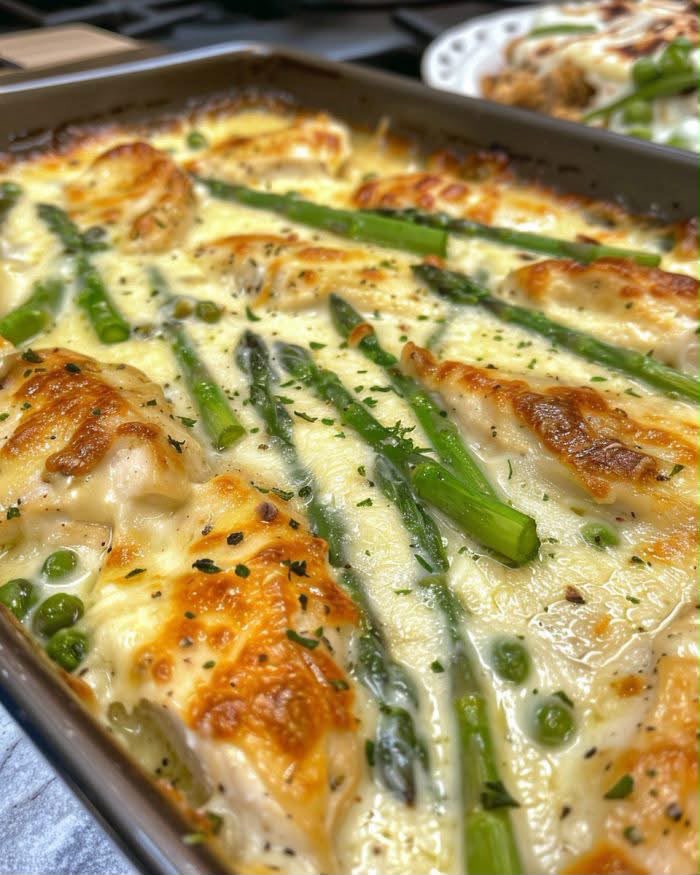
Arrange the chicken cutlets in the baking dish, scatter the frozen peas around them, then pour the sauce evenly over everything. Lay the asparagus spears across the top in a single layer, pressing them halfway into the sauce.
Step 6: Bake
Cover loosely with foil and bake for 20 minutes. This first stage cooks the chicken through while the foil prevents the surface from browning too early.
Step 7: Add cheese and broil
Remove the foil, scatter the mozzarella over the top, and return the dish to the oven for 10 to 12 minutes. Switch to the broiler for the final two minutes to get the blistered golden patches.
Step 8: Rest and serve
Let the dish sit for 10 minutes before serving so the sauce thickens and settles. Shower it with fresh parsley just before it goes to the table.
[AD PLACEMENT 4 — after the instructions]
Tips for the Best Results
Slice the chicken breasts horizontally without exception. Whole thick breasts need twenty extra minutes, and by then the asparagus has gone army-green and the sauce has reduced too far.
Add the frozen peas straight from the bag. Thawing them first makes them waterlogged and mushy, while frozen peas hold their shape and their bright color.
Lay the asparagus on top rather than burying it. Spears sitting partly above the sauce roast rather than steam, which keeps them snappy and lets the tips char slightly under the broiler.
Warm the milk and cream before adding them to the roux. Cold dairy hitting hot flour is the most common cause of lumps, and thirty seconds in the microwave prevents it entirely.
Never walk away during the broiling stage. Mozzarella goes from golden to black in under a minute, and the difference is the entire visual appeal of the dish.
Let it rest the full ten minutes. Served immediately, the sauce runs off the plate; after resting, it clings to every piece.
Variations to Try
Swap the chicken for salmon fillets and cut the covered bake to 12 minutes. The cream and lemon combination is a natural fit for fish, and the asparagus timing works perfectly.
For a lower-carb version, skip the flour and thicken with four ounces of cream cheese whisked into the warm cream instead. The texture is slightly richer and just as stable.
Add mushrooms if you want more depth. Sauté eight ounces of sliced cremini in the butter before the garlic, and let their moisture cook off completely first.
Broccoli florets and green beans both substitute for the asparagus one-for-one. Broccoli in particular soaks up the sauce beautifully and holds its texture better than asparagus does.
[AD PLACEMENT 5 — after the variations]
What to Serve With Creamy Chicken and Asparagus Bake
Crusty bread is almost mandatory, because leaving sauce in the dish would be a genuine loss. A baguette or focaccia does the job better than sliced sandwich bread.
Buttered egg noodles or orzo stretch the meal for a larger table. Both catch the sauce without adding competing flavors.
A sharp green salad cuts through all that dairy. Dress arugula or romaine with lemon, olive oil, and a little dijon, and skip creamy dressings entirely.
Roasted baby potatoes work if you want something heartier. Roast them at the same 400°F on a separate sheet pan while the casserole bakes.
Make-Ahead and Storage
You can assemble the entire dish up to 24 hours ahead, minus the mozzarella. Cover tightly with foil, refrigerate, and add 10 minutes to the covered bake time to account for the cold start.
The sauce can also be made separately up to three days in advance. Reheat it gently over low heat, whisking in a splash of milk to loosen it before assembling.
Leftovers keep for three days in an airtight container. Reheat covered at 325°F for about 15 minutes, adding a tablespoon of cream to bring the sauce back together.
Freezing is not recommended for this one. Cream sauces separate on thawing and asparagus turns limp, so this is a dish best made fresh.
Frequently Asked Questions
Can I use chicken thighs instead of breasts?
Yes, and boneless skinless thighs are actually more forgiving. Keep the covered bake at 25 minutes since thighs benefit from slightly longer cooking.
Can I use canned or jarred asparagus?
It is not a good substitute, because canned asparagus is already fully cooked and collapses in the oven. Frozen asparagus is a better backup, added straight from frozen.
Why did my sauce turn out thin?
Either the roux was undercooked or the sauce did not simmer long enough before assembling. It should visibly coat a spoon before it goes into the dish.
Can I make this gluten-free?
Yes, swap the flour for cornstarch, using one tablespoon whisked into a little cold milk and stirred into the simmering cream. The result thickens slightly faster.
What cheese works best if I have no mozzarella?
Gruyère, fontina, and provolone all melt well and add more flavor than mozzarella does. Avoid pre-shredded cheddar, which turns oily under the broiler.
Can I double this for a crowd?
Yes, using two separate 9×13-inch dishes rather than one very deep pan. Deep casseroles cook unevenly and the top browns long before the center is hot.
[AD PLACEMENT 6 — after the FAQ]
Nutrition Information
Per serving, based on 6 servings:
• Calories: 548
• Protein: 45 g
• Carbohydrates: 14 g
• Fat: 35 g
• Saturated fat: 20 g
• Sugar: 5 g
• Sodium: 780 mg
• Fiber: 3 g
These figures are estimates based on standard ingredient databases and will shift depending on the fat content of your dairy and the exact size of your chicken breasts. Substituting whole milk for half the cream lowers the calories by roughly 70 per serving.
Final Thoughts
This is the casserole for people who think they dislike casseroles. Nothing here comes from a can, the vegetables stay bright and distinct, and the sauce is built from scratch in the four minutes it takes to preheat the oven.
Make it once as written to learn the timing, then treat it as a template. The method holds up with almost any protein and any green vegetable you happen to have in the fridge.