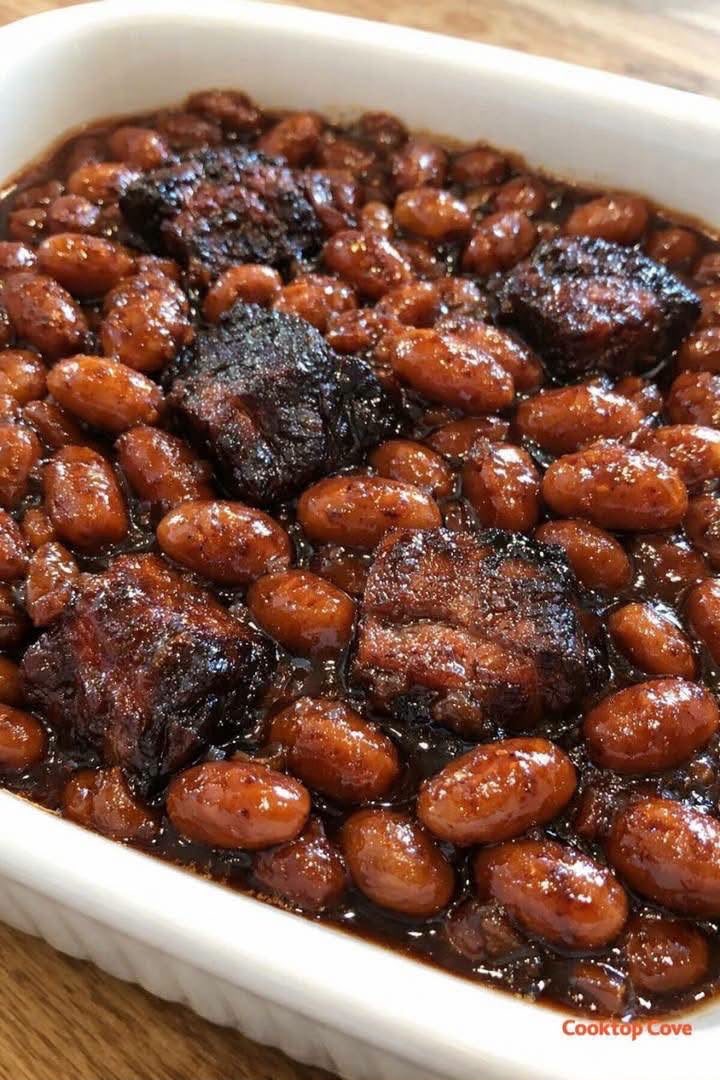
These baked beans are cooked long enough that the sauce reduces into a dark syrup rather than sitting thin around the beans, with cubes of burnt ends folded through. The pieces on top char slightly against the dry heat, which is exactly what you want.
The recipe is built around canned beans, not dried ones. Dried beans and an acidic sauce are a bad combination, and there is a reason nearly every barbecue joint uses canned.
Two hours in the oven does most of the work, and the last thirty minutes uncovered is where the colour comes from.
Why You Will Love This Recipe
The sauce actually thickens. Long uncovered baking evaporates liquid instead of trapping it, which is why these are not soupy.
Burnt ends turn a side into a main. Cubed, sauced pork belly or brisket point makes this substantial enough to eat on its own.
It scales to a crowd. One dish feeds twelve as a side, and it holds warm for an hour without suffering.
It reheats better than most sides. The flavour deepens overnight, which is rare for a bean dish.
Canned beans mean no soaking. No overnight planning and no unpredictable cooking times.
Recipe Overview
Prep time: 15 minutes
Bake time: 2 hours
Total time: About 2 hours 15 minutes
Yield: 12 side servings
Difficulty: Easy
Best for: Barbecue, cookouts, potlucks, holidays, game day
Ingredients
For the Beans
• 4 cans (15 oz each) navy beans or pinto beans, drained and rinsed
• 1 pound (450 g) burnt ends, or cubed cooked brisket or pork belly
• 6 slices thick-cut bacon, chopped
• 1 large yellow onion, finely diced
• 1 green bell pepper, finely diced
• 4 cloves garlic, minced
For the Sauce
• 1 cup (240 ml) barbecue sauce
• 1/2 cup (110 g) packed dark brown sugar
• 1/3 cup (80 ml) molasses
• 1/4 cup (60 ml) apple cider vinegar
• 2 tablespoons yellow mustard
• 1 tablespoon Worcestershire sauce
• 1 teaspoon smoked paprika
• 1 teaspoon garlic powder
• 1/2 teaspoon black pepper
• 1/4 teaspoon cayenne, optional
• 1/2 cup (120 ml) beef broth or water
Choosing the Right Beans and Meat
Navy beans are the traditional choice. Small, mild, and they hold their shape through two hours of baking while absorbing the sauce.
Pinto beans are the common substitute and slightly creamier.
Great northern beans work and are a little larger. Kidney beans hold up well but have a stronger flavour of their own.
Canned pork and beans can be used as a shortcut. If you do, drain off the packing sauce and reduce the brown sugar to 1/3 cup, since they are already sweetened.
Burnt ends are the ideal meat. These are cubes of brisket point or pork belly that have been smoked, cubed, sauced, and returned to the smoker until caramelized.
Substitutes that work well: chopped leftover brisket, cubed pulled pork, smoked sausage, or thick-cut bacon alone. Any of these give a good result.
Do not use raw meat here. Everything going into this dish should already be cooked. Two hours at 325°F will not properly cook raw pork belly.
Why Canned Beans Beat Dried Here
This is one of the few dishes where canned genuinely outperforms dried, and the reason is chemistry rather than convenience.
Acid stops beans softening. Vinegar, molasses, mustard, and barbecue sauce are all acidic, and acid strengthens the pectin in bean skins. Dried beans cooked in this sauce can stay firm for four or five hours.
Sugar does the same thing. It draws water out of the beans and slows hydration.
Canned beans are already fully cooked. They arrive soft, so the sauce only has to flavour them rather than tenderize them.
If you insist on dried, cook them fully in plain water first, then drain and proceed. Never start dried beans in the sauce.
How to Make Burnt Ends Baked Beans
Step 1: Cook the bacon
Preheat the oven to 325°F (165°C).
Cook the chopped bacon in a large oven-safe pot or skillet over medium heat for 6 to 8 minutes, until browned and most of the fat has rendered.
Step 2: Cook the vegetables
Add the diced onion and bell pepper to the bacon and its fat and cook for 5 to 6 minutes, until softened.
Add the garlic and cook for 1 minute more.
Step 3: Build the sauce
Add the barbecue sauce, brown sugar, molasses, vinegar, mustard, Worcestershire, smoked paprika, garlic powder, black pepper, cayenne if using, and broth.
Stir and bring to a simmer for 2 minutes, scraping the bottom of the pan.
Step 4: Add the beans
Stir in the drained beans until fully coated.
Rinse the beans well before adding them. The canning liquid is starchy and slightly metallic, and it muddies the sauce.
Step 5: Fold in the meat
Add about three quarters of the burnt ends and fold them through gently.
Reserve the rest for the top, where they will char.
Step 6: Transfer and top
If you are not using an oven-safe pot, transfer everything to a 9×13 inch baking dish.
Scatter the reserved burnt ends across the surface, pressing them lightly into the beans so they sit half exposed.
Step 7: Bake covered
Cover with foil and bake for 1 hour 15 minutes.
Step 8: Uncover and finish
Remove the foil and bake for a further 30 to 45 minutes, until the sauce has thickened noticeably and darkened, and the exposed meat has caramelized at the edges.
This uncovered stage is the entire point. Covered baking steams the dish and leaves it thin.
Step 9: Rest before serving
Let the dish stand for 15 minutes. The sauce thickens further as it cools and will look right by the time it reaches the table.
Tips for the Best Baked Beans
Rinse the canned beans thoroughly. It takes a minute and noticeably improves the sauce.
Bake uncovered for the last stretch. This is what separates thick baked beans from beans in soup.
Use dark brown sugar and real molasses. Both contribute colour as well as sweetness, and light brown sugar gives a paler, flatter result.
Leave some meat on top. Exposed pieces char in the dry heat and give the dish its best bites.
Taste before serving and adjust the vinegar. Two hours of baking mutes acidity. A splash of cider vinegar at the end lifts everything.
Common Mistakes to Avoid
Using dried beans in the sauce. They may never soften properly. Cook them separately first if you use them.
Covering the dish for the whole bake. The sauce stays thin and pale.
Skipping the vinegar. Without acid the dish is cloyingly sweet, and this is the most common complaint about homemade baked beans.
Adding raw meat. Two hours at 325°F is not enough for raw pork belly or brisket.
Baking too hot. Above 350°F the sugars scorch on the bottom before the sauce has reduced.
Easy Variations
• Sausage and bean. Replace the burnt ends with a pound of sliced smoked sausage or kielbasa.
• Pulled pork. Fold in 1 pound of leftover pulled pork and reduce the barbecue sauce slightly.
• Spicy. Add 2 diced jalapeños with the onion and increase the cayenne to 1/2 teaspoon.
• Bourbon. Add 1/4 cup of bourbon with the sauce ingredients.
• Slow cooker. Cook on low for 5 hours, then transfer to a baking dish and finish uncovered at 350°F for 30 minutes to thicken.
• Vegetarian. Skip the meat entirely, use vegetable broth, and add 1 teaspoon of liquid smoke and extra smoked paprika.
What to Serve With Them
These belong on a barbecue plate with brisket, ribs, pulled pork, or smoked chicken.
Coleslaw, cornbread, potato salad, and pickles are the standard supporting cast, and the coleslaw in particular cuts the sweetness.
For a cookout, they work alongside burgers, hot dogs, and grilled corn.
With enough burnt ends in them, they also stand alone as a main course with cornbread on the side.
Make-Ahead and Storage
Make-ahead: These are better made a day ahead. Bake fully, cool, refrigerate, and reheat covered at 325°F for 30 minutes. The flavour deepens overnight.
Refrigerator: Store in an airtight container for up to 5 days.
Freezer: Freeze for up to 3 months. The texture holds up well, which is unusual for a bean dish.
To reheat: Warm covered at 325°F for 25 to 30 minutes, adding a splash of broth if the sauce has set too thick. The stovetop over low heat also works.
Frequently Asked Questions
What exactly are burnt ends?
Cubes cut from the fatty point end of a smoked brisket, or from pork belly, which are sauced and returned to the smoker until the exterior caramelizes.
Can I make this without burnt ends?
Yes. Chopped brisket, pulled pork, smoked sausage, or a full pound of thick-cut bacon all work well.
Can I use dried beans?
Only if you cook them fully in plain water first. Acid and sugar prevent dried beans softening.
Why are my baked beans watery?
Almost always because they were covered for the whole bake. The final uncovered stretch is what reduces the sauce.
Are these too sweet?
The vinegar and mustard balance the sugar. If yours taste flat and sweet, add another tablespoon of cider vinegar at the end.
Can I make them in a slow cooker?
Yes, but finish them uncovered in the oven. A slow cooker cannot evaporate liquid, so the sauce will not thicken properly.
Nutrition Information
Approximate values per serving, based on 12 servings:
• Calories: 385
• Total fat: 14 g
• Saturated fat: 5 g
• Carbohydrates: 48 g
• Fiber: 8 g
• Sugar: 24 g
• Protein: 18 g
• Sodium: 790 mg
Nutrition is estimated and will vary with brands and portion sizes.
Final Thoughts
Burnt ends baked beans come down to two decisions: use canned beans, and take the foil off for the last forty minutes.
Rinse the beans, keep some meat exposed on top, and taste for vinegar before serving. That is what turns a sweet side dish into something people go back to.