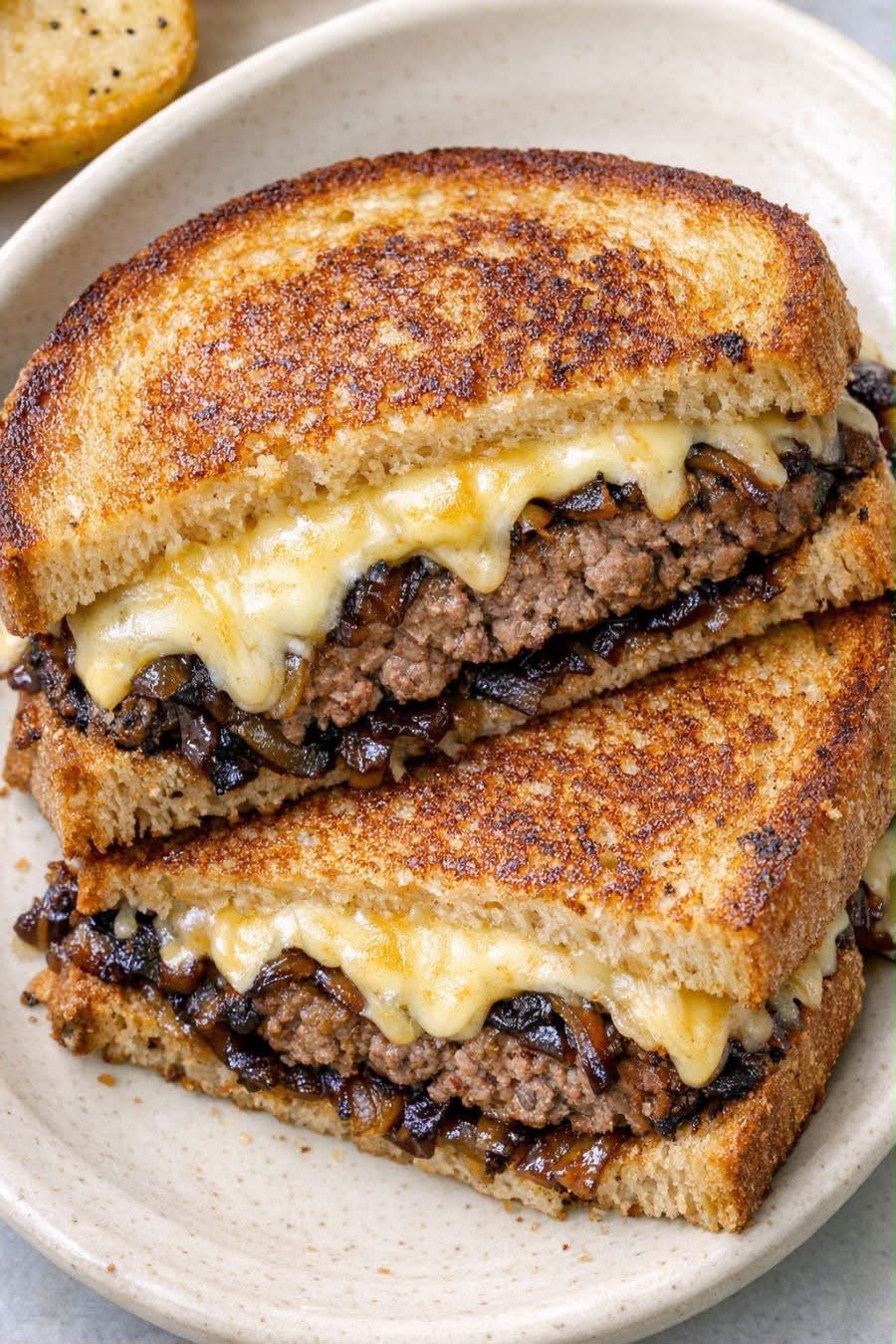
A patty melt is not a burger on toast. The bread is griddled in butter like a grilled cheese, the onions are properly caramelized rather than softened, and the whole thing is pressed until the cheese fuses the layers together.
The photo shows what it should look like inside: a thin beef patty, a dense layer of dark onions, and cheese that has melted into both. No lettuce, no tomato, nothing that would release water into a sandwich built on crispness.
The onions take thirty minutes and cannot be rushed. Everything else takes about fifteen.
Why You Will Love This Recipe
It is better than the burger it resembles. Griddled bread holds up where a bun goes soggy, and caramelized onions give it depth a burger rarely has.
Four ingredients carry it. Beef, onions, cheese, rye bread. Nothing else is required.
It uses one skillet. Onions, patties, and the final griddle all happen in the same pan.
It reheats well for a sandwich. A few minutes in a dry pan restores the crust almost completely.
It costs very little. Ground beef and an onion feed four people generously.
Recipe Overview
Prep time: 10 minutes
Onion time: 30 minutes
Cook time: 15 minutes
Total time: About 55 minutes
Yield: 4 sandwiches
Difficulty: Easy
Best for: Weeknight dinners, lunch, diner-style comfort food, late-night cooking
Ingredients
For the Caramelized Onions
• 2 large yellow onions, thinly sliced
• 2 tablespoons unsalted butter
• 1 tablespoon olive oil
• 1/2 teaspoon kosher salt
• 1 teaspoon granulated sugar
• 1 tablespoon Worcestershire sauce
For the Patties
• 1 pound (450 g) ground beef, 80/20
• 1 teaspoon kosher salt
• 1/2 teaspoon black pepper
• 1/2 teaspoon garlic powder
For Assembly
• 8 slices rye bread
• 8 slices Swiss or Gruyère cheese
• 4 tablespoons unsalted butter, softened
• Dijon or Russian dressing, optional
Choosing the Right Bread and Cheese
Rye bread is traditional and the best choice. Its tight crumb resists soaking through, and the caraway flavour cuts the richness of beef and cheese.
Sourdough is the best substitute. Sturdy, slightly tangy, and it griddles beautifully.
Avoid soft white sandwich bread. It compresses into a damp layer under the patty and tears when you press the sandwich.
Swiss is the classic cheese. It melts smoothly, browns well, and its mild nuttiness suits the onions.
Gruyère is the upgrade. More flavour, same melting behaviour, noticeably more expensive.
American cheese is not wrong. It melts more completely than anything else, which is exactly why diners use it. Use one slice of American and one of Swiss for both qualities.
Avoid pre-shredded cheese and hard aged cheeses. The first resists melting, the second turns oily rather than creamy.
Why the Patty Must Be Thin
A patty melt patty is not a burger patty, and treating it like one is the most common mistake.
It should be roughly the size and shape of the bread. Round patties on square bread leave corners with no filling and a middle that is too thick to bite through.
Thin means fast. A quarter-inch patty cooks in about four minutes total, which means it stays juicy rather than drying out while you wait for a thick centre.
The whole sandwich has to be bitable. A thick patty plus onions plus two slices of cheese plus two slices of bread does not compress into something you can eat.
Aim for about 1/4 inch thick and slightly larger than the bread, since it shrinks as it cooks.
How to Make a Patty Melt
Step 1: Start the onions
Melt the butter with the olive oil in a large skillet over medium-low heat. Add the sliced onions, salt, and sugar and stir to coat.
Step 2: Caramelize properly
Cook for 25 to 30 minutes, stirring every few minutes, until the onions are deep amber and reduced to about a quarter of their volume.
Add a splash of water whenever the pan looks dry and brown, scraping up the film. This is where most of the flavour comes from.
Stir in the Worcestershire at the end, then transfer the onions to a bowl and wipe the pan.
Step 3: Shape the patties
Divide the beef into 4 portions and press each into a thin rectangle roughly the size of your bread, about 1/4 inch thick.
Handle the meat as little as possible. Overworked ground beef turns dense.
Step 4: Season and sear
Season both sides with salt, pepper, and garlic powder.
Heat the skillet over medium-high and cook the patties for 2 minutes per side, until well browned. They should be just cooked through.
Set them aside and wipe out most of the fat.
Step 5: Butter the bread
Spread softened butter across one side of each slice of bread, edge to edge.
Butter, not oil. It browns unevenly in a way that gives the mottled golden crust in the photo, and it tastes better.
Step 6: Build the sandwiches
For each sandwich, place a slice of bread butter side down, then a slice of cheese, the patty, a generous spoonful of onions, a second slice of cheese, and the second slice of bread butter side up.
Cheese goes against both slices of bread. It melts into the surface and glues the sandwich together, which is what stops everything sliding out.
Step 7: Griddle
Cook over medium-low heat for 3 to 4 minutes per side, pressing gently with a spatula, until the bread is deep golden and the cheese has fully melted.
Medium-low, not medium-high. High heat browns the bread long before the cheese melts, which is the second most common failure.
Step 8: Rest briefly and cut
Let each sandwich sit for a minute, then cut in half diagonally with a sharp serrated knife.
The minute of rest lets the cheese set just enough that the filling stays put when cut.
Tips for the Best Patty Melt
Give the onions the full half hour. There is no shortcut. Ten-minute onions are softened, not caramelized, and the sandwich tastes flat without them.
Make the patty the shape of the bread. This one adjustment does more for the eating experience than any ingredient upgrade.
Butter the bread, not the pan. Butter in the pan burns and distributes unevenly. Butter on the bread browns exactly where it should.
Use cheese on both sides of the filling. It is structural, not just flavour.
Press gently and only once or twice. Hard pressing squeezes fat out of the patty and into the pan.
Common Mistakes to Avoid
Cooking on high heat. The bread scorches while the cheese sits cold in the middle.
Using a thick burger patty. The sandwich becomes impossible to bite and the proportions collapse.
Adding lettuce, tomato, or pickles inside. All release water into a sandwich whose entire appeal is a crisp exterior. Serve them on the side.
Skipping the sugar with the onions. It is not cheating, and it produces more even browning.
Assembling on cold bread in a cold pan. Everything should go into a pan already at temperature.
Easy Variations
• Mushroom patty melt. Add 8 ounces of sliced mushrooms to the onions for the last 10 minutes.
• Russian dressing. Spread a thin layer on the inside of the top slice for the classic diner version.
• Bacon patty melt. Add two slices of cooked bacon per sandwich.
• Spicy. Add pickled jalapeños and swap the Swiss for Pepper Jack.
• Sourdough melt. Use sourdough and Gruyère for a slightly more upscale version.
• Turkey patty melt. Use ground turkey with an extra tablespoon of olive oil mixed in.
What to Serve With It
Fries are the standard, and onion rings are the better choice given what is already in the sandwich.
A sharp dill pickle spear is close to mandatory. The acidity is what makes a second half of the sandwich possible.
Coleslaw, a green salad with vinaigrette, or a simple tomato soup all balance the richness.
Skip anything creamy on the side. The sandwich has that covered.
Make-Ahead and Storage
Make-ahead: Caramelize the onions up to 5 days in advance and refrigerate. This removes the only slow step, and the sandwich becomes a fifteen-minute meal.
Patties can be shaped a day ahead and stacked between parchment in the refrigerator.
Refrigerator: Store assembled leftover sandwiches wrapped for up to 2 days.
Freezer: Freeze the cooked patties and the onions separately for up to 3 months. Assembled sandwiches do not freeze well.
To reheat: Warm in a dry skillet over medium-low heat for 3 minutes per side, covered, so the cheese remelts before the bread over-browns. Avoid the microwave entirely.
Frequently Asked Questions
What is the difference between a patty melt and a burger?
A patty melt uses griddled bread instead of a bun, always includes caramelized onions and melted cheese, and never includes lettuce, tomato, or other cold toppings.
Can I use a different bread?
Sourdough is the best alternative. Any sturdy sandwich bread works. Soft white bread does not.
Why is my cheese not melting?
The heat was too high, so the bread browned before the cheese had time. Cook on medium-low and cover the pan for a minute if needed.
Can I make these ahead for a group?
Cook them in batches and hold them on a wire rack in a 250°F oven for up to 20 minutes. A rack keeps the bottoms crisp.
Do I need a griddle press?
No. Gentle pressure with a spatula is enough. A heavy pan set on top works if you want more contact.
Can I use ground turkey or chicken?
Yes, with a tablespoon of oil mixed in for moisture. The flavour is milder, so season a little more assertively.
Nutrition Information
Approximate values per sandwich, based on 4 servings:
• Calories: 720
• Total fat: 45 g
• Saturated fat: 22 g
• Carbohydrates: 38 g
• Fiber: 4 g
• Protein: 38 g
• Sodium: 980 mg
Nutrition is estimated and will vary with brands and portion sizes.
Final Thoughts
A patty melt rewards patience in exactly one place: the onions. Give them the full half hour and the rest of the sandwich takes fifteen minutes.
Keep the patty thin, put cheese against both slices of bread, and griddle on medium-low. That is the whole difference between a patty melt and a burger that fell into a grilled cheese.