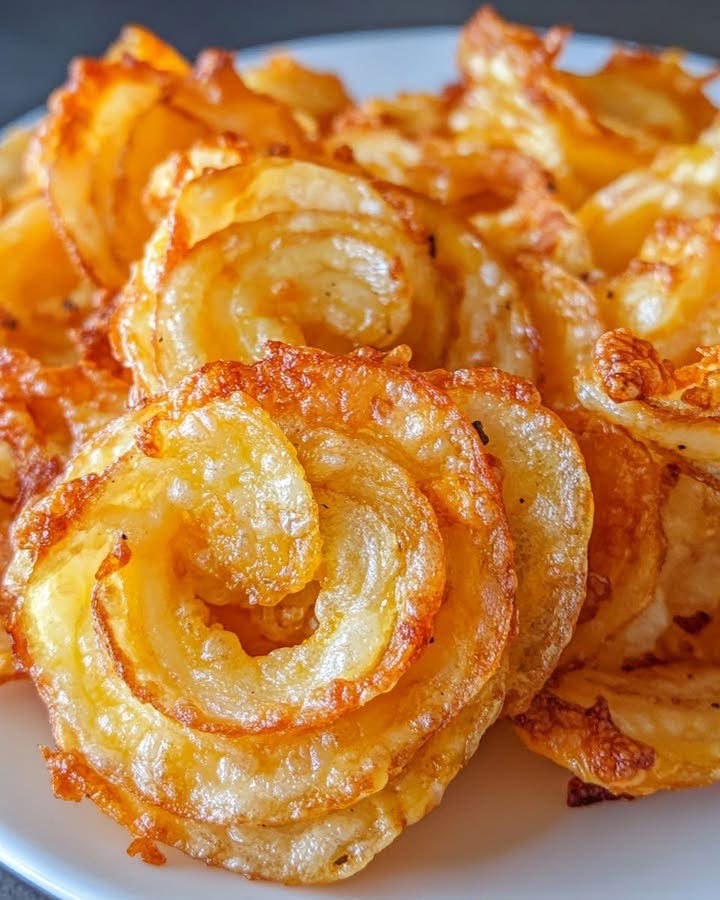
These onion rings are coated in a thin beer batter rather than breadcrumbs, which is why they fry into the translucent golden shells in the photo instead of a thick sandy crust. The batter is loose enough to see the onion through it and crisp enough to shatter when you bite.
The two decisions that matter are the batter consistency and the oil temperature. Everything else is technique you already have.
They are best eaten within about ten minutes of leaving the oil, which is the honest limitation of any fried onion ring.
Why You Will Love This Recipe
The crust shatters instead of crumbling. Cornstarch in the batter is what makes the difference.
The onion stays intact. A thin batter cooks fast, so the ring softens without turning to mush inside a heavy shell.
Six pantry ingredients. Flour, cornstarch, beer, baking powder, salt, and onions.
They fry in three minutes. Once the oil is up to temperature, the cooking is fast.
No breadcrumb station. One bowl of batter replaces the usual flour, egg, and crumb setup.
Recipe Overview
Prep time: 15 minutes
Rest time: 15 minutes
Fry time: 15 minutes
Total time: About 45 minutes
Yield: 4 to 6 servings
Difficulty: Easy to moderate
Best for: Game day, burgers night, appetizers, parties
Ingredients
For the Onions
• 2 large sweet onions, cut into 1/2-inch rings
• 1 cup (240 ml) buttermilk, optional soak
• 1/2 teaspoon kosher salt
For the Batter
• 1 cup (125 g) all-purpose flour
• 1/2 cup (60 g) cornstarch
• 1 teaspoon baking powder
• 1 teaspoon kosher salt
• 1/2 teaspoon garlic powder
• 1/2 teaspoon smoked paprika
• 1/4 teaspoon black pepper
• 1 1/4 cups (300 ml) cold lager or sparkling water
For Frying
• 6 cups neutral oil such as canola, peanut, or vegetable
To Finish
• Flaky sea salt
• Dipping sauce of choice
Choosing the Right Onions
Sweet onions are the best choice. Vidalia, Walla Walla, and Maui varieties have higher sugar and lower sulphur, so they turn mild and almost jammy inside the crust.
Yellow onions work well and cost less. They are sharper raw but mellow considerably in hot oil.
Red onions can be used but hold more moisture and have a more assertive flavour that competes with the batter.
Choose large onions. A large onion gives you wide rings that are easier to handle and look better on the plate. Small onions produce fiddly rings that break.
Cut them 1/2 inch thick. Thinner rings overcook before the batter browns. Thicker rings leave the onion raw and crunchy in the centre.
Why Cornstarch Is Non-Negotiable
Flour alone produces a batter that browns but stays slightly soft and chewy. Cornstarch is what makes it shatter.
Cornstarch has no gluten. Gluten develops into an elastic network that traps steam and turns leathery. Replacing a third of the flour with cornstarch limits how much gluten can form.
It also absorbs less oil, which is why cornstarch-heavy batters taste lighter and feel less greasy.
The ratio here is roughly 2 to 1. Two parts flour to one part cornstarch gives structure and crispness together.
Do not substitute all cornstarch. A pure cornstarch batter is brittle and slides off the onion.
How to Make Crispy Onion Rings
Step 1: Prepare the onions
Peel and slice the onions into 1/2-inch rings, then separate them carefully. Discard the small inner rings or save them for another use.
Step 2: Soak them, optionally
For milder, more tender rings, soak them in buttermilk for 30 minutes. Drain well and pat dry.
This step is worth doing with sharp yellow onions and unnecessary with sweet varieties.
Step 3: Mix the dry ingredients
Whisk the flour, cornstarch, baking powder, salt, garlic powder, smoked paprika, and black pepper together in a large bowl.
Reserve about 1/2 cup of this mixture in a separate bowl for dusting.
Step 4: Add the beer
Pour in the cold beer and whisk just until combined. Some small lumps are fine and preferable to an overworked batter.
The batter should be about the consistency of thin pancake batter and should coat a spoon in a translucent layer. If it is thick enough to be opaque, add more beer a tablespoon at a time.
Step 5: Rest the batter
Let the batter sit for 15 minutes at room temperature. This lets the flour hydrate and the bubbles distribute.
Step 6: Heat the oil
Heat 2 to 3 inches of oil in a heavy pot to 375°F (190°C). Use a thermometer.
Temperature is the single biggest variable in fried food. Below 350°F the batter absorbs oil and goes greasy. Above 385°F it browns before the onion softens.
Step 7: Dust, then dip
Toss each ring in the reserved dry mixture, shaking off the excess, then dip it in the batter and let the excess drip off for a second or two.
The dry dusting gives the batter something to grip. Skipping it is why batter slides off onion rings.
Step 8: Fry in small batches
Lower 4 to 5 rings into the oil at a time. Fry for 2 to 3 minutes, turning once, until deep golden.
Do not crowd the pot. Each addition drops the oil temperature, and a crowded pot never recovers.
Step 9: Drain and salt immediately
Lift the rings onto a wire rack set over a tray, not onto paper towels, and season with flaky salt while they are still glistening.
A wire rack keeps air circulating underneath. Paper towels trap steam and soften the bottom of every ring.
Tips for the Crispiest Onion Rings
Keep the batter cold. Cold batter hitting hot oil produces a more violent steam release and a lighter crust. Some cooks set the bowl in ice.
Use a thermometer, not guesswork. Bringing the oil back to 375°F between batches is the difference between crisp and greasy.
Dry the onions thoroughly. Water under the batter turns to steam and pushes the coating away from the ring.
Salt the moment they come out. Salt sticks to hot oily surfaces and slides off cooled ones.
Serve within ten minutes. This is a limitation, not a fault. Fried batter begins softening as soon as its internal steam condenses.
Common Mistakes to Avoid
Skipping the dry dust. Wet onion plus wet batter equals batter in the oil and bare onion on the plate.
Overmixing the batter. Vigorous whisking develops gluten and makes the crust chewy.
Crowding the pot. Four or five rings at a time in a large pot. More than that and the temperature crashes.
Draining on paper towels. The bottoms steam and go soft within a minute.
Using olive oil. Its smoke point is too low for 375°F frying and it gives an off flavour.
Easy Variations
• Air fryer. Dust and batter as usual, then cook at 400°F for 10 to 12 minutes, spraying generously with oil. The result is lighter but less shattering.
• Spicy. Add 1/2 teaspoon of cayenne to the batter and serve with sriracha mayo.
• Parmesan. Toss the hot rings with finely grated Parmesan and chopped parsley.
• Non-alcoholic. Replace the beer with cold sparkling water or club soda. The carbonation is doing most of the work anyway.
• Gluten-free. Use a gluten-free flour blend with the same cornstarch ratio. The result is actually crisper.
• Onion ring stack. Serve with burger sauce as a burger topping rather than a side.
What to Serve With Them
Burgers are the obvious partner, and onion rings on top of the burger is arguably better than beside it.
Steak, fried chicken, barbecue, and hot dogs all work.
For dips, put out two or three: garlic aioli, chipotle mayo, ranch, barbecue sauce, or a horseradish cream.
A sharp coleslaw or pickles cut through the richness better than another fried side.
Make-Ahead and Storage
Make-ahead: Slice the onions up to a day ahead and keep them covered in the refrigerator. The batter should be made within an hour of frying.
Refrigerator: Store cooled rings in an airtight container for up to 2 days. They will soften considerably.
Freezer: Freeze fried rings on a tray, then bag, for up to 2 months.
To reheat: Spread on a wire rack over a baking sheet at 400°F for 6 to 8 minutes, or in an air fryer at 400°F for 4 minutes. Never the microwave, which turns them limp.
Frequently Asked Questions
Why does my batter fall off the onion?
The rings were wet, or you skipped the dry flour dusting. Pat them dry and dust them first.
Can I make these without a deep fryer?
Yes. A heavy pot with 2 to 3 inches of oil and a thermometer works perfectly.
What oil is best?
Canola, peanut, vegetable, or sunflower. All have high smoke points and neutral flavour.
Can I use pancake mix or self-rising flour?
Self-rising flour works if you omit the baking powder and salt. Pancake mix contains sugar and will brown too fast.
Do I have to use beer?
No. Cold sparkling water or club soda gives nearly identical results, since the carbonation is what lightens the batter.
Can I reuse the frying oil?
Yes, two or three times. Cool it completely, strain it through a fine sieve, and store it in a sealed container away from light.
Nutrition Information
Approximate values per serving, based on 6 servings:
• Calories: 310
• Total fat: 16 g
• Saturated fat: 2 g
• Carbohydrates: 36 g
• Fiber: 2 g
• Protein: 5 g
• Sodium: 480 mg
Nutrition is estimated and will vary with oil absorption and portion sizes.
Final Thoughts
Onion rings come down to a thermometer and a batter thin enough to see through. Cornstarch handles the crispness, carbonation handles the lightness, and 375°F handles the rest.
Fry in small batches, drain on a rack, salt immediately, and eat them standing at the stove. That last part is not optional either.