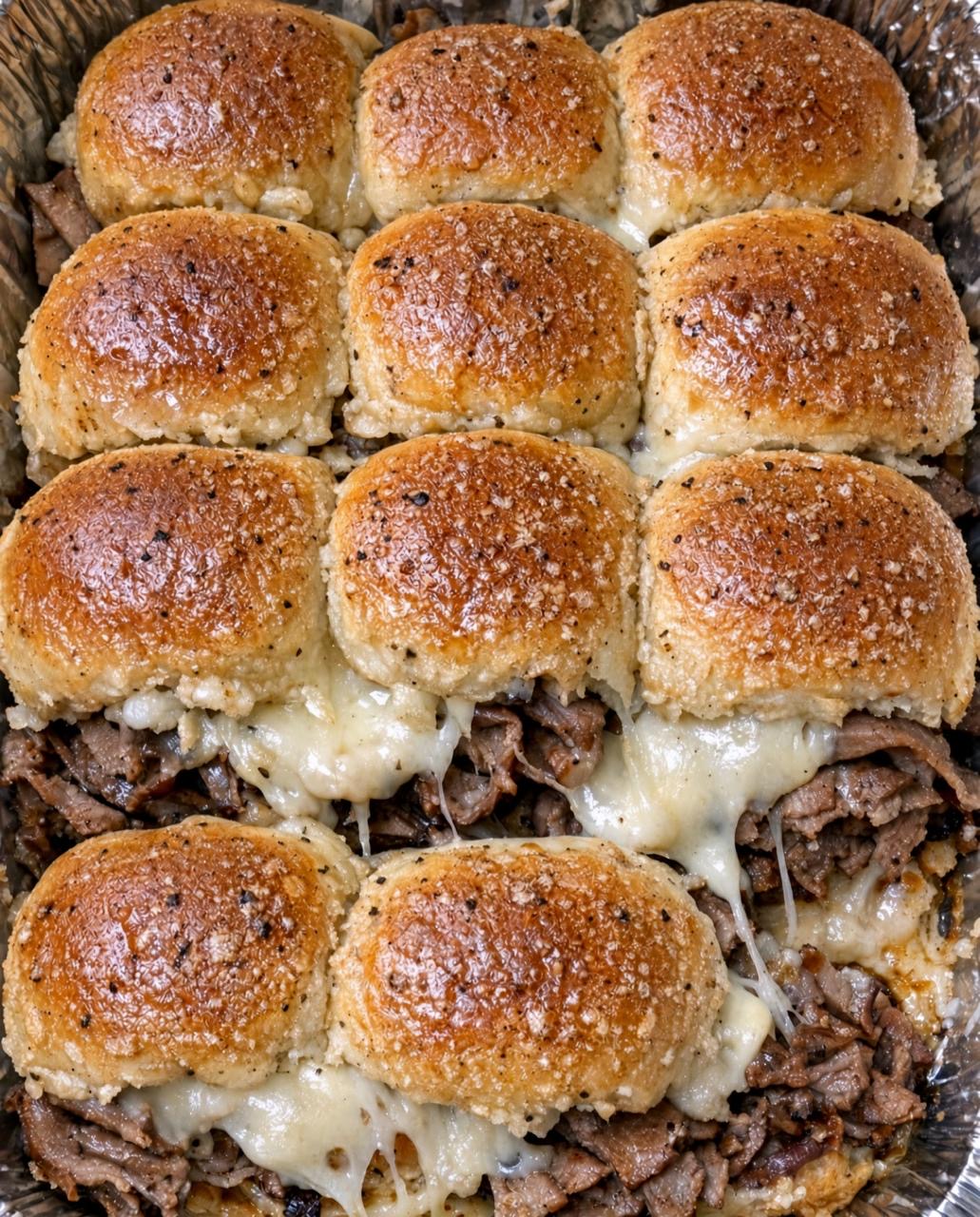
These Philly Cheesesteak Sliders take thinly sliced steak, sweet sautéed onions and peppers, and a heavy layer of provolone, then bake the whole thing inside soft dinner rolls under a garlic-butter glaze. They come out of the pan as one connected slab and pull apart into twelve individual sandwiches.
The bottom half of the rolls soaks up the steak juices while the tops turn glossy and golden from the butter topping. Every slider has cheese pulling out the sides, which is exactly the point.
They are built for feeding a group with almost no plating effort. One pan handles game day, a party table, a family dinner, or a lunch that needs to be portable.
Table of Contents
Why You Will Love This Recipe
Recipe Overview
Ingredients
Ingredient Notes
Choosing the Right Beef
Why Provolone Is the Right Cheese Here
How to Keep the Bottom Rolls from Going Soggy
How to Make Philly Cheesesteak Sliders
Tips for the Best Sliders
Easy Variations
What to Serve With Them
Make-Ahead, Freezing, and Storage
Frequently Asked Questions
Nutrition Information
Final Thoughts
[AD 1]
Why You Will Love This Recipe
Twelve sandwiches from one pan. No assembling anything individually. You build it in layers and cut it at the end.
The garlic butter topping does the heavy lifting. Butter, garlic, Parmesan, and cracked pepper brushed over the tops turn ordinary dinner rolls into something that tastes baked from scratch.
It uses cheap cuts well. Thinly sliced ribeye is traditional, but shaved sirloin, flank, or even deli roast beef all work here.
Make-ahead friendly. Assemble in the morning, refrigerate, and bake when people arrive.
Everyone recognizes it. Cheesesteak is a familiar flavor, so nobody has to be talked into trying it.
Recipe Overview
Prep time: 20 minutes
Cook time: 25 minutes
Total time: About 45 minutes
Yield: 12 sliders, serving 6 as a meal or 12 as an appetizer
Difficulty: Easy
Best for: Game day, parties, potlucks, family dinner, casual entertaining
[AD 2]
Ingredients
For the Sliders
12 Hawaiian sweet rolls or soft dinner rolls, kept connected
1 1/2 pounds thinly sliced ribeye or shaved steak
1 large yellow onion, thinly sliced
1 green bell pepper, thinly sliced
8 ounces cremini mushrooms, sliced, optional
2 tablespoons olive oil
1 teaspoon kosher salt
1/2 teaspoon black pepper
1 tablespoon Worcestershire sauce
12 slices provolone cheese
For the Garlic Butter Topping
4 tablespoons unsalted butter, melted
3 cloves garlic, minced
2 tablespoons grated Parmesan
1/2 teaspoon black pepper, coarsely cracked
1 teaspoon chopped fresh parsley, optional
Ingredient Notes
Rolls: Buy them in a connected slab and do not separate them. The whole method depends on slicing the entire sheet horizontally in one piece.
Steak: Ask the butcher for shaved steak or ribeye sliced for cheesesteaks. Many stores sell it pre-shaved in the freezer section.
Provolone: Sliced, not shredded. Slices lay flat and form a continuous cheese layer that holds the sandwich together.
Bell pepper: Green is traditional. Red or yellow are sweeter and perfectly good if that is what you have.
Worcestershire sauce: Small amount, large effect. It gives the beef the savory depth that plain salt cannot.
[AD 3]
Choosing the Right Beef
Ribeye is the traditional cut and the best-tasting one. Its fat marbling melts during the quick sear and keeps the meat tender even when sliced paper-thin.
Shaved steak from the freezer section is the practical everyday choice. It is usually sirloin or round, cooks in about three minutes, and costs considerably less than ribeye.
Flank or skirt steak works if you slice it yourself, but slice against the grain and as thin as you can manage. Thick slices of these cuts go chewy.
Deli roast beef is the shortcut version, and it is a legitimate one. Chop it roughly and add it to the vegetables at the very end, just long enough to warm through.
To slice steak yourself, freeze it for 20 to 30 minutes first. Partially frozen meat holds its shape against the knife and lets you get slices thin enough for this.
Why Provolone Is the Right Cheese Here
Provolone melts smoothly without splitting into oil and cheese, which matters when it sits under a hot roll for fifteen minutes.
It also has real flavor. Mozzarella melts more dramatically but tastes like almost nothing next to seasoned beef and onions.
American cheese is the authentic Philadelphia alternative and melts into an almost sauce-like layer. It is a genuine option, not a compromise, though the result is softer and less structured.
Provolone and mozzarella mixed half and half gives you the flavor of one and the cheese pull of the other. This is worth doing if the photos matter to you.
Avoid pre-shredded cheese in this recipe. The starch coating keeps it from melting into a smooth sheet, and you want a continuous layer, not clumps.
[AD 4]
How to Keep the Bottom Rolls from Going Soggy
Soggy bottoms are the main failure mode with any slider recipe, and the cause is always moisture sitting on untoasted bread.
Drain the steak and vegetables before layering. Tip the skillet and let the liquid run off, or lift the filling out with a slotted spoon.
Toast the bottom half of the rolls first. Five minutes in the oven at 350°F creates a dry surface that resists moisture.
Lay cheese directly on the bottom bread, under the meat. The melted cheese forms a barrier between the bread and the filling.
Cover with foil for the first part of the bake, then uncover. Foil the whole time traps steam, and steam is what softens the bread.
Serve within about thirty minutes of baking. These are at their best while the tops are still crisp and the bottoms are still firm.
How to Make Philly Cheesesteak Sliders
Step 1: Heat the oven and prepare the pan
Preheat the oven to 350°F (175°C).
Line a 9×13 inch baking dish with foil, letting a little hang over the edges so you can lift the whole slab out later.
Step 2: Slice the rolls
Keeping the rolls connected, slice the entire slab horizontally through the middle with a long serrated knife.
Place the bottom half in the prepared dish and set the top half aside.
Step 3: Toast the bottom half
Bake the bottom half alone for 5 minutes, until just dry to the touch.
This is the step most people skip, and it is the one that prevents a soggy base.
Step 4: Cook the vegetables
Heat 1 tablespoon of the olive oil in a large skillet over medium-high heat.
Add the onion, bell pepper, and mushrooms and cook for 6 to 8 minutes, until softened and lightly browned at the edges. Transfer to a plate.
Step 5: Sear the steak
Add the remaining oil to the same skillet and raise the heat.
Add the steak in a single layer and cook for 3 to 4 minutes, breaking it apart, until browned. Season with salt, pepper, and Worcestershire sauce.
Step 6: Combine and drain
Return the vegetables to the skillet and toss everything together for 1 minute.
Tilt the pan and drain off the accumulated liquid. This matters.
Step 7: Layer the sliders
Lay 6 slices of provolone over the toasted bottom rolls.
Spread the steak and vegetable mixture evenly over the cheese, then cover with the remaining 6 slices of provolone. Place the top half of the rolls over everything.
Step 8: Make the garlic butter
Stir together the melted butter, minced garlic, Parmesan, and cracked black pepper.
Brush the mixture generously over the tops of the rolls, letting it run into the seams.
Step 9: Bake
Cover loosely with foil and bake for 15 minutes.
Remove the foil and bake for another 5 to 8 minutes, until the tops are deep golden and the cheese is bubbling at the edges.
Step 10: Rest and cut
Let the pan sit for 5 minutes.
Cut along the seams with a serrated knife, sprinkle with parsley, and serve warm.
[AD 5]
Tips for the Best Sliders
Do not separate the rolls before baking. Slicing the connected slab in one piece is what keeps the filling contained and the sides sealed.
Get the skillet properly hot before the steak goes in. Thin steak in a lukewarm pan releases water and steams grey instead of browning.
Use cheese on both sides of the filling. The bottom layer blocks moisture and the top layer glues the roll tops down.
Push the garlic butter into the seams. Brushing only the domed tops leaves the sides dry and pale.
Cover for the first fifteen minutes, then uncover. Covered the whole time and the tops stay soft; uncovered the whole time and they darken before the middle heats through.
Cut with a serrated knife, not a chef’s knife. A straight blade compresses the sliders and squeezes the filling out the sides.
Easy Variations
Chicken cheesesteak sliders. Swap the steak for 1 1/2 pounds of thinly sliced chicken breast, cooked the same way.
Mushroom-free. Simply leave them out and add an extra half onion. The recipe works without any adjustment.
Spicy. Add sliced banana peppers or jalapeños with the vegetables, or use pepper jack in place of half the provolone.
Cheese whiz style. Skip the provolone and drizzle warmed cheese sauce over the steak layer for the authentic Philadelphia version.
Garlic Parmesan overload. Double the Parmesan in the topping and add a half teaspoon of Italian seasoning.
French dip version. Use roast beef and swiss, and serve with warm au jus for dipping.
Breakfast version. Use the same method with sausage, scrambled egg, and cheddar.
What to Serve With Them
A sharp, acidic side is what these need most. Dill pickles, pickled banana peppers, or a vinegar-based slaw cut through the butter and cheese.
Oven fries or potato wedges are the obvious pairing and turn the sliders into a full plate.
For a party spread, serve them with kettle chips and a simple green salad so there is something light on the table.
Warm au jus or a small bowl of marinara on the side gives people something to dip, and both work well with the flavors here.
[AD 6]
Make-Ahead, Freezing, and Storage
Make-ahead: Cook the steak and vegetable filling up to 2 days in advance and refrigerate. Assembly then takes about five minutes.
Assembled ahead: Build the sliders completely, cover with foil, and refrigerate for up to 8 hours. Add 5 minutes to the bake time and hold the garlic butter until just before baking.
Refrigerator: Store leftovers wrapped in foil for up to 3 days.
Freezer: Wrap the assembled, unbaked sliders tightly and freeze for up to 2 months. Thaw overnight in the refrigerator before baking.
Reheating: Reheat covered at 325°F for 10 to 12 minutes. The oven keeps the tops crisp; the microwave turns the rolls rubbery.
Frequently Asked Questions
Can I use deli roast beef instead of steak? Yes. Chop about 1 pound roughly and stir it into the cooked vegetables for the last minute, just to warm it.
What rolls work best? Hawaiian sweet rolls are the most popular because the sweetness plays against the savory filling. Any soft connected dinner rolls work equally well.
Can I make these without a 9×13 dish? Yes. A rimmed baking sheet works, though the sides of the sliders brown more without the dish walls holding heat.
Why is my filling falling out when I cut them? Usually too much filling, or cutting before the five-minute rest. The cheese needs a moment to set.
Can I assemble these the night before? Up to about 8 hours ahead is reliable. Longer than that and the bottom rolls soften even with toasting.
Do I need to use mushrooms? No. They are traditional in many cheesesteak versions but entirely optional here.
How do I double this recipe? Use two separate pans rather than one large one. Crowding slows the bake and leaves the centers underheated.
Nutrition Information
Approximate values per slider, based on 12 sliders:
- Calories: 385
- Total fat: 22 g
- Saturated fat: 11 g
- Carbohydrates: 26 g
- Fiber: 1 g
- Protein: 22 g
- Sodium: 620 mg
Nutrition is estimated and will vary with the cut of beef, the rolls, and the cheese used.
Final Thoughts
Philly Cheesesteak Sliders deliver the flavor of a proper cheesesteak with none of the per-sandwich assembly. Slice the rolls as one slab, toast the base, drain the filling, and finish with garlic butter.
Those four details are the whole recipe. Get them right and you end up with twelve sandwiches that hold together, stay crisp on top, and disappear faster than you expect.