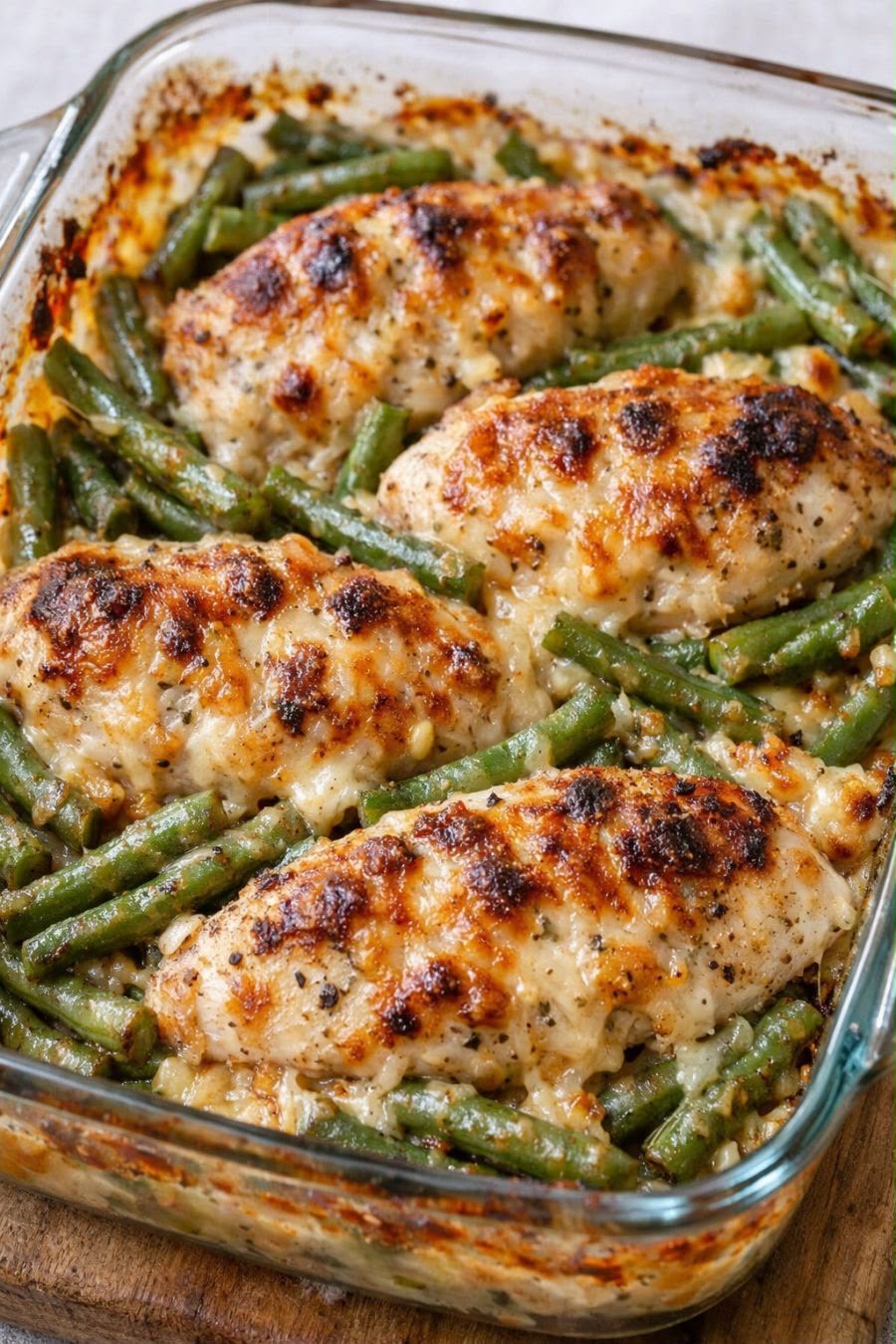
Chicken breasts nestled into a creamy, cheesy green bean base and baked together until the chicken browns on top and the beans underneath turn tender. One dish, minimal prep, and dinner and a vegetable cooked as a single unit.
The technique that matters is starting with fresh or thawed beans cut small, never a can. Canned green beans are already fully cooked and turn to mush under another forty minutes of oven heat, while fresh beans cut into short pieces cook down to tender in exactly the same window the chicken needs to reach temperature.
Fifteen minutes of prep, forty in the oven, and both parts of dinner finish at the same time.
Why You Will Love This Recipe
It is a complete meal in one dish. Protein and vegetable cook together, so there is no second pan and no separately timed side.
The sauce needs no roux. Cream, broth, and cheese combine directly and thicken in the oven around the beans.
The chicken stays juicy. Baked nestled into a moist base rather than exposed on a dry tray, it never dries out the way a plain baked breast can.
It is genuinely low effort. Fifteen minutes of chopping and mixing, then the oven does the rest.
It reheats as a complete plate. No coordinating two separately reheated components.
Recipe Overview
Prep time: 15 minutes
Cook time: 40 minutes
Total time: 55 minutes
Yield: 4 servings
Difficulty: Easy
Best for: Weeknight dinners, low-carb meals, using up fresh green beans
Ingredients
For the chicken
• 4 boneless skinless chicken breasts
• 1 teaspoon salt
• 1 teaspoon black pepper
• 1 teaspoon garlic powder
• ½ teaspoon paprika
For the green bean base
• 1½ pounds fresh green beans, trimmed and cut into 2-inch pieces
• 1 small onion, finely diced
• 3 cloves garlic, minced
• ¾ cup heavy cream
• ½ cup chicken broth
• 1 tablespoon Dijon mustard
• ½ teaspoon dried thyme
• ½ teaspoon salt
• ¼ teaspoon black pepper
For the topping
• 1½ cups sharp cheddar or Gruyère, freshly grated
• ½ cup parmesan, freshly grated
Choosing the Right Green Beans
The beans carry more of this dish than they might appear to, since they cook into the sauce itself.
Fresh green beans. The best choice by a wide margin. They hold enough structure to survive forty minutes in the oven while still becoming properly tender, and they release just enough liquid to help build the sauce.
Frozen green beans, thawed and well drained. A good substitute. Pat them dry after thawing, since they carry excess water that would otherwise thin the sauce.
Canned green beans. Not suitable. They arrive already fully cooked, and another forty minutes in the oven turns them to grey mush with no texture at all.
Haricots verts. Thinner and more delicate. They cook faster, so check at the 30-minute mark rather than waiting the full time.
Frozen French-cut green beans. Workable but they cook down faster and softer than whole pieces, giving a less distinct texture in the finished bake.
Trim the stem ends and cut into pieces around two inches. Shorter than that and they lose their identity in the sauce; longer and they are awkward to eat alongside the chicken.
Why Fresh Beans and a Nestled Assembly Both Matter
Green beans are cooked in stages, whether in a pot or an oven. Raw, they are firm and slightly squeaky. As they heat, the pectin holding their cell walls together breaks down gradually, moving from crisp to tender to, eventually, mush. Canned beans have already gone through nearly this entire process during commercial processing, so a second forty-minute cook pushes them straight past tender into disintegration.
Fresh beans cut to two inches start at the beginning of that curve, and forty minutes in a moist, covered environment brings them to tender exactly as the chicken finishes cooking. This is not a coincidence to work around but the entire reason the dish is built this way: the timing of raw chicken breasts reaching a safe internal temperature and the timing of raw green beans reaching tender both land in roughly the same window.
Nestling the chicken into the bean mixture rather than laying it on top of a separate layer matters for the chicken’s own texture. Surrounded by a cream and broth mixture, the chicken breast is partially insulated from the dry heat of the oven, cooking closer to a gentle braise than a bare roast. That is a large part of why chicken breast, a cut that dries out easily on its own, stays moist here through a fairly long bake.
How to Make Cheesy Chicken and Green Bean Bake
Step 1: Heat the oven
Preheat to 375°F and butter a 9×13 baking dish.
Step 2: Season the chicken
Pat the chicken breasts dry and season both sides with salt, pepper, garlic powder, and paprika. Set aside.
Step 3: Mix the bean base
In the baking dish, combine the green beans, onion, garlic, cream, broth, Dijon, thyme, salt, and pepper. Stir until evenly distributed.
Step 4: Nestle the chicken
Press the seasoned chicken breasts into the bean mixture so they are partially submerged, with the tops exposed.
Submerging most of the breast is what keeps it moist. Only the top should sit above the liquid.
Step 5: Cover and bake
Cover tightly with foil and bake for 25 minutes.
Covering traps the steam that cooks the beans and keeps the chicken from drying out early.
Step 6: Uncover and cheese
Remove the foil, scatter the cheddar and parmesan evenly over the chicken and beans, and return to the oven uncovered.
Step 7: Finish baking
Bake another 15 minutes, until the chicken reaches 165°F internally and the cheese is melted and browning in patches.
Step 8: Broil briefly if needed
If the top needs more colour, broil for 1 to 2 minutes, watching closely.
Step 9: Rest and serve
Rest 5 minutes before serving, spooning the sauce and beans over each portion of chicken.
Resting lets the sauce settle and the chicken juices redistribute.
Tips for the Best Chicken and Green Bean Bake
Use chicken breasts of similar size. Uneven sizes mean uneven cooking times, and one may dry out while another undercooks.
Do not skip the covered stage. It is what cooks the beans through and protects the chicken before the cheese goes on.
Grate the cheese from a block. Pre-shredded cheese is coated in cellulose, which prevents a smooth melt over the dish.
Check the chicken with a thermometer. 165°F in the thickest part is the target, and it is more reliable than timing alone.
Cut the beans evenly. Uniform two-inch pieces cook at the same rate, so none stay crunchy while others go soft.
Easy Variations
• Add sliced mushrooms to the bean mixture before baking
• Swap the cheddar for Swiss or Gruyère for a nuttier flavour
• Add crumbled cooked bacon over the cheese before the final bake
• Use crème fraîche in place of some of the heavy cream for tang
• Add a squeeze of lemon over the finished dish before serving
• Stir a tablespoon of grainy mustard into the sauce for extra sharpness
What to Serve With It
This is close to a complete meal on its own, since it already carries a protein and a vegetable. Mashed potatoes or crusty bread alongside catch the sauce, if you want something more substantial.
A simple green salad with a sharp vinaigrette is a good lighter option if the dish itself feels rich enough as it is.
Make-Ahead and Storage
Make ahead. Assemble the bean base and season the chicken up to a day ahead, keeping them separate and covered in the fridge. Combine and bake fresh.
Fridge. Store baked leftovers in an airtight container for up to 3 days.
Freezer. Not recommended. The cream sauce and green beans both change texture significantly on thawing.
Reheating. Cover and warm in a 350°F oven for 15 to 20 minutes, or in a covered skillet on the stove with a splash of broth. The microwave works for a single portion but softens the beans further.
Frequently Asked Questions
Can I use frozen green beans?
Yes, thawed and patted dry. Skip nothing else in the method.
Why is my sauce thin?
It likely needs the final uncovered stage to reduce, or the beans released more liquid than usual. Simmer it a few extra minutes uncovered if it is still loose after baking.
Can I use chicken thighs instead?
Yes. They are more forgiving of the bake time and stay moist even if left in a few extra minutes.
Do I have to cover it for the first stage?
Yes. That stage is what cooks the beans through and protects the chicken from drying out before the cheese goes on.
Can I add rice or pasta to make it heartier?
Not directly in this method, since raw rice or pasta would need more liquid and a longer cook than the chicken allows. Serve it over cooked rice or pasta instead.
How do I know the chicken is done?
165°F on an instant-read thermometer in the thickest part is the reliable marker, more so than time or appearance alone.
Nutrition Information
• Calories: 465 per serving
• Protein: 42g
• Fat: 27g
• Carbohydrates: 12g
• Fiber: 4g
• Sodium: 780mg
Nutrition is estimated and will vary with portion size and brands used.
Final Thoughts
Two rules make this dish come together properly. Use fresh or well-drained thawed beans rather than canned, and nestle the chicken into the sauce rather than laying it on top. The first keeps the vegetable from turning to mush and the second keeps the chicken from drying out.
The nestled-assembly principle is worth remembering for other one-dish chicken bakes. Surrounding a lean protein with a moist base rather than exposing it directly to dry oven heat is one of the most reliable ways to keep chicken breast from drying out, whatever vegetable or sauce you build around it.