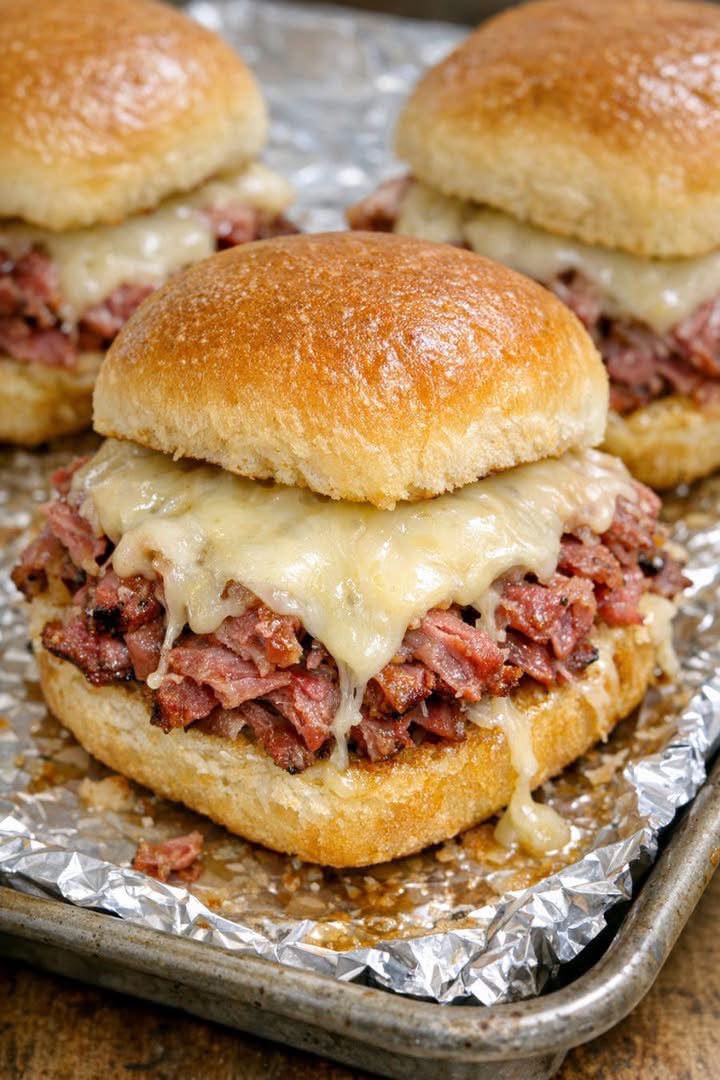
Chopped pastrami and melting Swiss piled into soft rolls, brushed with butter, and baked under foil until the cheese runs down the sides. Twelve sliders off one tray and they take half an hour.
The technique that decides the texture is baking covered first and uncovered second. Foil traps steam, which is what melts the cheese all the way through a stacked slider without drying out the meat. Take the foil off for the last five minutes and the tops brown properly. Do it the other way round and you get golden tops over cold, unmelted centres.
Fifteen minutes of prep, fifteen in the oven, and they pull apart at the table.
Why You Will Love This Recipe
Twelve sliders in one tray. A slab of connected rolls, sliced once horizontally, filled, and baked whole.
Deli pastrami does the work. No brining, no smoking, no cooking meat from raw.
They assemble ahead. Build them in the morning, bake them when people arrive.
The butter topping is what people remember. Melted butter with mustard, poppy seeds, and onion brushed over the tops before baking.
It scales easily. Two trays for a crowd, and nothing about the method changes.
Recipe Overview
Prep time: 15 minutes
Cook time: 15 minutes
Total time: 30 minutes
Yield: 12 sliders
Difficulty: Easy
Best for: Game day, parties, casual dinners, potlucks
Ingredients
For the sliders
• 12 slider rolls, connected in a slab
• 1 pound deli pastrami, thinly sliced
• 12 slices Swiss cheese, or 3 cups grated
• 3 tablespoons whole grain or Dijon mustard
For the butter topping
• 6 tablespoons butter, melted
• 1 tablespoon Dijon mustard
• 1 tablespoon poppy seeds
• 1 teaspoon onion powder
• 1 teaspoon Worcestershire sauce
• ½ teaspoon garlic powder
Optional additions
• 1 cup sauerkraut, squeezed very dry
• Sliced dill pickles
Choosing the Right Pastrami
The pastrami is the whole sandwich, so the counter is where this recipe is won.
Freshly sliced deli pastrami. The best choice by some distance. Ask for it sliced thin, and ask them not to press it into a solid block in the paper.
Hot pastrami from the steam counter. Excellent if your deli has one. Already warm and tender, and you can reduce the covered bake to eight minutes.
Pre-packaged sliced pastrami. Perfectly usable, though saltier and firmer. Chop it a little smaller to compensate.
Corned beef. A close relative and a good substitute, milder and less peppery. The dish becomes something closer to a Reuben.
Thick-cut pastrami. Hard to eat in a slider. The slices slide out whole when you bite.
Chop the slices roughly before they go in rather than laying them flat. Chopped pastrami stays put; whole slices pull out of the roll in one piece.
Why the Foil Comes First and the Meat Gets Chopped
A slider tray is a stack: bread, meat, cheese, bread. Heat from an oven arrives at the outside and has to travel inward, and bread is a good insulator. In an uncovered tray the tops start browning within five minutes while the cheese in the middle is still cold, and by the time the centre melts the rolls are dry and hard.
Foil changes the mechanism. Covered, the moisture in the bread and the meat turns to steam and is held in the tray, and steam transfers heat far more efficiently than dry air. Ten minutes under foil brings the whole stack to temperature evenly, the cheese melts through, and nothing dries out. Removing the foil for the final five minutes then gives the tops the direct dry heat they need to brown and take on the butter topping.
Chopping the pastrami is the second half of it. A stack of whole slices in a slider behaves like a single sheet, and it pulls out in one piece at the first bite, leaving bread and cheese behind. Roughly chopped meat interlocks with itself and with the melting cheese, so the filling holds together. It also distributes far more evenly across twelve rolls than draped slices ever do.
How to Make Pastrami and Swiss Sliders
Step 1: Heat the oven
Preheat to 350°F and line a 9×13 baking dish or tray with foil.
Step 2: Split the rolls
Slice the entire slab of rolls horizontally in one cut, keeping the top and bottom halves intact.
One cut, not twelve. Keeping the slab whole is what makes assembly fast.
Step 3: Chop the pastrami
Roughly chop the slices into pieces about an inch across.
This is what keeps the filling in the sandwich instead of pulling out in a sheet.
Step 4: Build the base
Place the bottom half in the tray and spread the mustard across it, then add half the Swiss.
Cheese under the meat as well as over it. The lower layer seals the bread against moisture.
Step 5: Add the filling
Distribute the chopped pastrami evenly, then the sauerkraut if using, then the remaining Swiss.
Squeeze the sauerkraut genuinely dry. Wet sauerkraut soaks the bottom rolls.
Step 6: Close and butter
Put the top half of the rolls in place. Mix the melted butter with the Dijon, poppy seeds, onion powder, Worcestershire, and garlic powder, and brush it generously over the tops.
Get it into the gaps between the rolls as well as over the surface.
Step 7: Bake covered
Cover tightly with foil and bake for 10 minutes.
Tightly. A loose cover lets the steam escape and defeats the purpose.
Step 8: Uncover and finish
Remove the foil and bake another 5 minutes, until the tops are golden and the cheese is bubbling at the edges.
Step 9: Rest and cut
Rest 5 minutes, then cut between the rolls with a serrated knife.
Resting lets the cheese set slightly so the sliders hold together when you separate them.
Tips for the Best Sliders
Slice the cheese yourself or buy it sliced. Pre-shredded cheese is coated in cellulose, which stops it melting smoothly.
Do not overfill. A pound of pastrami across twelve rolls. More and the tops slide off as people pick them up.
Brush the butter right to the edges. Corner rolls miss out otherwise and bake pale.
Use a serrated knife. A straight blade compresses the sliders and pushes the filling out.
Serve within twenty minutes. They are at their best hot, and the bread firms up as they cool.
Easy Variations
• Add Thousand Island dressing and sauerkraut for a full Reuben slider
• Swap the Swiss for provolone or havarti
• Use corned beef in place of pastrami
• Add caramelised onions between the meat and the top layer of cheese
• Use everything bagel seasoning instead of poppy seeds
• Add a layer of sliced dill pickles under the top rolls
What to Serve With It
Dill pickles are the standard partner and the acidity is genuinely needed against all that salt and fat. Potato chips or kettle chips do the rest.
For something more substantial, coleslaw, potato salad, or a bowl of soup alongside makes it a meal. On a party table these sit well next to a cheese dip and a bowl of olives.
Make-Ahead and Storage
Make ahead. Assemble completely, cover, and refrigerate for up to 24 hours. Brush with butter just before baking and add 5 minutes to the covered time.
Fridge. Store baked sliders covered for up to 3 days.
Freezer. Freeze assembled unbaked sliders, tightly wrapped, for up to 2 months. Bake from frozen, covered, for 25 minutes, then uncovered for 5.
Reheating. Cover with foil and warm in a 325°F oven for 10 minutes. The microwave makes the bread tough.
Frequently Asked Questions
Can I use corned beef instead?
Yes. It is milder and less peppery, and the result is closer to a Reuben.
Do I have to use sauerkraut?
No, it is optional. If you use it, squeeze it as dry as you can first.
Why are my bottom rolls soggy?
Usually wet sauerkraut, or too much mustard. A layer of cheese directly on the bottom bread also helps.
Can I make these on a grill?
Yes. Wrap the whole tray in foil and cook over indirect medium heat for about 15 minutes.
What rolls work best?
Soft slider rolls sold as a connected slab, such as Hawaiian or potato rolls. Individual buns work but assembly takes longer.
Can I assemble them the night before?
Yes, up to 24 hours. Hold back the butter topping until just before they go in the oven.
Nutrition Information
• Calories: 315 per slider
• Protein: 18g
• Fat: 19g
• Carbohydrates: 19g
• Fiber: 1g
• Sodium: 980mg
Nutrition is estimated and will vary with portion size and brands used.
Final Thoughts
Two rules carry these. Bake covered for ten minutes before you uncover them, and chop the pastrami rather than layering whole slices. The first melts the cheese all the way through and the second keeps the filling inside the roll.