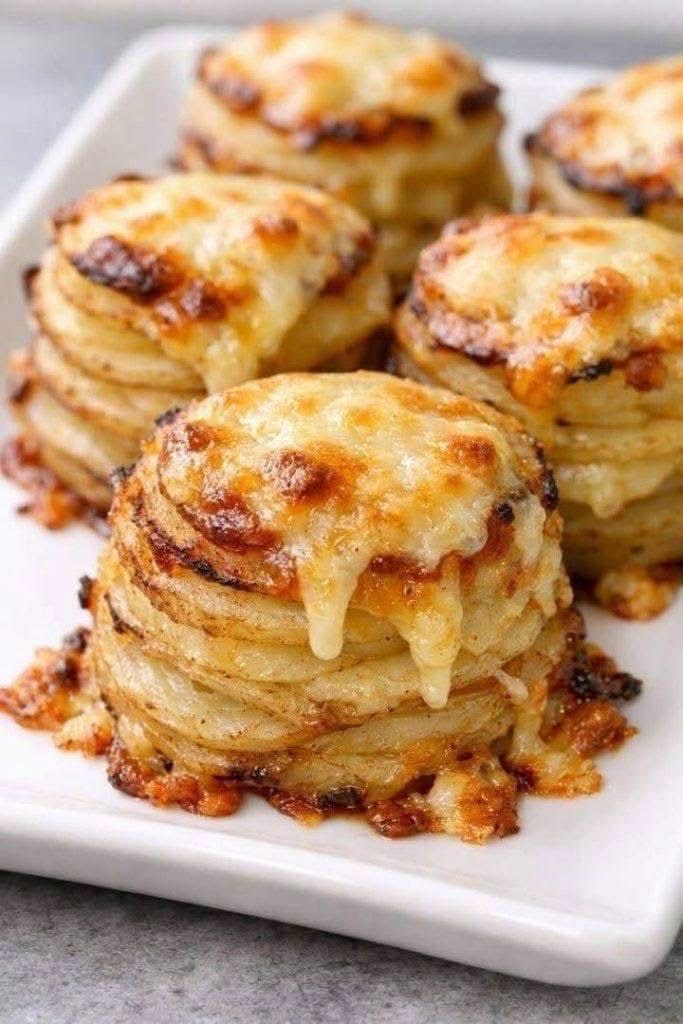
These are thin potato slices layered in a muffin tin with garlic butter and cheese, baked until the layers fuse into individual stacks with crisp edges and melted tops. They are essentially a gratin portioned before it goes in the oven.
The photo shows what makes them work: the slices are thin enough to compress into a single tender stack, and the top has browned rather than sitting pale and soft.
They take twenty minutes to assemble and about fifty in the oven, most of which is unattended.
Why You Will Love This Recipe
They portion themselves. No cutting a gratin at the table and no ragged servings.
Crisp edges and a soft centre. Every stack has both, which a large gratin dish cannot deliver evenly.
They look far harder than they are. Layering slices in a muffin tin is the entire technique.
They can be assembled ahead. Build them in the morning and bake before dinner.
Five real ingredients. Potatoes, butter, garlic, cream, and cheese.
Recipe Overview
Prep time: 20 minutes
Bake time: 45 to 55 minutes
Cool time: 5 minutes
Total time: About 1 hour 15 minutes
Yield: 12 stacks, 6 servings
Difficulty: Easy to moderate
Best for: Holidays, dinner parties, steak dinners, Sunday roasts
Ingredients
For the Stacks
• 2 1/2 pounds (1.1 kg) Yukon Gold or russet potatoes
• 4 tablespoons unsalted butter, melted
• 1/3 cup (80 ml) heavy cream
• 4 cloves garlic, finely minced
• 1 teaspoon kosher salt
• 1/2 teaspoon black pepper
• 1 teaspoon fresh thyme leaves, or 1/2 teaspoon dried
For the Cheese
• 1 cup (110 g) shredded Gruyère or Monterey Jack
• 1/2 cup (50 g) finely grated Parmesan
To Finish
• 2 tablespoons chopped fresh parsley or chives
• Flaky sea salt
Choosing the Right Potatoes and Cheese
Yukon Gold potatoes are the best choice. They hold together in stacks while staying creamy inside, and their thin skin means peeling is optional.
Russets work and give a fluffier interior with more browning, since their higher starch content caramelizes well. They are slightly more prone to falling apart.
Red potatoes are too waxy. The layers stay distinct rather than fusing, so the stacks come apart when lifted.
Choose potatoes with a diameter close to your muffin cups. Around two inches is ideal. Much larger and the slices need trimming; much smaller and the stacks are fiddly.
Gruyère is the best melting cheese here. It browns well and has enough flavour to carry the dish.
Parmesan does the browning and seasoning. Its low moisture and high salt content give the crisp golden top. Use both rather than choosing one.
Why the Slices Must Be Thin
Slice thickness is the single variable that decides whether these work.
Aim for about 1/16 of an inch, or 1.5 mm. At that thickness the slices soften enough to compress into a single unit and the layers fuse together.
A mandoline is the right tool. It is faster and far more consistent than a knife, and consistency matters more than speed here. Use the guard.
By knife it is possible but harder. Cut as thinly and evenly as you can, and expect the stacks to be slightly less cohesive.
Thick slices stay separate. At a quarter inch the slices cook as individual chips rather than merging, and the stack falls apart when lifted.
Do not rinse the slices. The surface starch is what glues the layers together. Rinsing washes it away, which is the opposite of what this recipe needs.
How to Make Cheesy Potato Stacks
Step 1: Prepare the tin
Preheat the oven to 375°F (190°C). Grease a 12-cup muffin tin generously with butter, including the flat surface between the cups.
Grease more than feels necessary. Potato starch and melted cheese stick firmly, and this is where most of the frustration with this recipe comes from.
Step 2: Make the butter mixture
Whisk together the melted butter, cream, minced garlic, salt, pepper, and thyme in a large bowl.
Step 3: Slice the potatoes
Slice the potatoes about 1/16 inch thick using a mandoline. Peeling is optional with Yukon Golds.
Slice directly into the butter mixture as you go, so the slices do not brown while you work.
Step 4: Coat the slices
Toss the slices thoroughly in the butter mixture until every one is coated.
Use your hands and separate the slices as you toss. Slices stuck together in pairs will not cook through.
Step 5: Stack them
Stack the slices into loose piles and slide each pile into a muffin cup, filling to just above the rim.
They shrink by roughly a third. Overfilling slightly is correct, not a mistake.
Step 6: Add cheese between layers
For the best result, add a pinch of Gruyère every four or five slices as you build each stack.
Cheese only on top gives a good crust but a plain interior. Cheese through the layers is what holds the stacks together.
Step 7: Bake covered
Cover the tin loosely with foil and bake for 30 minutes.
The foil traps steam and cooks the potatoes through. Uncovered from the start, the tops brown long before the centres are tender.
Step 8: Uncover and top
Remove the foil, scatter the remaining Gruyère and all the Parmesan over the stacks, and return to the oven.
Bake uncovered for 15 to 25 minutes, until the tops are deep golden and a knife slides easily into the centre of a stack.
Step 9: Rest and lift out
Let the tin sit for 5 minutes, then run a thin knife or small offset spatula around each stack and lift it out.
Five minutes lets the layers set. Lifting immediately makes them slump apart.
Tips for the Best Potato Stacks
Use a mandoline. Even slices are the difference between a stack and a pile.
Do not rinse the slices. The surface starch is the glue.
Grease the tin heavily, including the top surface. Cheese always spreads over the rim.
Cover for the first thirty minutes. Steam cooks the interior; dry heat browns the top. You need both, in that order.
Test with a knife, not the clock. It should slide through the whole stack with no resistance.
Common Mistakes to Avoid
Slicing too thick. The layers never fuse and the stacks collapse when lifted.
Rinsing the potatoes. Removes the starch that binds the layers.
Baking uncovered the whole time. Dark tops, hard edges, and raw centres.
Under-greasing the tin. The stacks tear apart on the way out.
Lifting them out immediately. They need five minutes to set.
Easy Variations
• Bacon and cheddar. Add crumbled cooked bacon between layers and use sharp cheddar.
• Rosemary and Parmesan. Swap the thyme for rosemary and use all Parmesan.
• Blue cheese. Crumble 1/2 cup of blue cheese through the layers with the Gruyère.
• Sweet potato. Use sweet potatoes and reduce the bake time by about 10 minutes.
• Herbed cream. Infuse the cream with a bay leaf and a garlic clove before mixing.
• Larger portions. Use a 6-cup jumbo muffin tin and add about 15 minutes.
What to Serve With Them
Steak is the obvious partner, and these plate far better than roast potatoes next to a ribeye.
Roast chicken, lamb, pork chops, or a holiday roast all work.
For vegetables, roasted asparagus, green beans, or a sharp salad balance the richness.
They also work at brunch alongside eggs and bacon, in place of hash browns.
Make-Ahead and Storage
Make-ahead: Assemble the stacks in the tin, cover tightly, and refrigerate for up to 8 hours. Add 5 to 10 minutes to the covered baking time. Do not slice potatoes more than a few hours ahead without keeping them fully coated in the butter mixture, or they will discolour.
Refrigerator: Store baked stacks in an airtight container for up to 3 days.
Freezer: Freeze baked and cooled stacks on a tray, then bag, for up to 2 months.
To reheat: Bake at 400°F for 10 to 12 minutes, or air fry at 375°F for 6 minutes. The microwave makes them soft and is best avoided.
Frequently Asked Questions
Do I need a mandoline?
It is strongly recommended. A knife works but the slices will be less even and the stacks less cohesive.
Should I peel the potatoes?
Optional with Yukon Golds and thin-skinned varieties. Peel russets, since their skin is thicker and separates from the flesh.
Why did my stacks fall apart?
The slices were too thick, they were rinsed, or they were lifted out too soon. All three are common.
Can I assemble them the night before?
Up to about eight hours ahead. Longer and the potatoes discolour and release water into the tin.
Can I use a different cheese?
Yes. Any good melting cheese works for the layers, but keep the Parmesan on top for browning.
Can I make these dairy-free?
Use olive oil in place of the butter, unsweetened oat cream, and a dairy-free hard cheese. They will brown less.
Nutrition Information
Approximate values per serving, based on 6 servings of two stacks:
• Calories: 385
• Total fat: 21 g
• Saturated fat: 13 g
• Carbohydrates: 38 g
• Fiber: 4 g
• Protein: 12 g
• Sodium: 520 mg
Nutrition is estimated and will vary with brands and portion sizes.
Final Thoughts
Cheesy potato stacks are a gratin with the portioning done in advance, and they come down to two decisions: slice thin enough that the layers fuse, and cover the tin for the first half of the bake.
Grease the tin heavily, tuck cheese through the layers rather than only on top, and give them five minutes before you lift them out.