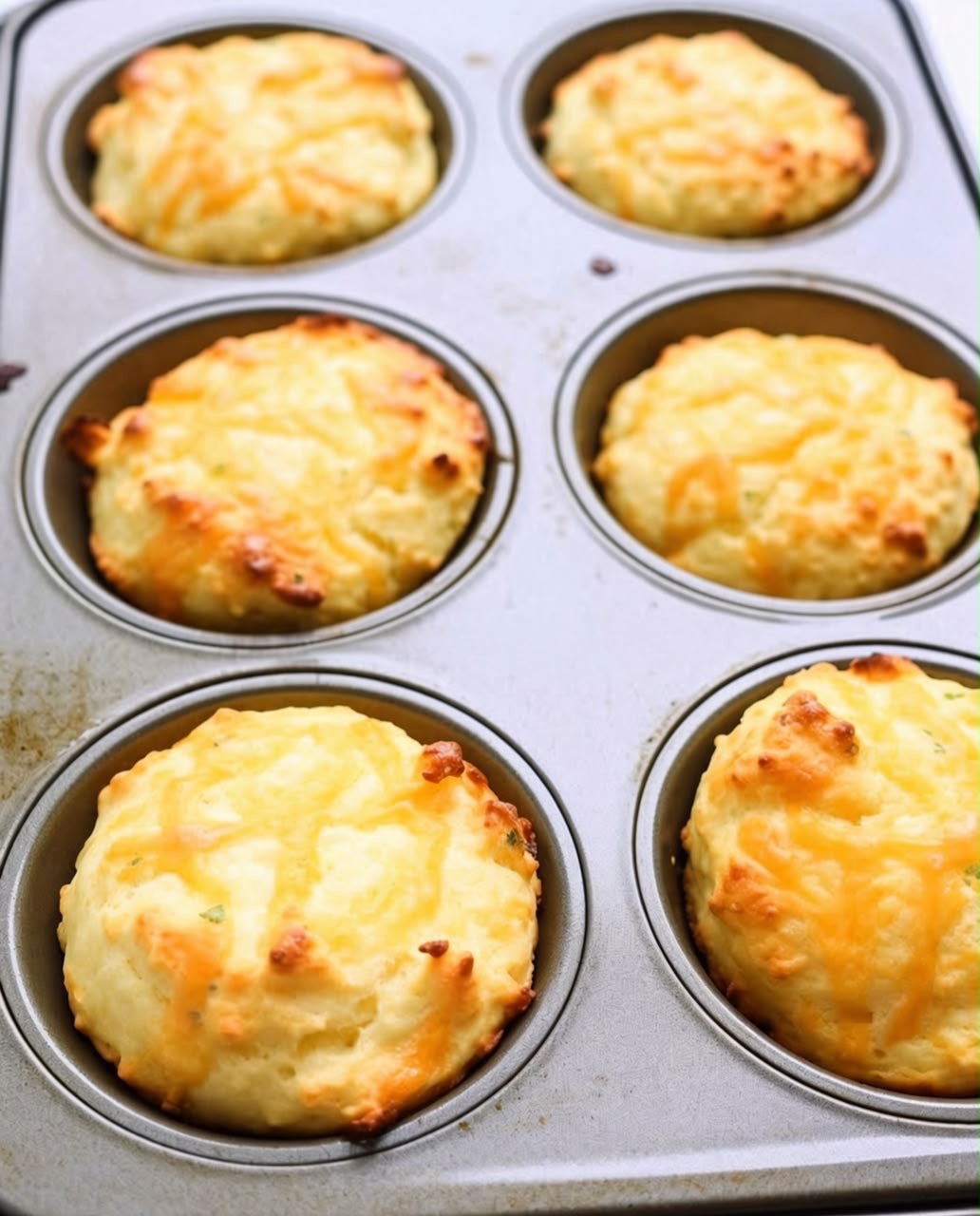
Cheesy Garlic Biscuit Muffins (Cheddar Bay Style, Ready in 30 Minutes)
These Cheesy Garlic Biscuit Muffins bake up tall and craggy with a soft, buttery crumb and a sharp cheddar crust that crisps right at the edges of the pan. They taste exactly like the warm cheddar biscuits you get at a seafood restaurant, but they come together in one bowl with no rolling, no cutting, and no biscuit cutter.
They are the answer for nights when dinner is almost ready and the bread basket is empty. Twelve minutes of hands-on work, sixteen in the oven, and a brush of garlic butter over the tops while they are still steaming.
Because the batter is a drop-biscuit batter baked in a muffin tin, the sides stay tender and the tops get all the browning. That contrast is the whole point of the recipe.
Why You Will Love These Cheesy Biscuit Muffins
One bowl, one whisk, no chilling. There is no cutting cold butter into flour and no resting time. Melted butter goes straight into the wet ingredients.
They are genuinely fast. Thirty minutes from an empty counter to a hot muffin in your hand, which makes them realistic on a weeknight.
The muffin tin does the shaping. Drop biscuits on a sheet pan spread out and flatten. The tin forces them upward, so you get height, a defined edge, and a consistent bake across all twelve.
They reheat well. Unlike most biscuits, these hold their texture for three days and come back to life in a hot oven in five minutes.
Easy to adapt. Swap the cheese, add bacon, make them spicy, or go herb-forward. The base batter tolerates a lot.
Recipe Overview
Prep time: 10 minutes
Bake time: 16 to 18 minutes
Total time: About 30 minutes
Yield: 12 muffins
Serving size: 1 muffin
Difficulty: Easy
Best for: Weeknight dinners, soup night, holiday tables, brunch, potlucks
Ingredients
For the Biscuit Muffins
2 cups (250 g) all-purpose flour, spooned and leveled
1 tablespoon baking powder
1 tablespoon granulated sugar
1 teaspoon garlic powder
1 teaspoon salt
1/4 teaspoon black pepper
1 1/2 cups (170 g) shredded sharp cheddar cheese
2 tablespoons finely chopped fresh chives or parsley
1 cup (240 ml) whole milk or buttermilk
1/3 cup (75 g) unsalted butter, melted and slightly cooled
1 large egg
For the Garlic Butter Topping
3 tablespoons unsalted butter, melted
1/2 teaspoon garlic powder
1 tablespoon finely chopped fresh parsley
Pinch of salt
Choosing the Right Cheese
Sharp cheddar is the best choice. Mild cheddar melts fine but disappears into the crumb. Sharp or extra-sharp cheddar keeps its flavor after baking, which is what makes these taste like restaurant cheddar biscuits instead of plain cheese bread.
Shred it yourself if you can. Pre-shredded cheese is coated with potato starch or cellulose to stop clumping. That coating slightly dulls the melt and can make the tops look powdery rather than glossy. Pre-shredded still works, especially on a busy night, but block cheese shredded on a box grater melts noticeably better.
Other cheeses that work: Gruyère for a nuttier, more grown-up version. Pepper Jack for heat. Smoked gouda for depth. A half-and-half mix of cheddar and Parmesan gives the sharpest, saltiest tops.
Avoid fresh mozzarella and other wet cheeses. The extra moisture makes the crumb gummy and stops the tops from browning.
Milk or Buttermilk?
Both work, and the difference is real but small.
Whole milk gives a softer, slightly sweeter crumb and a clean cheddar flavor. This is the version most people prefer on a first bake.
Buttermilk adds a gentle tang and reacts with the baking powder for a touch more lift. If you use buttermilk, the muffins are a little more tender and taste a little more like a Southern biscuit.
No buttermilk on hand? Add 1 tablespoon of lemon juice or white vinegar to a measuring cup, top with milk to reach 1 cup, and let it stand for 5 minutes.
Skip low-fat and skim milk if you can. There is not enough fat to keep the crumb tender, and the muffins turn out drier.
How to Make Cheesy Garlic Biscuit Muffins
Step 1: Heat the oven and prepare the pan
Preheat the oven to 400°F (200°C). Grease a 12-cup standard muffin tin generously with butter or nonstick spray, including the flat surface between the cups. Cheese always escapes over the rim, and greasing the top surface is what lets you lift the muffins out cleanly.
Paper liners work but will strip away some of the crisp cheesy edge. Greasing the metal directly gives a better crust.
Step 2: Whisk the dry ingredients
In a large bowl, whisk together the flour, baking powder, sugar, garlic powder, salt, and black pepper. Whisk for a full 20 seconds. Baking powder that is not evenly distributed leaves some muffins flat and others domed.
Step 3: Add the cheese and herbs
Add the shredded cheddar and the chopped chives to the flour mixture and toss with your fingers until every shred is coated in flour. Coating the cheese keeps it suspended in the batter instead of sinking to the bottom of each cup.
Step 4: Combine the wet ingredients
In a separate bowl or a large measuring cup, whisk the milk and the egg until smooth, then whisk in the melted butter.
Make sure the melted butter has cooled for a minute or two before it meets the egg. Butter straight off the heat can scramble it.
Step 5: Mix, but only just
Pour the wet mixture into the dry mixture. Fold with a rubber spatula for about 12 to 15 strokes, stopping the moment no dry flour is visible. The batter should be thick, lumpy, and shaggy.
This is the step that decides whether the muffins are tender or tough. Overmixing develops gluten, and gluten turns biscuit muffins rubbery. Lumps are correct. Smooth batter is a mistake.
Step 6: Fill the cups
Scoop about 1/4 cup of batter into each of the 12 cups. A large cookie scoop makes this fast and even. The cups will look nearly full, which is what you want for a proper domed top.
Do not smooth the tops. The rough peaks are what catch the heat and turn golden.
Step 7: Bake
Bake on the center rack for 16 to 18 minutes, until the tops are golden and the exposed cheese has browned at the edges. A toothpick inserted into the center should come out clean, with no wet batter clinging to it.
Ovens vary. Start checking at 15 minutes.
Step 8: Brush with garlic butter
While the muffins bake, stir together the melted butter, garlic powder, parsley, and salt.
As soon as the pan comes out of the oven, brush the garlic butter generously over every top. Doing this while the muffins are hot lets the butter soak in instead of sitting on the surface.
Step 9: Rest, then serve
Let the muffins sit in the pan for 5 minutes, then run a thin knife or an offset spatula around each one and lift it out. Serve warm.
Tips for the Best Biscuit Muffins
Grease the top of the pan, not just the cups. This one tip prevents almost every sticking problem people run into with cheesy muffins.
Measure flour by spooning and leveling. Scooping the cup directly into the bag can add 20 to 25 percent more flour, which produces dry, heavy muffins. A kitchen scale is better still.
Use fresh baking powder. If yours has been open longer than six months, test it: a teaspoon dropped into hot water should fizz immediately. Dead baking powder is the most common cause of flat biscuit muffins.
Bake on the center rack. Too low and the bottoms scorch before the tops color. Too high and the cheese browns before the centers set.
Do not open the oven in the first 12 minutes. The initial burst of steam is doing the lifting.
Fill any empty cups with water if you make a smaller batch, so the pan heats evenly.
Easy Variations
Bacon cheddar. Fold in 1/2 cup of cooked, crumbled bacon with the cheese. Reduce the salt to 3/4 teaspoon since bacon adds plenty.
Jalapeño popper. Add 2 tablespoons of finely diced jalapeño and swap 1/2 cup of the cheddar for cream cheese pinched into small pieces.
Herb and Parmesan. Replace 1/2 cup of the cheddar with grated Parmesan and add 1 teaspoon of dried Italian seasoning to the dry ingredients.
Everything bagel. Skip the parsley in the topping and sprinkle everything bagel seasoning over the muffins right after the garlic butter goes on.
Spicy honey. Add 1/4 teaspoon of cayenne to the batter and drizzle hot honey over the finished muffins instead of parsley.
Broccoli cheddar. Fold in 3/4 cup of finely chopped steamed broccoli, patted very dry. Wet broccoli will make the crumb soggy.
What to Serve With Them
These are built for soup. Tomato soup, broccoli cheddar, clam chowder, and creamy potato soup are all natural matches, and the muffins hold up to dunking better than sliced bread.
They also work as a dinner roll alongside roast chicken, pot roast, chili, or a big salad. On a holiday table they are a shortcut that looks like effort.
For brunch, split one, toast the cut sides in butter, and build a breakfast sandwich with a fried egg and a slice of ham.
Make-Ahead and Storage
Make-ahead: Whisk the dry ingredients (including the cheese and herbs) up to two days ahead and keep the bowl covered on the counter. Combine the wet ingredients separately and refrigerate. When you are ready, mix and bake. Do not mix the full batter in advance, because the baking powder begins working immediately and the muffins will not rise properly.
Room temperature: Store cooled muffins in an airtight container for up to 2 days.
Refrigerator: Because of the cheese and milk, refrigeration is safer past day two. They keep for up to 4 days in a sealed container.
Freezer: Cool completely, wrap each muffin in plastic, and freeze in a zip-top bag for up to 3 months.
To reheat: Bake at 350°F (175°C) for 5 to 7 minutes, or 10 to 12 minutes from frozen. An air fryer at 330°F for 3 to 4 minutes also works well. The microwave makes them soft and slightly rubbery, so use it only if speed matters more than texture.
Frequently Asked Questions
Why did my biscuit muffins turn out dense? Almost always overmixing or too much flour. Fold only until the flour disappears, and spoon your flour into the measuring cup rather than scooping.
Can I make these without a muffin tin? Yes. Drop 1/4-cup mounds onto a parchment-lined baking sheet, spaced 2 inches apart, and bake for 12 to 14 minutes. They will be wider and flatter, with more crisp edge and less soft center.
Can I use self-rising flour? Yes. Use 2 cups of self-rising flour and omit both the baking powder and the salt.
Can I make them gluten-free? A cup-for-cup gluten-free flour blend containing xanthan gum works well here. The crumb is slightly more delicate, so let the muffins rest a full 10 minutes in the pan before removing them.
Can I make them dairy-free? Use a plant-based butter, unsweetened almond or oat milk, and a dairy-free cheddar-style shred. The tops will brown less, so bake toward the longer end of the range.
How do I get taller muffins? Fill the cups nearly to the rim, make sure your baking powder is fresh, and get the pan into a fully preheated oven.
Can I double the recipe? Yes, and it scales cleanly. Bake two pans on the center and upper-center racks, and rotate them halfway through.
Nutrition Information
Approximate values per muffin, based on 12 muffins:
Calories: 230
Total fat: 14 g
Saturated fat: 8 g
Carbohydrates: 18 g
Protein: 8 g
Sodium: 420 mg
Nutrition is estimated and will vary with brands and portion sizes.
Final Thoughts
Cheesy Garlic Biscuit Muffins solve a specific problem: you want warm homemade bread with dinner and you do not have an hour. One bowl, a muffin tin, and half an hour gets you twelve of them, golden on top and soft inside, with garlic butter soaking into every crack.
Make them once and you will start planning soup around them. If you try a variation, the bacon cheddar version is the one people ask for again.
Zedt f blayes dyal ad slots f l version dyal l file. Hna khlithom barra bach ykon copy nqi.