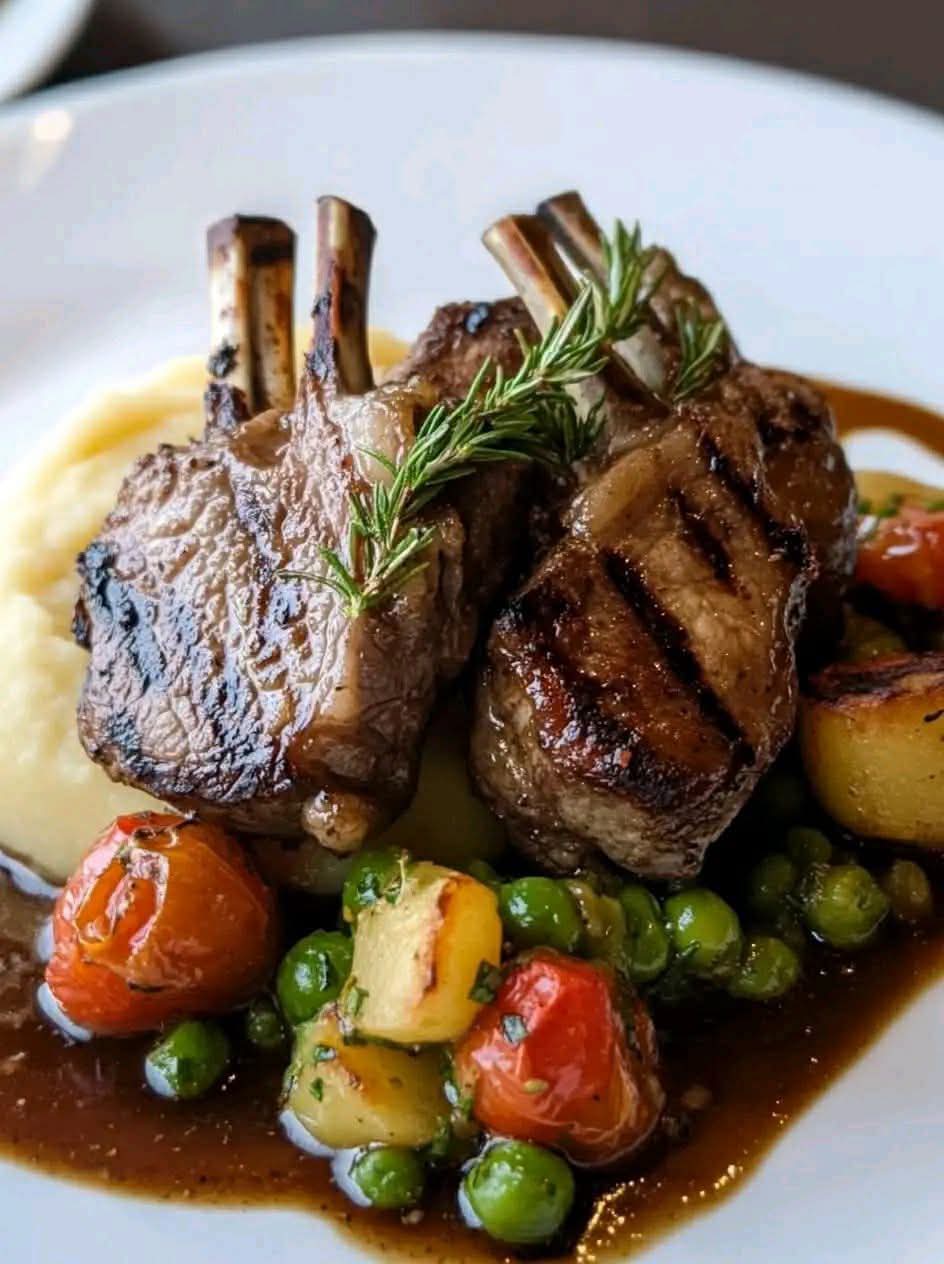
Fire-Kissed Karoo Lamb Chops with Velvety Creamed Potatoes, Rustic Ratatouille, Minted Pea Purée, and Rich Lamb JusAn Ode to the South African Veld: A Culinary Masterpiece of Smoke, Slow-Simmered Depth, and Vibrant Garden FreshnessThere exists a rare and hallowed category of dishes that transcend mere sustenance to become an experience—a symphony of elemental forces, a dialogue between the rugged earth and the refined hand of the chef. The dish before you, the Fire-Kissed Karoo Lamb Chops, is precisely such a creation. It is a plate that tells a story of vast, semi-arid landscapes, of ancient herding traditions, of open flames and patient reduction. Each component has been conceived not as an isolated element but as a movement within a larger composition, where smoke, cream, earthiness, brightness, and umami-rich meatiness converge.Let us begin by deconstructing each element in turn, exploring its provenance, preparation, and purpose, before finally understanding how they unite to form a truly unforgettable main course.—The Protagonist: Fire-Kissed Karoo Lamb ChopsThe soul of this dish lies in its lamb, and not just any lamb—it is Karoo lamb, a product of the semi-desert Karoo region of South Africa. What sets Karoo lamb apart is its terroir, a word more often reserved for wine. The region is carpeted in a dazzling biodiversity of hardy, drought-resistant shrubs and aromatic herbs: wild rosemary (kapokbos), thyme, sage, buchu, and a host of other indigenous succulents and bushes. As the sheep graze freely across this vast, unforgiving landscape, they consume these herbs daily, which infuses their fat with a subtle, complex herbal character—hints of rosemary and juniper, a whisper of aniseed, and a faint, pleasant earthiness. This is not a gamey or aggressive flavor; rather, it is a sophisticated, aromatic nuance that discerning palates revere worldwide, often compared to the finest herb-crusted meats but achieved entirely through nature.The chops themselves are cut from the prime rib section, each one a generous, double-cut or single-cut rib, marbled with just the right amount of fat to ensure juiciness and flavor during high-heat cooking. A typical portion includes three to four chops, weighing approximately 250 to 300 grams in total. They are then “fire-kissed”—a term that deliberately evokes a specific, primal cooking method. This is not a simple pan-sear on a stovetop. The lamb is cooked over a live, open flame, ideally using hardwood coals such as rooikrans (red gum) or kameeldoring (camel thorn), traditional South African braai woods that burn at an exceptionally high temperature and impart a clean, aromatic, slightly sweet woody smoke unlike any charcoal briquette.The chef carefully manages a two-zone fire. The chops are first seared fiercely over the hottest coals, about two to three minutes per side, to achieve a dramatic, caramelized crust—a deep mahogany brown, almost blackened in spots, where the Maillard reaction has worked its magic to create hundreds of savory, roasted flavor compounds. Then, they are moved to the cooler, indirect heat zone, covered loosely with foil, and allowed to finish cooking gently for another four to six minutes, ensuring a perfect medium-rare center: warm, red, incredibly tender, and registering an internal temperature of 54–57°C (130–135°F). The result is a chop that is smoky on the outside, almost sweet from the caramelization of natural sugars in the fat, and succulent within, each bite releasing that signature Karoo herbaceousness that lingers pleasantly on the palate.—The Foundation: Velvety Creamed PotatoesWhile the lamb commands attention, it requires a soft, luxurious bed upon which to rest. That role falls to the velvety creamed potatoes. These are not mere mashed potatoes; they are an exercise in texture and dairy alchemy, a benchmark of classical French purée technique adapted for warmth and comfort.The chef begins with a floury potato variety such as Maris Piper, Desiree, or a local South African cultivar like Up-to-Date. These potatoes are high in starch and low in moisture, which is essential for achieving a light, fluffy result. Approximately 800 grams of potatoes are peeled, cut into uniform 4-centimeter chunks to ensure even cooking, and slowly simmered in lightly salted water—or, for deeper flavor, in a mixture of milk and cream that pre-infuses the starch with richness. Once fork-tender, typically after fifteen to twenty minutes of gentle boiling, they are drained thoroughly and passed through a ricer or a fine-mesh tamis. A food processor is never used, as its high-speed blades would shear the starch molecules, develop gluten, and create a gluey, unpleasantly elastic texture.The hot, riced potatoes are then returned to the pot and worked gently with a silicone spatula over low heat for one to two minutes to drive off excess steam and surface moisture. Into this dry, fluffy base, the chef incorporates small, cold cubes of high-quality unsalted butter—100 grams in total, ideally a European-style butter with 82% butterfat or higher—allowing each cube to melt slowly into the potato. Next comes a stream of warm, double-thick cream (or clotted cream for extra decadence) at 120 milliliters, followed by 60 milliliters of full-cream milk. These liquids are folded in with deliberate, sparing movements, never whipped or beaten. The goal is a purée that is impossibly smooth, glossy, and rich, yet still light enough to be spooned without feeling like a paste or a glue.A final seasoning of white pepper (used instead of black to avoid dark specks that would mar the pristine cream color), fine sea salt, and a generous whisper of freshly grated nutmeg elevates the potatoes from simple comfort to refined elegance. The nutmeg, in particular, provides a warm, slightly sweet aromatic note that complements both the lamb and the ratatouille. When done correctly, these creamed potatoes should feel like a savory cloud on the tongue—airy, buttery, and deeply satisfying without being heavy.—The Garden’s Bounty: Rustic RatatouilleTo cut through the richness of the lamb and the cream, we introduce the rustic ratatouille. Unlike the finely diced, meticulously arranged tian of Provence, which is baked into a compact vegetable cake, this version embraces a bolder, more robust, looser character. Each vegetable is cooked separately to preserve its individual integrity, texture, and color before being married together—a classic Provençal technique that prevents the dish from becoming a monochrome, mushy stew.The components are quintessential summer, each prepared with care. Deep-purple eggplant (aubergine), one large specimen weighing approximately 350 grams, is cut into rough 2-centimeter chunks with its skin left on for color, texture, and nutritional value. Zucchini (courgettes), two medium specimens totaling about 300 grams, are cut into similar-sized pieces, each one glistening with olive oil as they hit the pan. Sweet bell peppers—one red and one yellow—are charred briefly over an open gas flame or under a broiler until their skins blister and blacken, then placed in a covered bowl to steam for ten minutes, making the skins easy to peel away. Once peeled, the peppers are sliced into wide, rustic strips. Finally, ripe, meaty Roma tomatoes—four medium fruits, about 400 grams—are briefly blanched, shocked in ice water, peeled, seeded by hand, and then crushed roughly between the fingers to preserve a chunky texture.Each vegetable is sautéed separately in extra-virgin olive oil (two tablespoons per batch) with a sliced garlic clove and a sprig of fresh thyme until just tender and lightly caramelized at the edges—about three to four minutes per batch. They are then removed to a plate. In the same large, wide pan, a soffritto of finely diced onion (150 grams), fennel bulb (75 grams), and celery (50 grams) is slowly sweated in two more tablespoons of olive oil over medium-low heat for eight to ten minutes, until translucent and fragrant but not browned.A splash of dry white wine—100 milliliters of a crisp Sauvignon Blanc or unoaked Chenin Blanc—is added to deglaze the pan, scraping up the flavorful browned bits (sucs) left behind from the vegetables. The reserved eggplant, zucchini, peppers, and tomatoes are then returned to the pan, along with a fresh bundle of herbs: four sprigs of thyme, one sprig of rosemary, and one bay leaf. The mixture simmers gently for no more than fifteen minutes—just enough for the flavors to meld and exchange essences, but not so long that the vegetables lose their individual shapes or vibrant hues. The herb bundle is removed before serving. The result is a ratatouille that is rustic, yes—chunky, varied, and full of textural contrast—but also bright, tangy, and faintly sweet from the roasted peppers. It offers a vegetal, slightly acidic counterpoint to the richness elsewhere on the plate.—The Bright Element: Minted Pea PuréeA dish that features lamb and mint is a classic pairing for good reason: the cool, sweet, slightly camphoraceous note of fresh mint cuts directly through the fattiness of the meat, refreshing the palate with each bite and resetting the taste buds for the next mouthful. Here, that timeless pairing is elevated into a silky, vibrant green purée that serves as both a flavor bridge and a visual jewel.The minted pea purée begins with the best possible peas—preferably fresh garden peas in spring, or high-quality petite frozen peas that have been flash-frozen within hours of harvest at peak sweetness. Approximately 300 grams of shelled peas are used. The peas are blanched for just 45 seconds in salted, vigorously boiling water, then immediately plunged into an ice bath to shock them and fix their brilliant emerald color. This rapid chilling also stops the cooking process, preserving the peas’ natural sweetness and preventing them from becoming mealy.Fresh mint leaves—spearmint, not peppermint, for a milder, sweeter, less medicinal flavor—are similarly blanched for ten seconds and then shocked. Approximately 20 grams of leaves (a tightly packed cup) are used, with all tough stems removed beforehand. Blanching the mint softens its raw, grassy edge and deepens its color while retaining its essential aromatic oils.Drained and patted dry on paper towels, the peas and mint are transferred to a high-speed blender with 60 to 80 milliliters of light vegetable stock or, for extra silkiness, two tablespoons of crème fraîche. A generous squeeze of fresh lemon juice—one full tablespoon, from about half a lemon—is critical. It is not enough to taste distinctly of lemon, but it provides acidity that lifts all the flavors, balances the sweetness of the peas, and prevents oxidation, which would dull the bright green color to a muddy olive. The mixture is blitzed on high for sixty to ninety seconds until utterly smooth, then passed through a fine-mesh sieve or chinois to remove any fibrous bits of mint stem or pea skins that might remain. The final purée is the color of spring grass after a rain, with a texture that flows like heavy cream and tastes of concentrated, pure pea sweetness underscored by the cool, aromatic kiss of mint. It is drizzled or dotted across the plate as a vibrant, refreshing accent.—The Essence: Rich Lamb JusNo great roasted meat dish is complete without its jus—a concentrated, deeply savory essence that captures and amplifies the flavor of the protein. This is not a simple pan gravy thickened with flour or cornstarch. It is a labor of patience, a reduction that takes hours and extracts the very soul of lamb into a few precious tablespoons.The foundation is a rich, dark lamb stock. The chef begins with 1.5 kilograms of lamb bones—necks, shanks, and rib trimmings—preferably with some meat still attached for deeper flavor. These bones are roasted at 200°C (400°F) for 45 minutes to one hour until deeply caramelized and mahogany-brown. Halfway through roasting, a mirepoix of roughly chopped onion (one large), carrot (one large), celery (two stalks), and leek (one small) is added to the roasting pan along with two tablespoons of tomato paste, which is stirred into the vegetables to caramelize slightly. The roasted bones and vegetables are then transferred to a large stockpot, and the roasting pan is deglazed with a cup of cold water, scraping up all the browned bits, which are poured into the pot.Cold water—three to four liters, or enough to cover the bones by five centimeters—is added. The pot is brought slowly to a bare simmer, never a rolling boil, and skimmed regularly of any gray foam or impurities that rise to the surface. The stock simmers gently, uncovered, for eight to twelve hours, with more water added as needed to keep the bones submerged. After this long extraction, the stock is strained through a fine-mesh sieve lined with cheesecloth, then returned to a clean pot and reduced by two-thirds until it is deeply flavorful, gelatinous, and coats the back of a spoon.For the final jus, the chef deglazes the very same pan used to sear the lamb chops immediately after the lamb is removed. A generous splash of red wine—150 milliliters of a robust Syrah, Shiraz, or a South African Pinotage from the Stellenbosch or Swartland regions—is poured into the hot pan. The alcohol evaporates quickly, and the liquid is stirred with a wooden spoon, scraping up every last caramelized bit of lamb residue (sucs). This wine reduction is added to the concentrated lamb stock, along with a fresh sprig of rosemary, six to eight black peppercorns, and a single strip of orange zest (five centimeters by one centimeter, with all white pith removed to avoid bitterness). The mixture is reduced again until it is glossy, almost syrupy, and intensely flavorful. It is then strained once more through a fine sieve. Just before serving, a 20-gram cold knob of unsalted butter is swirled into the warm jus off the heat (monter au beurre), a classical French technique that adds a final sheen, silkiness, and richness. The resulting jus is mahogany-dark, aromatic with herbs and wine, and so concentrated that a few drops elevate every single component on the plate.—The Assembly and CulminationThe plating of this dish is an art in itself, a deliberate balance of colors, textures, temperatures, and heights. A large, warmed, white ceramic plate serves as the canvas, its pale surface making the vibrant colors of the food stand out. A generous swoop or rounded spoonful of the velvety creamed potatoes is placed slightly off-center, creating a soft, pale foundation approximately the size of a fist. The rustic ratatouille is spooned beside it in a loose, organic mound, offering a mosaic of ruby red, golden yellow, deep purple, and bright green from the zucchini skin. Three or four fire-kissed Karoo lamb chops are then leaned against the potatoes, their charred, smoky, mahogany crust contrasting dramatically with the pristine white of the cream. A delicate, artistic drizzle of the minted pea purée arcs across the plate in one or two sweeping lines, not covering the meat but accenting it. Finally, a generous ladle of the rich lamb jus is poured tableside or spooned carefully around the meat and vegetables, its dark gloss pooling into the crevices of the ratatouille and soaking gently into the edge of the potatoes.Garnishes are minimal but purposeful: a scattering of flaky sea salt (such as Maldon or a South African fleur de sel) over the lamb chops to add a final textural pop and burst of salinity, a few small, tender fresh mint leaves for a whisper of additional freshness, and perhaps a single tiny sprig of wild rosemary from the Karoo placed delicately on the jus as a subtle aromatic and visual signature.—To Eat This DishTo eat this dish is to travel. It is to taste the sun-scorched, herb-scented, ancient plains of the Karoo with the first bite of lamb. It is to feel the comfort of a centuries-old European creamery with the velvety potatoes. It is to experience the sun-warmed, late-summer vegetables of a Provençal garden with the rustic ratatouille. It is to be cleansed and refreshed by the bright, sweet, minted pea purée. And it is to be brought back to the primal, savory heart of the dish by the intense, glossy, labor-of-love lamb jus that ties everything together in a deep, resonant embrace. The fire-kissed lamb is primal and smoky; the creamed potatoes are a balm; the ratatouille offers rustic acidity and vegetal depth; the minted pea purée provides a bright, cleansing lift; and the lamb jus is the umami-rich conductor of this orchestra. It is a dish that satisfies on every level: textural, emotional, aromatic, and sensory. It is not merely a meal; it is a memory in the making.—Complete Ingredients ListFor the Fire-Kissed Karoo Lamb Chops· Karoo lamb rib chops – 8–12 chops (allow 2–3 per person), each approximately 2.5–3 cm thick, preferably free-range, grass-fed, and finished on Karoo scrubland· Extra-virgin olive oil – 2 tablespoons (for brushing before grilling)· Coarse sea salt (e.g., Maldon or South African fleur de sel) – to taste· Freshly cracked black pepper – to taste· Optional dry rub – 1 teaspoon dried wild rosemary (from Karoo if possible), 1 teaspoon smoked paprika, ½ teaspoon garlic powder (applied lightly, as the lamb’s natural flavor is the star)For the Velvety Creamed Potatoes· Floury potatoes (e.g., Maris Piper, Desiree, or South African Up-to-Date) – 800 g (about 4–5 medium)· Unsalted butter (high-fat, European-style, 82%+ butterfat) – 100 g, cold and cut into small cubes· Double-thick cream (or clotted cream) – 120 ml· Full-cream milk – 60 ml· Fine sea salt – to taste (approximately 1 teaspoon)· White pepper – ¼ teaspoon (to avoid black specks)· Freshly grated nutmeg – a generous pinch (approximately ⅛ teaspoon)For the Rustic Ratatouille· Eggplant (aubergine) – 1 large (approximately 350 g), cut into 2 cm chunks, skin on· Zucchini (courgette) – 2 medium (approximately 300 g), cut into 2 cm chunks· Red bell pepper – 1 large, charred, peeled, and sliced into wide strips· Yellow bell pepper – 1 large, prepared the same way· Ripe Roma tomatoes – 4 medium (approximately 400 g), peeled, seeded, and hand-crushed· Yellow onion – 1 medium (approximately 150 g), finely diced· Fennel bulb – ½ small (approximately 75 g), finely diced· Celery stalk – 1 small (approximately 50 g), finely diced· Garlic cloves – 4 total: 2 thinly sliced (for individual vegetable sautéing), 2 finely minced (for the soffritto)· Fresh thyme – 6 sprigs total: 2 for individual sautéing, 4 for the herb bundle· Fresh rosemary – 1 sprig (for the herb bundle)· Bay leaf – 1 dried or fresh· Extra-virgin olive oil – 6–8 tablespoons (generous amounts for separate sautéing)· Dry white wine (e.g., Sauvignon Blanc or unoaked Chenin Blanc) – 100 ml· Sea salt and freshly cracked black pepper – to tasteFor the Minted Pea Purée· Fresh garden peas (or high-quality frozen petite peas) – 300 g (shelled weight)· Fresh mint leaves (spearmint variety) – 20 g (a tightly packed cup), stems removed· Crème fraîche (optional for extra silkiness) – 2 tablespoons· Vegetable stock (light, low-sodium) – 60–80 ml (as needed for blending)· Fresh lemon juice – 1 tablespoon (from approximately ½ lemon)· Fine sea salt – a pinch (approximately ⅛ teaspoon)· Ice water – for the shocking bathFor the Rich Lamb Jus· Lamb bones (necks, shanks, rib trimmings) – 1.5 kg, preferably with some meat attached· Tomato paste – 2 tablespoons· Yellow onion (for mirepoix) – 1 large (approximately 200 g), roughly chopped· Carrot – 1 large (approximately 150 g), roughly chopped· Celery stalk – 2 (approximately 150 g), roughly chopped· Leek (white and pale green part only) – 1 small (approximately 100 g), roughly chopped· Red wine (robust Syrah, Shiraz, or South African Pinotage) – 150 ml (for deglazing)· Fresh rosemary – 1 sprig· Black peppercorns – 6–8· Orange zest – 1 strip (approximately 5 cm x 1 cm), white pith removed· Unsalted butter – 20 g, cold (for monter au beurre at the end)· Cold water – approximately 3–4 litres (for stock)· Fine sea salt – to taste (only at the final reduction stage)For Garnish and Final Plating· Fresh mint leaves – 8–12 small, tender leaves· Fresh wild rosemary sprigs (or standard rosemary) – 2–3 very small sprigs (optional, for visual and aromatic accent)· Flaky sea salt – for sprinkling over the lamb just before serving—Chef’s Note on Substitutions and Quality:Authentic Karoo lamb is ideal for its unique herbaceous terroir and is protected by a geographical indication in South Africa. If unavailable, use high-quality grass-fed lamb from a region with aromatic grazing (e.g., salt-marsh lamb from coastal areas or mountain-grazed lamb from alpine pastures). For the ratatouille, all vegetables should be at peak summer ripeness; avoid out-of-season produce, which will lack sweetness and become watery. The lamb jus requires patience and attention—do not rush the stock. A minimum eight-hour, preferably twelve-hour, gentle simmer is essential for depth, body, and that prized gelatinous texture. The minted pea purée should be made as close to serving time as possible to retain its brilliant green color; if made ahead, press a layer of plastic wrap directly onto the surface to prevent oxidation.